

For high-volume DTF production shops, printing transfers faster is only valuable if the rest of the production process can keep up. As production volume grows, heat pressing can quickly become one of the most labor-intensive parts of the workflow.
Adding more manual heat presses can increase capacity, but it can also mean adding more operators, more labor hours, and more production space.
That raises an important question for large DTF shops:
How much is your current heat press operation costing you?
Calculate Your Current DTF Pressing Labor Costs
Before adding another heat press or another employee, use the ColDesi AP360 Labor Savings Calculator to see what your current pressing workflow costs and how automation could change those numbers.
Enter your actual production information, including weekly garment volume, current pressing speed, number of heat presses, and labor costs.
The calculator can help you compare:
- Total production hours
- Labor hours required
- Estimated pressing labor costs
- Labor cost per finished garment
- Current manual production against automated AP360 production
For a shop producing thousands of garments every week, even a relatively small reduction in labor cost per shirt can become a significant annual savings.
AP360 Labor Savings Calculator
Compare Your Current Heat Press Production
Enter your weekly shirt volume, current production rate, number of presses, and labor cost.
Your Current Setup
1 Heat Press
1 ColDesi AP360
Standard Production
Produce your weekly volume with dramatically fewer labor hours.
Labor Savings Forecast
See What the Labor Difference Can Add Up To
Based on 2,500 shirts per week.
Weekly Labor Cost
Average Monthly Labor Cost
Annual Labor Cost
The Labor Difference
How many traditional presses would it take to produce about 450 shirts per hour?
8 operators
1 operator
Calculator Assumptions
- Your current press production rate defaults to 60 shirts per hour per press.
- You can enter your own current production rate.
- One operator is assumed per traditional heat press.
- One operator is assumed for the AP360.
- Monthly estimates use 52 weeks per year divided by 12 months.
- Annual estimates use 52 weeks of production.
- Conservative AP360 estimate: 360 shirts per hour.
- Standard AP360 estimate: 450 shirts per hour.
- High Output AP360 estimate: 525 shirts per hour.
Estimates are for comparison purposes only. Actual production and labor costs can vary based on garment type, transfer, operator, workflow, press settings, employee costs, downtime, and shop conditions.
The DTF Production Bottleneck May Have Moved
When businesses first invest in DTF, production capacity is often measured by the printer.
- How many transfers can it print per hour?
- How wide is the printer?
- How quickly can it process a gang sheet?
Those numbers matter, but they do not necessarily tell you how many finished garments your business can produce.
A high-production printer can generate hundreds of transfers per hour. If your heat press department cannot apply them at a similar pace, printed transfers begin accumulating while operators work to catch up.
At that point, increasing printer speed alone does not solve the problem.
The bottleneck has moved downstream.
For a large production shop, the more important question becomes:
How many finished garments can we produce per labor hour?
Scaling With Manual Heat Presses Has a Labor Cost
One of the simplest ways to increase pressing capacity is to add another heat press.
When that press reaches capacity, add another.
Then another.
The challenge is that every additional manual press may also require another employee to operate it.
Consider a simplified example.
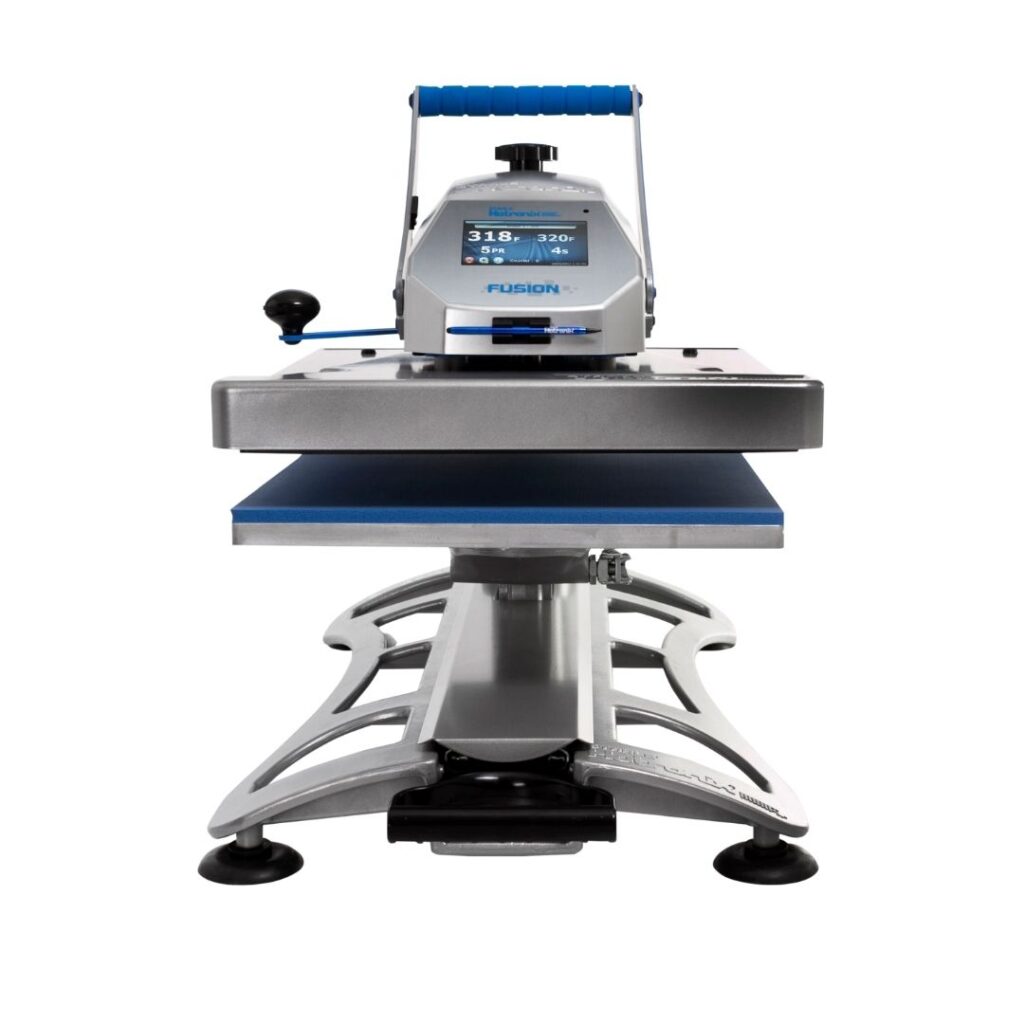
If a traditional heat press produces approximately 60 finished shirts per hour, reaching 360 shirts per hour could require approximately six presses operating simultaneously.
If each press requires an operator, the business may also need six employees dedicated to pressing.
Production increased, but labor increased along with it.
At higher production volumes, that model becomes increasingly expensive.
This is why large DTF operations should look beyond shirts per hour and evaluate labor hours per finished shirt.
Why Labor Cost Per Shirt Matters
Most production managers closely monitor blank garment costs, DTF transfer costs, consumables, packaging, shipping, spoilage, and reprints.
Labor deserves the same attention.
For example, if an operator costs $25 per hour and produces 60 finished shirts per hour, direct pressing labor is approximately $0.42 per shirt.
At 1,000 garments, that is approximately $420.
At 10,000 garments, it becomes approximately $4,200.
At 50,000 garments, it reaches approximately $21,000 in direct pressing labor.
For a high-production operation, reducing labor costs by even a few cents per garment can have a substantial impact over the course of a year.
DTF Production Automation Changes How a Shop Scales
Traditional production growth often follows a predictable pattern:
More Orders → More Presses → More Operators → More Labor Hours
DTF production automation creates an opportunity to break that relationship.
Instead of asking how many additional employees are needed to produce more garments, a high-volume shop can ask:
How much more production can we generate with our existing labor?
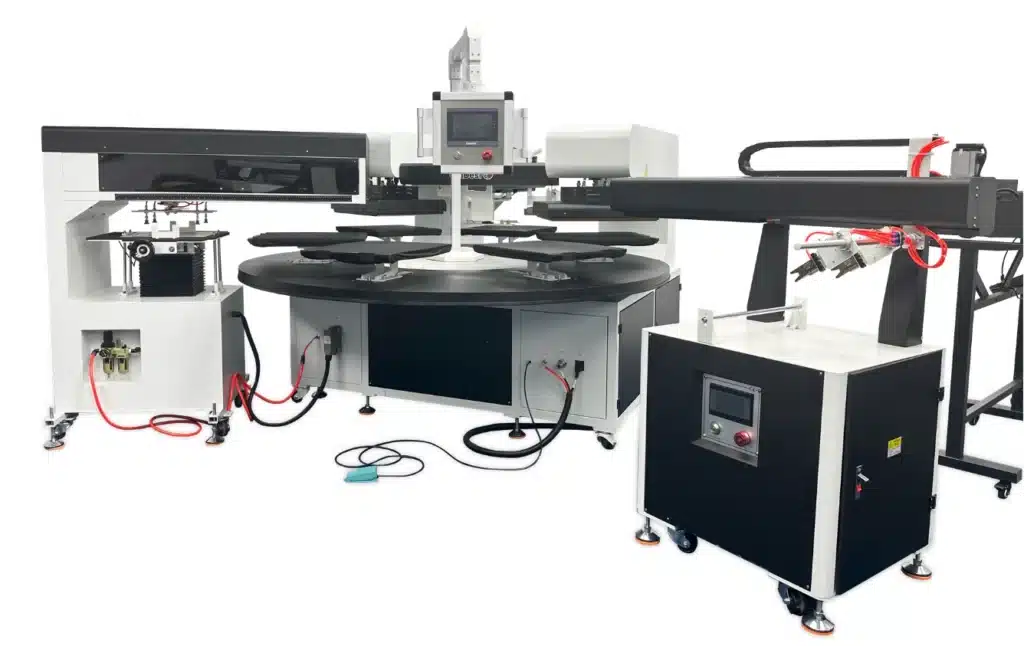
That is where the ColDesi AP360 Automatic DTF Heat Press fits into a high-production DTF workflow.
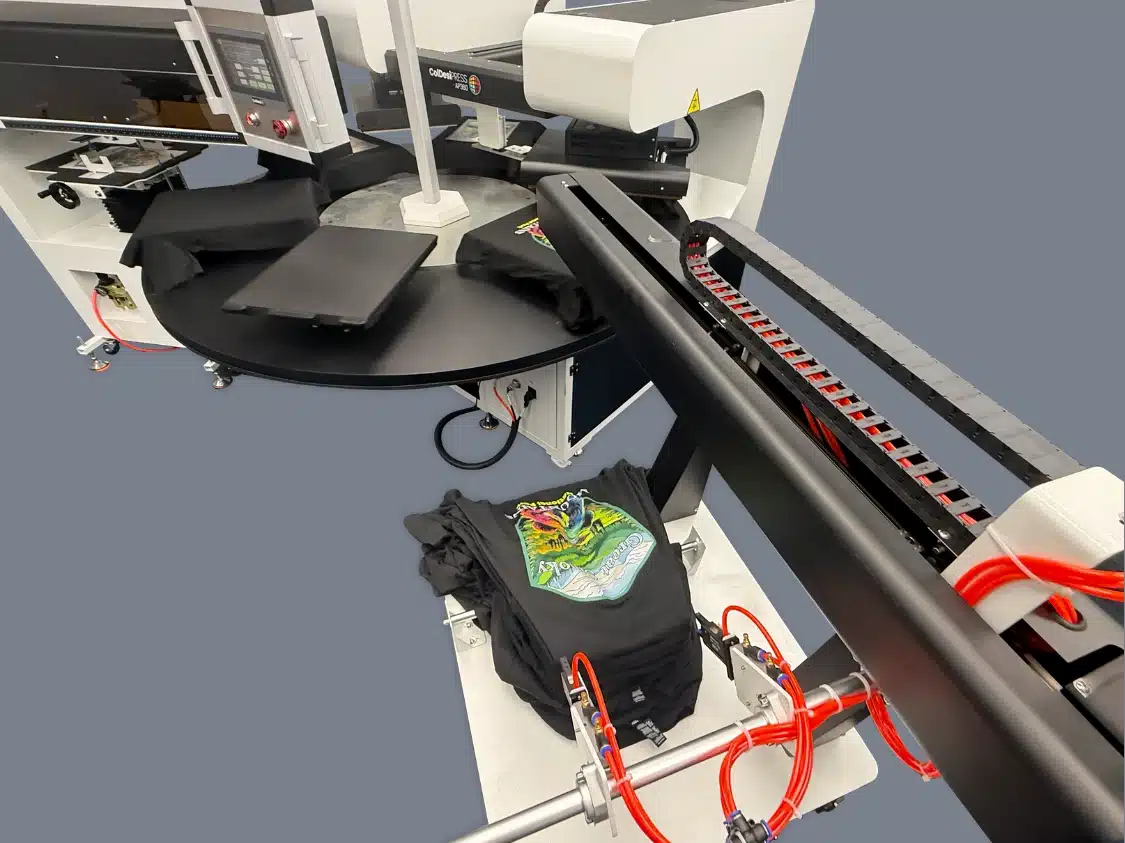
The AP360 uses a six-station carousel designed to keep garments continuously moving through the application process.
Rather than relying on an operator to complete the entire pressing process on one garment before starting the next, multiple garments can move through different production stages simultaneously.
The result is a workflow designed to produce 350+ shirts per hour while reducing the amount of manual labor required to maintain high production volumes.
Automation Is About More Than Reducing Headcount
Labor savings do not necessarily mean eliminating employees.
For many growing production shops, the larger opportunity is reallocating employees to areas where their time creates more value.
Instead of operating individual heat presses throughout an entire shift, employees may be able to support:
- Garment preparation
- Order staging
- Quality control
- Printing
- Packing
- Shipping
- Inventory
- Additional production equipment
This becomes particularly important when hiring is difficult or production volume changes significantly during peak periods.
The goal of automation is not simply to replace labor.
It is to increase the amount of production each labor hour can support.
High-Volume DTF Production Requires a Balanced Workflow
Investing in faster DTF printing equipment can dramatically increase transfer capacity.
But there is little operational advantage to producing transfers faster than your team can apply them.
A scalable DTF production environment needs enough capacity throughout the workflow—from printing and finishing transfers to cutting, pressing, quality control, and fulfillment.
For high-production shops, automation can help bring those stages into better alignment.
ColDesi has developed commercial DTF solutions around this broader production approach, including high-production DTF printers, automated transfer cutting technology, and the AP360 Automatic DTF Heat Press.
The objective is not simply to make one machine faster.
It is to build a more scalable DTF production workflow from printing through the finished garment.
When Does an Automatic DTF Heat Press Make Sense?
Not every DTF shop needs automated pressing.
Automation becomes more compelling as production volume increases and businesses begin experiencing problems such as:
- Multiple employees dedicated primarily to pressing
- Several heat presses operating simultaneously
- Printed transfers waiting to be applied
- Difficulty keeping up with large recurring orders
- Increasing overtime during production peaks
- High labor costs per finished garment
- Limited ability to increase output without hiring
- Pressing becoming the primary DTF production bottleneck
These can be signs that adding another manual heat press is no longer the most efficient way to increase capacity.
Stop Measuring DTF Capacity by Printer Speed Alone
High-volume DTF production is ultimately about finished products.
A printer capable of producing hundreds of transfers per hour creates tremendous production potential. Realizing that potential requires the rest of the workflow to keep pace.
Large apparel production businesses should therefore measure more than printer speed.
- Measure finished garments per hour.
- Measure labor hours per order.
- Measure labor cost per garment.
And measure how many employees are required to achieve your target production capacity. Those numbers provide a much clearer picture of how efficiently your operation is scaling.
See What DTF Production Automation Could Save Your Business
If your shop produces thousands of garments and pressing has become a production bottleneck, adding more manual presses and more operators may not be the most efficient path forward.
Use the ColDesi AP360 Labor Savings Calculator above to compare your existing production workflow with automated DTF pressing.
Then talk with a ColDesi equipment specialist about your current production volume, labor requirements, and growth goals to determine how the AP360 could fit into your high-volume DTF operation. Fill out the form below to get started.


