

For customization businesses producing at high volume, adding a faster DTF printer is only part of the solution.
The real challenge is keeping production moving after the transfers are printed.
As output increases, manual cutting can become a bottleneck. Increase cutting capacity, and garment application can become the next bottleneck. At a certain production level, businesses need to look beyond the speed of an individual machine and consider the efficiency of the entire DTF production workflow.
That is where the combination of the ColDesi 24H6E Printer/Dryer, AcroShear DTF Transfer Cutting System, and AP360 Automatic DTF Heat Press makes sense.
Together, these solutions address three major stages of high-volume DTF production:
Print + Cure → Cut + Slit → Press + Finish
The result is a production environment designed to keep transfers moving from digital artwork to finished apparel with fewer manual processes between each major stage.
It Starts With the 24H6E Printer + Dryer
The ColDesi 24H6E is a complete Printer + Dryer system built for businesses that need serious DTF production capacity.
The printer produces the transfers, while the accompanying dryer handles the powdering and curing process. Instead of treating printing and curing as separate equipment decisions, the system creates the first major stage of the production workflow.
Artwork enters production.
Printed and cured DTF film comes out.
For a lower-volume business, what happens next may still be manageable manually. Employees can cut transfers apart, organize jobs, place transfers onto garments, run heat presses, peel film, and perform finishing presses.
At high volume, those individual manual steps begin to matter much more.
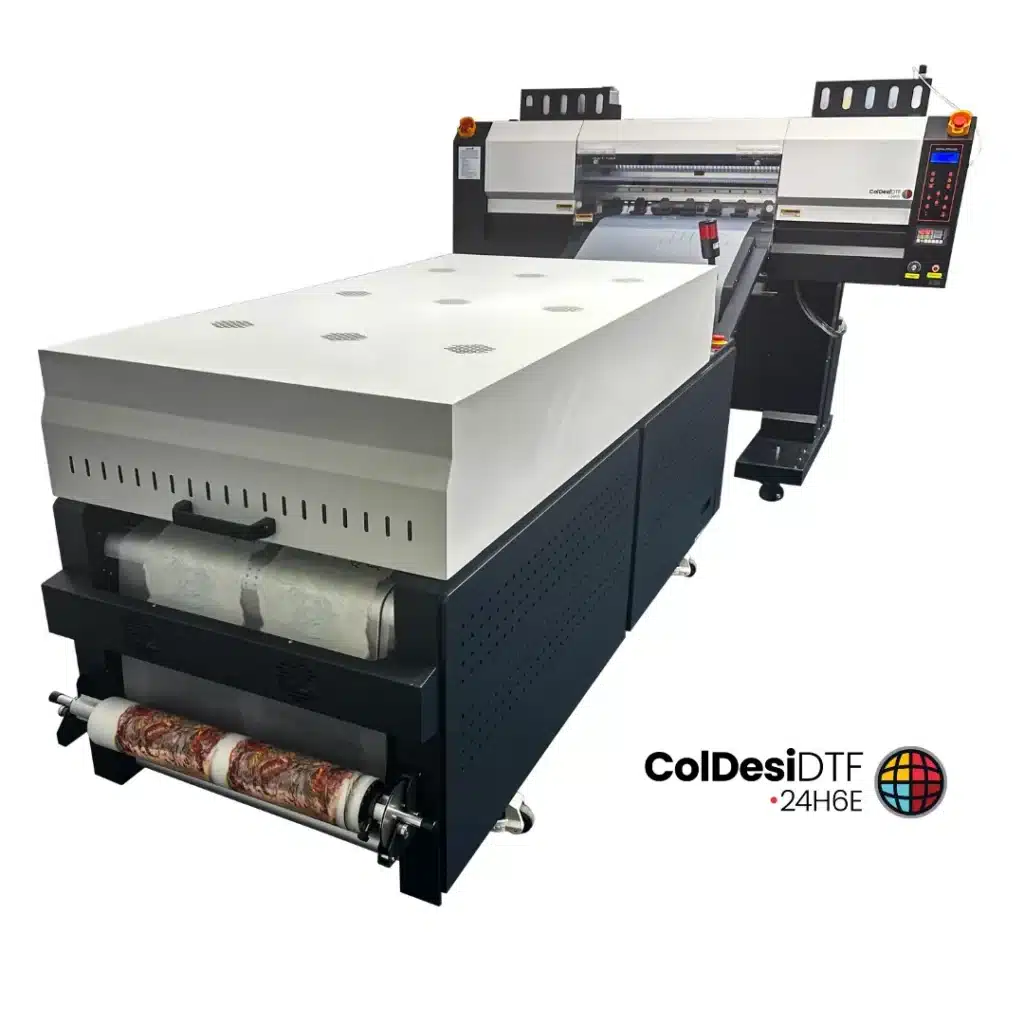
If your 24H6E is producing transfers faster than employees can process them, increasing printer output alone does not necessarily increase the number of finished garments leaving your facility.
The bottleneck has simply moved.
Stage Two: AcroShear Keeps Printed Transfers Moving
Once the 24H6E Printer + Dryer has produced the cured film, those transfers need to be separated into production-ready pieces.
That is the role of AcroShear.
Instead of having employees manually cut sheets and separate transfers, AcroShear handles cross-cutting and slitting of the printed DTF film.
It can work inline from the dryer or offline from pre-printed rolls, giving high-production businesses flexibility in how they organize their production floor.
AcroShear uses printed marks and QR job information to help control the cutting workflow. Its proprietary production application generates cross-cut marks, slitter positions, and job-change information independently of the printer RIP.
With five slitter combinations and two independently driven rotary shear positions per combination, the system provides a total of 10 shear positions for different transfer layouts.
The value here is bigger than simply eliminating some cutting.
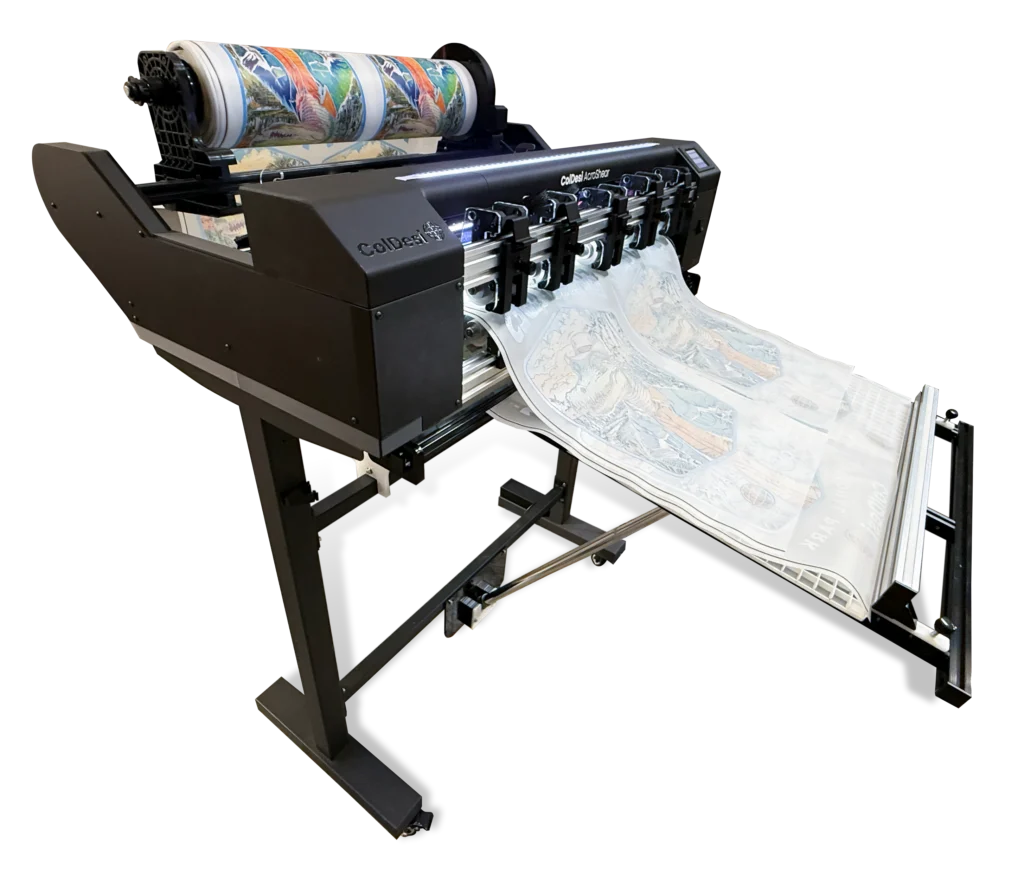
It helps connect printing to pressing.
Instead of high-speed printing creating rolls of transfers waiting for employees to manually process them, AcroShear helps turn that output into separated transfers that can continue to the next stage of production.
Stage Three: The AP360 Takes Production to the Garment
Now the transfers have been printed, cured, cut, and slit.
The next challenge is applying them.
Traditional DTF production generally relies on individual heat presses. As production increases, businesses may add more presses and more operators to increase capacity.
The AP360 Automatic DTF Heat Press takes a different approach.
The AP360 uses a six-station carousel to create a continuous garment-production process capable of producing 350+ shirts per hour.
Operators can focus on loading garments and positioning transfers while the system moves products through the pressing workflow, including automatic film peeling and the finishing press.
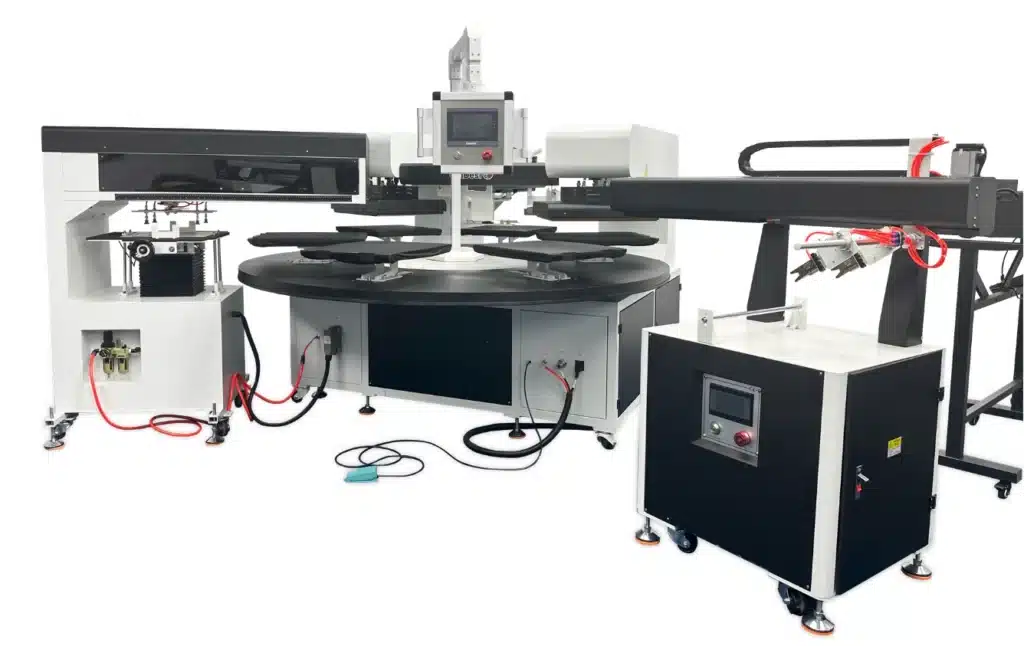
Instead of one employee repeatedly completing an entire press cycle on a conventional heat press, multiple garments can be moving through different production stages simultaneously.
For a business generating a large volume of transfers upstream, this becomes an important part of keeping the entire workflow balanced.
Three Solutions. One Production Workflow.
The real story isn’t the individual capabilities of these machines.
It is what happens when they are used together.
PRINT + CURE
The 24H6E Printer + Dryer produces and cures DTF transfers at commercial production volumes.
↓
CUT + SLIT
AcroShear processes the cured film into individual transfers ready for garment production.
↓
PRESS + FINISH
The AP360 moves those transfers onto garments through a continuous six-station pressing workflow.
↓
FINISHED APPAREL
Completed garments can move into quality control, sorting, packing, and fulfillment.
That is a very different way of thinking about DTF production.
Instead of buying individual machines based primarily on their maximum speeds, businesses can start designing a production floor around how work moves from one stage to the next.
A Fast Printer Shouldn't Create Your Next Bottleneck
High production exposes inefficiencies quickly.
If you can print hundreds of transfers per hour but employees cannot cut them quickly enough, cutting becomes the constraint.
Solve cutting without increasing pressing capacity, and stacks of finished transfers can begin accumulating at the heat presses.
Add more conventional heat presses, and you may also need more operators to run them.
This is why production capacity should not be measured by printer speed alone.
A customization business considering this type of investment should be asking:
- How quickly can we print and cure transfers?
- How efficiently can we turn rolls of transfers into individual pieces?
- How quickly can those transfers be applied to garments?
- How much manual handling takes place between those stages?
- How much labor will we need as volume increases?
- Where will our next production bottleneck occur?
Those questions reveal much more about a high-production DTF operation than the speed specification of any individual machine.

Produce More Without Making Every Process More Labor-Intensive
Production growth has traditionally required adding labor alongside equipment.
- More orders create more transfers.
- More transfers require more cutting.
- More garments require more heat pressing.
Eventually, businesses can find themselves adding employees simply to keep up with all of the manual processes created by increased production.
The combination of the 24H6E, AcroShear, and AP360 changes where labor is needed throughout that process.
The goal isn’t to remove people from production entirely.
It is to reduce repetitive manual processes and allow employees to focus on the tasks where they add more value.
At high volumes, that distinction can become significant.
Saving a few seconds or eliminating a manual step may seem relatively minor when producing 20 shirts.
Repeat that process across hundreds or thousands of garments, and the impact becomes much larger.
Designed for Customization Businesses Ready for High-Production
This combination is not intended to be an entry-level DTF setup.
It makes the most sense for established customization businesses that already have significant production requirements or are preparing for substantial growth.
That can include:
- High-volume custom apparel businesses
- Screen-printing companies expanding into DTF
- Contract apparel decorators
- DTF transfer producers
- E-commerce apparel operations
- Promotional product companies with substantial apparel volume
- Team, school, and sports apparel producers
- Businesses fulfilling large recurring apparel programs
These companies have moved beyond asking:
“Can we produce this with DTF?”
The question becomes:
“How can we produce hundreds or thousands of these efficiently?”
That requires a different type of equipment strategy.
Think About Throughput, Not Just Equipment
One of the biggest advantages of approaching DTF this way is that businesses can evaluate the production floor as a system.
The conversation becomes less about buying three machines and more about designing a workflow.
- How much are you producing today?
- How much do you expect to produce tomorrow?
- Where are employees spending the most time?
- Where does work currently accumulate?
- How many operators are required to support production?
- How quickly can a printed transfer become a finished garment?
Those answers help determine the value of a connected high-production workflow.
The goal is not simply to own faster equipment.
It is to keep production moving.

From Digital File to Finished Shirt
The combination of the ColDesi 24H6E Printer + Dryer, AcroShear, and AP360 demonstrates what a complete high-production DTF workflow can look like.
The 24H6E handles printing and curing.
AcroShear handles cutting and slitting.
The AP360 handles pressing, peeling, and finishing.
Together:
PRINT + CURE → CUT + SLIT → PRESS + FINISH
For customization businesses ready for this level of production, the value comes from more than the capabilities of any single machine.
It comes from creating a production environment where each major stage is designed to support the next.
And when the entire workflow can keep moving, businesses have a much stronger foundation for increasing DTF production without simply increasing manual work alongside it.
Frequently Asked Questions
What is a high-production DTF workflow?
A high-production DTF workflow connects the major stages required to create finished DTF apparel, including printing, curing, cutting, transfer handling, pressing, peeling, and finishing. The goal is to increase overall production capacity rather than focusing exclusively on printer speed.
What does the ColDesi 24H6E system include?
The 24H6E is a Printer + Dryer solution, providing the printing, powdering, and curing stages needed to produce finished DTF transfer film for downstream processing.
What does AcroShear do in the DTF workflow?
AcroShear processes printed and cured DTF film using cross-cutting and slitting. It helps reduce the manual cutting needed between transfer production and garment application.
Can AcroShear work directly with the 24H6E Printer + Dryer?
AcroShear is designed to work inline from a DTF dryer and can also run offline using pre-printed rolls, giving businesses options for configuring their production workflow.
What does the AP360 do?
The AP360 is a six-station automatic DTF heat press designed for continuous garment production. It handles major application stages including pressing, automatic film peeling, and finishing, with production rated at 350+ shirts per hour.
Why use all three solutions together?
Each addresses a different part of DTF production. The 24H6E Printer/Dryer creates the transfers, AcroShear prepares them for application, and the AP360 applies them to garments. Using the solutions together helps businesses address bottlenecks across the complete workflow.
Who is this DTF production setup designed for?
This combination is best suited to customization businesses with substantial production requirements, including high-volume apparel decorators, contract printers, DTF transfer producers, screen printers, and businesses preparing to significantly increase apparel output.
Do I need this level of equipment to start a DTF business?
No. ColDesi offers DTF solutions for different production requirements. This combination is specifically positioned for businesses where higher throughput, labor efficiency, and production scalability have become priorities.
Ready to Build a High-Production DTF Workflow?
See how the ColDesi 24H6E Printer/Dryer, AcroShear, and AP360 can work together to increase production, reduce manual processes, and keep jobs moving from print to finished apparel.
Fill out the form below to speak with a ColDesi DTF expert about building the right high-production workflow for your business.

