

How the ColDesi DTF 24 Series gives commercial apparel decorators a smarter path to increased production, expanded color capabilities, and long-term growth.
For DTF printing businesses, increasing production capacity is rarely as simple as purchasing a faster printer.
A new machine can mean learning different software, retraining operators, adjusting production procedures, recalibrating color profiles, and reorganizing the workflow around unfamiliar equipment. Even when the new printer delivers greater output, the transition can introduce downtime and added operating costs.
What if increasing DTF production didn’t require starting over?
That’s the advantage of the ColDesi DTF 24 Series.
Built around a configurable commercial printing platform, the ColDesi 24H4, 24H5, 24H6, and 24H6E provide businesses with a way to increase production capacity, expand printing capabilities, and improve workflow efficiency while maintaining a familiar equipment and software environment.
Instead of treating every production increase as a complete equipment replacement, businesses can take a more strategic approach to growth.
One DTF Printing Platform. Multiple Production Configurations.
Not every DTF business needs the same production capabilities.
A contract decorator producing several hundred transfers per day has different requirements than a wholesale transfer supplier fulfilling thousands of orders or a screen printing operation moving significant production volume into DTF.
Even within the same business, those requirements change over time.
The ColDesi DTF 24 Series addresses these differences through a configurable platform designed around production volume, printhead capacity, ink configuration, and finishing equipment.
Rather than requiring businesses to adopt an entirely different printing system as demand increases, the platform provides a progression through increasingly capable configurations.
The advantages include:
- Additional printhead capacity: Increase production capabilities as order volume grows.
- Expanded color gamut: Move beyond standard CMYK + White into supported configurations incorporating orange and green inks.
- Configurable shaker/dryer solutions: Match curing capacity to faster printing speeds and higher production demands.
- Consistent software environment: Continue working with ColDesi’s DTF Print Optimizer rather than introducing an entirely unfamiliar RIP platform.
- Familiar operating procedures: Retain knowledge of equipment operation, maintenance, media handling, and daily production processes.
For an experienced DTF operator, the real value isn’t simply having more equipment options. It’s the ability to plan production growth around a platform the business already understands.

From the 24H4 to the 24H6E: Built to Scale with Your Business
The ColDesi DTF 24 Series provides several production configurations, each addressing different throughput and workflow requirements.
ColDesi 24H4: A Strong Foundation for Commercial Production
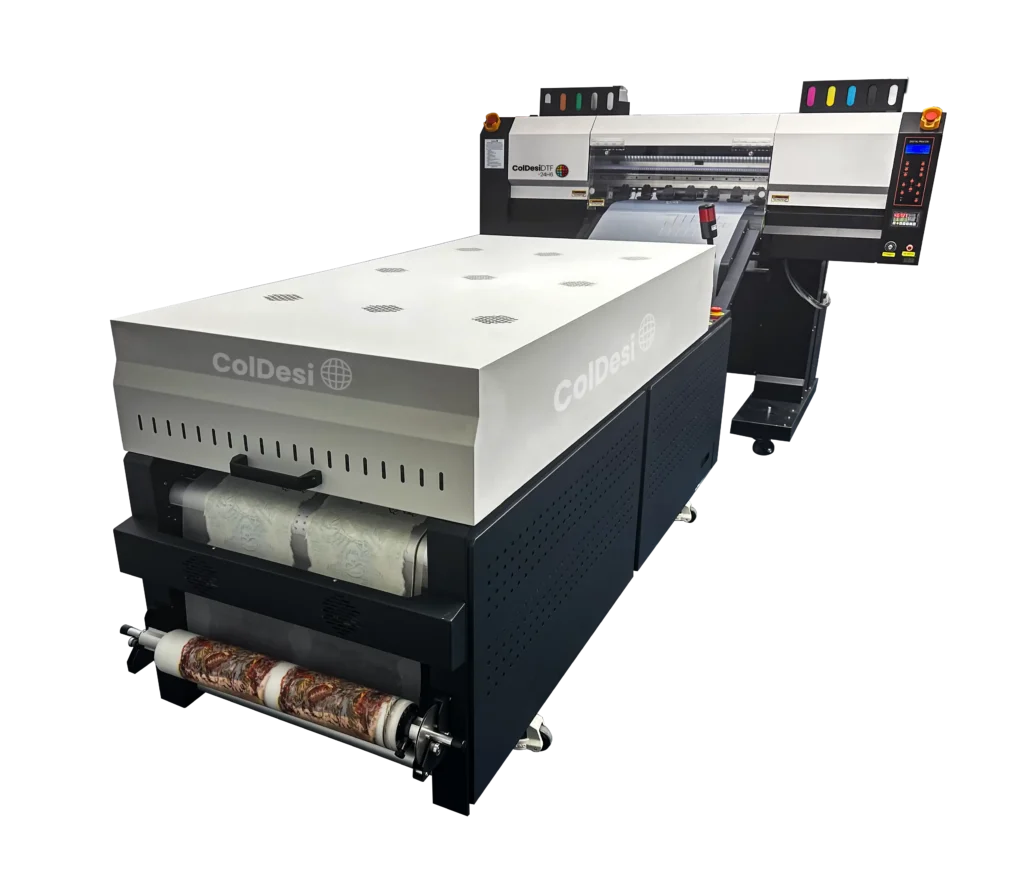
The ColDesi 24H4 DTF Printer features four Epson i3200 printheads and a CMYK + White configuration.
With production speeds reaching 125 linear feet per hour and approximately 225 full-front transfers per hour, the 24H4 provides the capacity required by established apparel decorators managing larger orders and tighter turnaround times.
For shops already producing consistent DTF volume, the 24H4 represents a capable commercial production platform with room to plan for future expansion.
ColDesi 24H5: Increase Output and Expand Color Possibilities
As production demands increase, the ColDesi 24H5 introduces a five-printhead configuration designed for higher-volume operations.
The 24H5 also offers the choice of an expanded CMYKOG + White ink configuration.
Adding Orange and Green expands the reproducible color gamut, creating more opportunities for applications requiring greater color saturation, smoother tonal transitions, and improved reproduction of certain brand colors.
For businesses producing contract apparel, licensed merchandise, detailed graphics, or color-sensitive customer orders, that added color capability can be an important competitive advantage.
The ability to select a standard or expanded color configuration also allows businesses to balance production speed with the requirements of their customer base.
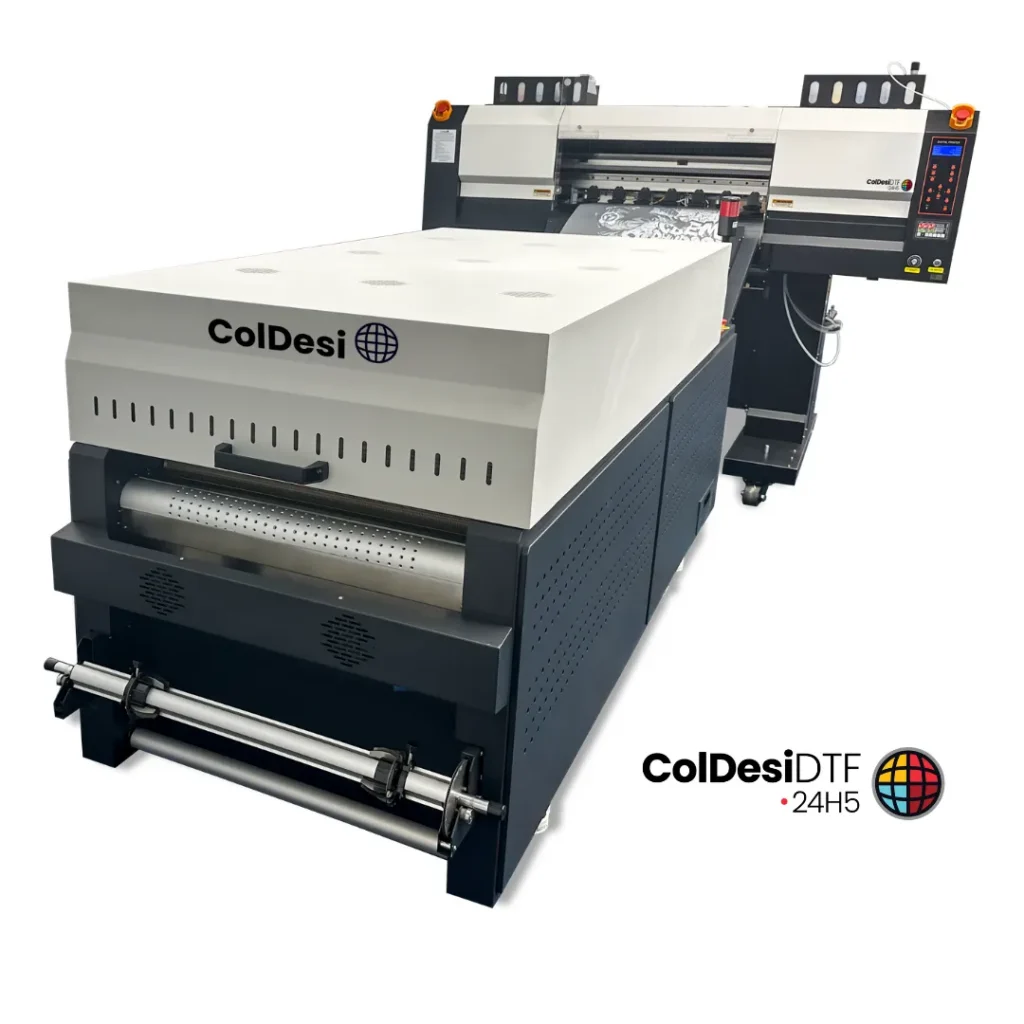
ColDesi 24H6: Greater Printhead Capacity and Color Flexibility
The ColDesi 24H6 advances the platform with six Epson i3200 printheads and support for standard CMYK + White or expanded CMYKOG + White configurations.
For higher-volume production environments, more printhead capacity can help increase output and support more demanding print schedules.
Expanded color capabilities also allow businesses to pursue work that benefits from a broader reproducible color range.
Instead of changing to an unrelated printing platform, operators can continue building on their experience with the ColDesi DTF production environment.
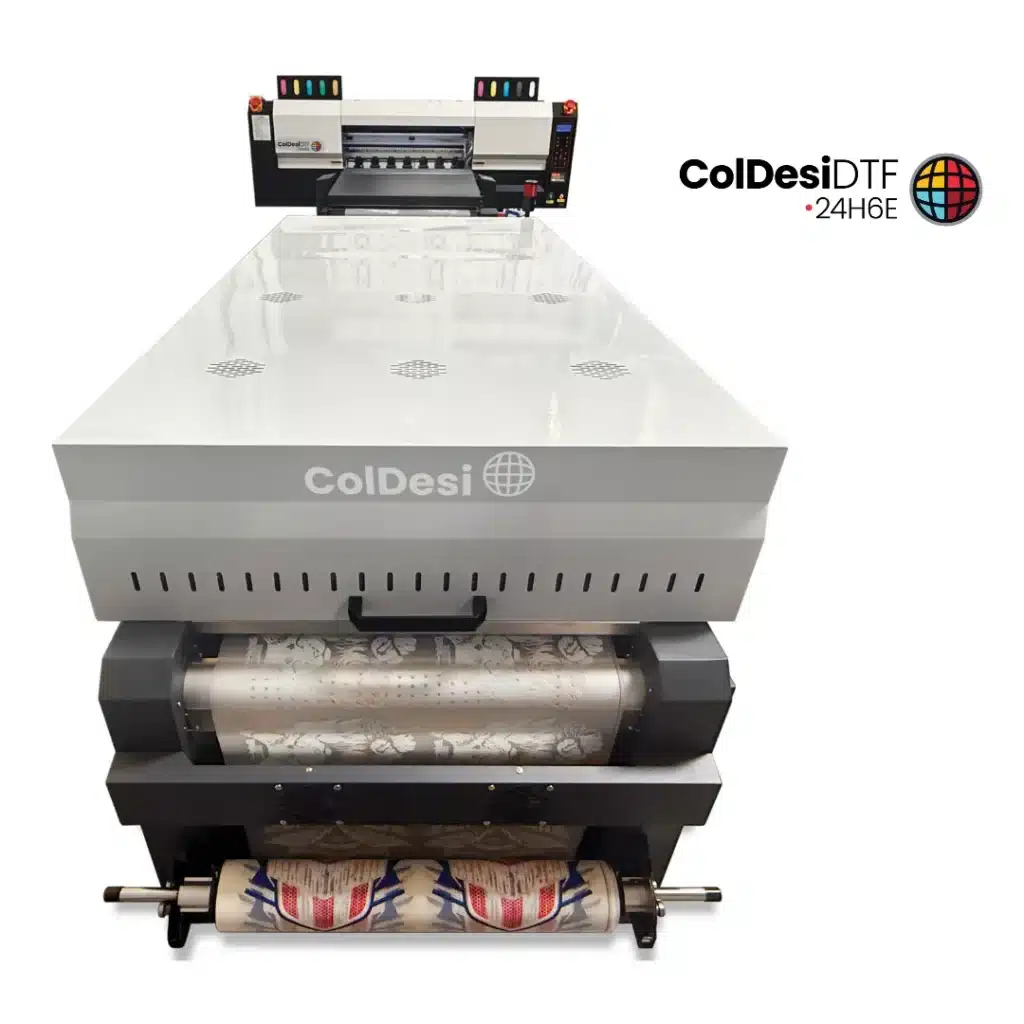
ColDesi 24H6E: High-Production Printing with an Integrated Finishing Strategy
At the high-production end of the series, the ColDesi 24H6E combines six-printhead printing technology with an extended dryer configuration designed for higher-throughput workflows.
At this production level, the printer is only one part of the equation.
Increasing print speed without adequate powder application, curing capacity, and film handling can create bottlenecks downstream.
The 24H6E addresses the importance of matching the printer with a finishing system capable of supporting the intended production volume.
For businesses fulfilling wholesale transfer orders or supplying multiple apparel decoration operations, this coordinated approach becomes increasingly important.
The Advantage of Keeping the Same Printer Platform
One of the most overlooked costs of expanding DTF production is the disruption associated with switching equipment platforms.
A business may buy a faster machine only to discover that the transition requires significant changes to its established production process.
Operators must learn a new interface. Production managers need to understand different maintenance requirements. Artwork and color workflows may need to be revised. New equipment may also require changes to operator training and troubleshooting procedures.
These challenges take time, and time has a measurable cost in a busy production environment.
Reduce the Learning Curve for Your Operators
Experienced DTF operators develop a detailed understanding of their equipment.
They know how to manage film tension, check white ink performance, recognize nozzle issues, adjust production settings, and maintain consistent output across long print runs.
That experience has value.
Staying within the ColDesi DTF 24 Series allows businesses to keep familiarity with the equipment platform as they move into higher-capacity configurations.
Operators still need training for added printheads, new ink configurations, and upgraded finishing equipment, but they aren’t necessarily learning an entirely unfamiliar production system.
This can shorten the transition to higher-volume production and help experienced employees become productive on an upgraded configuration more quickly.

Maintain a Familiar RIP Software Environment
For commercial DTF operations, the RIP is central to production.
It controls critical aspects of the printing process, including color management, white ink generation, image processing, and production settings.
Introducing a different RIP can mean rebuilding workflows that operators have spent months or years refining.
The ColDesi DTF 24 Series uses ColDesi’s DTF Print Optimizer software, giving businesses a familiar software environment across the product family.
That consistency offers several practical advantages:
- Operators can build on their existing software knowledge.
- Production teams keep familiarity with artwork preparation and print-job setup.
- Training new employees can remain more consistent across the operation.
- Managers can standardize more of their production procedures.
- Businesses can avoid some of the disruption associated with switching to an entirely different RIP system.
New printhead or ink configurations still require proper profiles, settings, and validation. However, maintaining the same software family helps preserve operational knowledge rather than forcing employees to start from scratch.

Add Printheads and Production Capacity as Demand Increases
When a DTF business begins reaching the limits of its existing equipment, the traditional answer is often to buy another printer or replace the current system with a faster machine.
Both approaches can work, but they also introduce more considerations.
Adding another independent printer may increase maintenance requirements, floor-space needs, and operator responsibilities. Replacing equipment with a completely different system may introduce new training and workflow challenges.
A configurable platform offers another choice.
With the ColDesi DTF 24 Series, businesses can evaluate supported printhead and production upgrades within the same equipment family.
This creates an opportunity to align investment with actual order volume rather than buying substantially more capacity before it’s needed.
For example, a shop running a 24H4 may eventually require the added output available through a five-head or six-head configuration.

This approach can support more predictable production planning, better use of existing operator knowledge, and a more controlled transition to higher-volume manufacturing.
Expand Your Color Gamut Without Changing Your Entire Production Strategy
Production speed is only one reason to expand a DTF printing operation.
For many businesses, color reproduction is equally important.
Standard CMYK + White DTF printing handles a broad range of commercial apparel applications. However, certain brand colors, saturated graphics, and detailed artwork can benefit from an expanded ink configuration.
The supported CMYKOG + White configurations within the ColDesi 24 Series add Orange and Green to extend the available color gamut.
This can improve the reproduction of specific colors that are difficult to achieve using CMYK alone.
Potential advantages include improved reproduction of certain saturated hues, smoother transitions in complex artwork, and greater flexibility when working with brand-critical graphics.

For wholesale transfer suppliers, contract decorators, and businesses serving corporate apparel customers, expanded color capabilities can open opportunities for more demanding projects.
It’s important to recognize that expanded-gamut printing is not simply a matter of adding two ink colors.
Proper color profiling, artwork preparation, ink configuration, and production settings stay essential. There can also be differences in throughput between standard and expanded-gamut configurations.
The advantage of the ColDesi platform is the ability to evaluate these capabilities within a familiar production ecosystem.
Upgrade Your Dryer to Match Your Printing Speed
An experienced DTF operator knows that the printer’s rated speed does not always represent the actual output of the complete production line.
A printer capable of producing film faster than the shaker/dryer can process it doesn’t automatically increase finished-transfer production.
In fact, an undersized finishing system can introduce problems with powder application, curing consistency, film handling, and overall workflow efficiency.
That’s why scalable DTF production requires looking beyond the number of printheads.
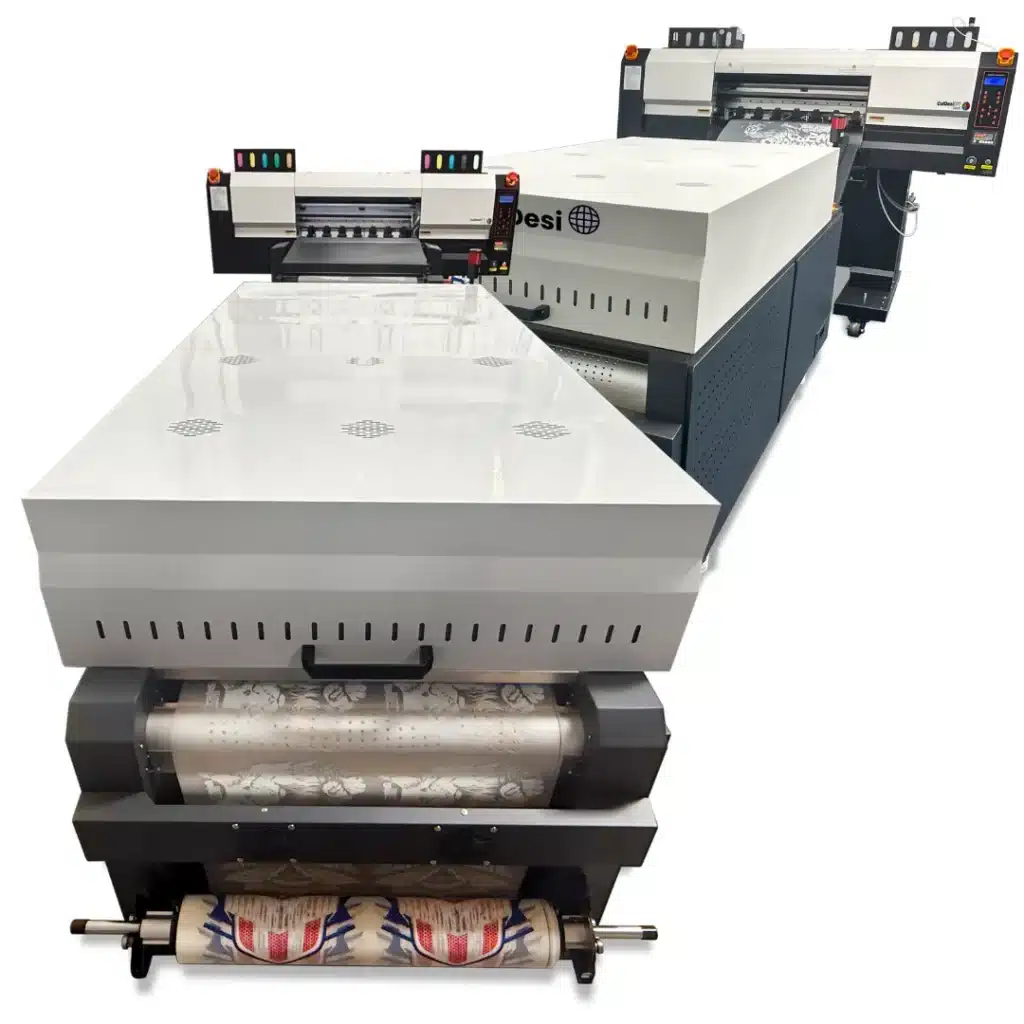
The ColDesi DTF 24 Series offers shaker/dryer configurations designed to match different production requirements.
As businesses move into higher-speed printing, the finishing system can be evaluated and upgraded to support the increased volume.
This coordinated approach helps maintain a balanced production line.
For businesses considering an upgrade, the question should not simply be “How much faster can the printer run?”
It should be “How many properly cured, press-ready transfers can the complete system produce per hour?”
That distinction becomes especially important when production volume reaches several hundred transfers per hour.
Reduce Disruption and Protect Your Production Investment
Equipment decisions should be evaluated over the useful life of the production system, not just at the time of purchase.
For commercial DTF businesses, the total cost of ownership includes much more than the purchase price.
Operator training, maintenance, production downtime, software familiarity, workflow integration, and finishing capacity all affect profitability.
A configurable equipment platform can help reduce some of these transition costs.
By maintaining a familiar printer family and software environment, businesses can preserve much of the knowledge their employees have already developed.
It also provides a clearer framework for planning future equipment investments.
Rather than buying a machine based only on today’s order volume, owners can consider how that configuration fits into a longer-term production strategy.
The goal is to increase productive capacity without unnecessarily disrupting the processes that are already working.
A Better Way to Plan DTF Production Growth
For an established DTF operation, the decision to increase capacity should begin with an evaluation of the complete workflow.
Consider the following questions:
- Is the printer the actual bottleneck? If printing is limiting output, additional printhead capacity may provide the greatest benefit.
- Can the shaker/dryer support faster production? A higher-speed printer requires finishing equipment capable of keeping pace.
- Would expanded-gamut printing create new revenue opportunities? Evaluate the types of artwork and customer requirements that justify additional ink colors.
- How much downtime can the operation tolerate? Equipment upgrades should be planned around production schedules, installation requirements, and operator training.
- Can the existing production team transition efficiently? Maintaining a familiar software and equipment platform may reduce the time required to reach full production.
Businesses should also evaluate film utilization, artwork dimensions, gang-sheet efficiency, curing requirements, and downstream heat-press capacity.
The most effective upgrade isn’t necessarily the printer with the highest-rated speed. It’s the configuration that delivers the greatest improvement to the complete production operation.
Scale Production Without Starting Over
For growing DTF businesses, investing in additional production capacity is inevitable. Rebuilding the entire production workflow every time that happens shouldn’t have to be.
The ColDesi DTF 24 Series offers a different approach.
With configurable printhead capacity, standard and expanded-gamut ink options, multiple dryer solutions, and a consistent software environment, the platform allows businesses to make equipment decisions with future production requirements in mind.
From the four-head 24H4 through the high-production 24H6E, the series provides a path for increasing output while preserving the value of existing operator experience and established production procedures.
For commercial apparel decorators, wholesale transfer suppliers, and high-volume customization businesses, that consistency can be just as valuable as the additional production speed.
The real advantage of scalable DTF printing isn’t simply producing more transfers. It’s being able to produce more without starting over.
Ready to Plan Your Next Production Upgrade?
Explore the ColDesi DTF Printer lineup and speak with a ColDesi equipment specialist about available configurations, supported upgrade options, expanded color capabilities, and shaker/dryer solutions.
Find the right combination of printing speed, color performance, and finishing capacity for your operation today, with a plan for where your production needs may go next. Fill out the form below to get started.