

For many apparel decorators, the question is no longer, “Should we add DTF printing?”
The better question is: “How do we add serious DTF production without giving up half the shop?”
That question is driving interest in a new class of equipment: the compact commercial DTF printer.
A compact commercial DTF solution is designed to bridge the gap between small desktop DTF printers and larger production systems. It gives growing print shops the speed, print width, workflow, and production capabilities they need to produce transfers commercially, without demanding an oversized production floor.
At ColDesi, we believe compact should describe the footprint, not the ambition of the business using it.
That philosophy can be seen across the ColDesi DTF lineup, particularly in two systems: the ColDesi DTF 12H2, designed to make professional DTF production accessible in smaller spaces, and the ColDesi DTF 24H2, which combines commercial production capacity with a remarkably space-conscious printer and dryer configuration.
What Is a Compact Commercial DTF Printer?
“Compact” and “desktop” are sometimes used interchangeably when talking about DTF equipment. They shouldn’t be.
A desktop DTF printer is generally designed around entry-level production, very limited floor space, and relatively low transfer volume. That can make desktop equipment appealing to hobbyists, very small startups, or businesses experimenting with DTF.
A compact commercial DTF printer solves a different problem.
The goal isn’t simply to make the machine small. The goal is to deliver the capabilities a real apparel business needs — production speed, usable print width, roll-to-roll workflow, and a curing solution — in a footprint that makes sense for an operating print shop.
That’s an important distinction.
A shop producing customer orders every day doesn’t just need a printer that physically fits through the door. It needs a DTF workflow capable of becoming part of the business.
Why Would a Print Shop Need a Compact DTF Solution?
Space is one of the most valuable resources inside a decorating business.
Screen printers already have presses, dryers, exposure equipment, and screens. Embroidery businesses have multi-head machines, worktables, hooping stations, and inventory. Sign and promotional product companies may be running several different production technologies under one roof.
Adding DTF shouldn’t require redesigning the entire shop.
A compact commercial DTF system can make it easier to bring transfer production in-house while preserving space for the equipment and processes already generating revenue.
That creates opportunities for several kinds of businesses.
A screen printer can use DTF for short runs, detailed artwork, personalization, and jobs that don’t make sense to put on press.
An embroidery shop can add full-color apparel without introducing another space-intensive decorating process.
A promotional products company can expand into decorated apparel.
And a business currently buying transfers can begin controlling more of its production schedule internally.
The value of compact commercial DTF isn’t simply saving square footage.
It’s making that square footage more productive.
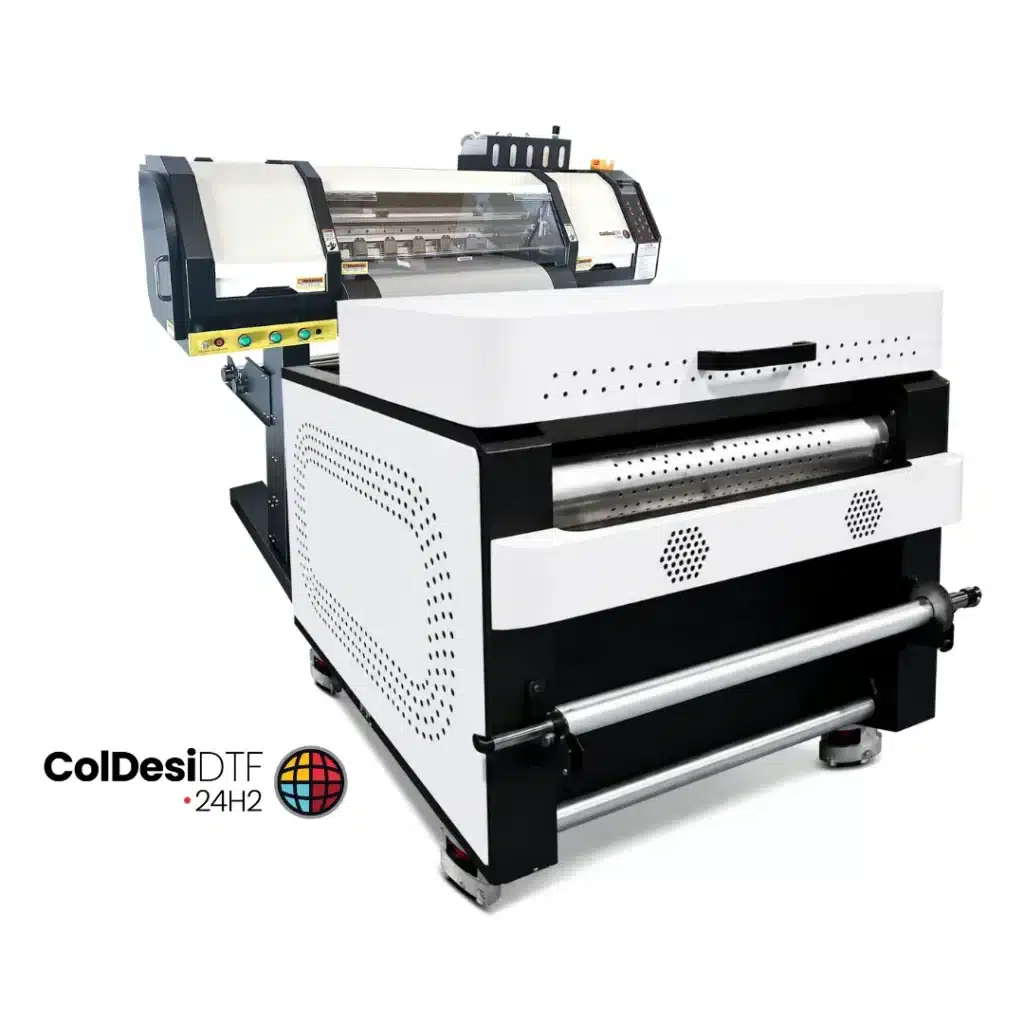
Desktop DTF vs. Compact Commercial DTF: What's the Difference?
The biggest difference is the job the equipment is expected to perform.
Desktop equipment is often chosen because of its size or initial accessibility. Compact commercial equipment should be evaluated as production equipment.
That means asking questions such as:
- How many transfers can we realistically produce?
- Can the system handle the kinds of orders our customers are placing?
- Does the print width fit our product mix?
- How do printing, powdering, and curing work together?
- How much operator attention does the workflow require?
- Can this equipment support the business as order volume increases?
- Who provides training, service, and support when DTF becomes an important revenue stream?
Once DTF becomes part of daily production, the purchase is no longer just about buying a printer. It is about building a dependable production process.
That’s why ColDesi approaches DTF as a complete business solution, with systems designed for different stages of growth rather than treating every shop as though it has the same production requirements.
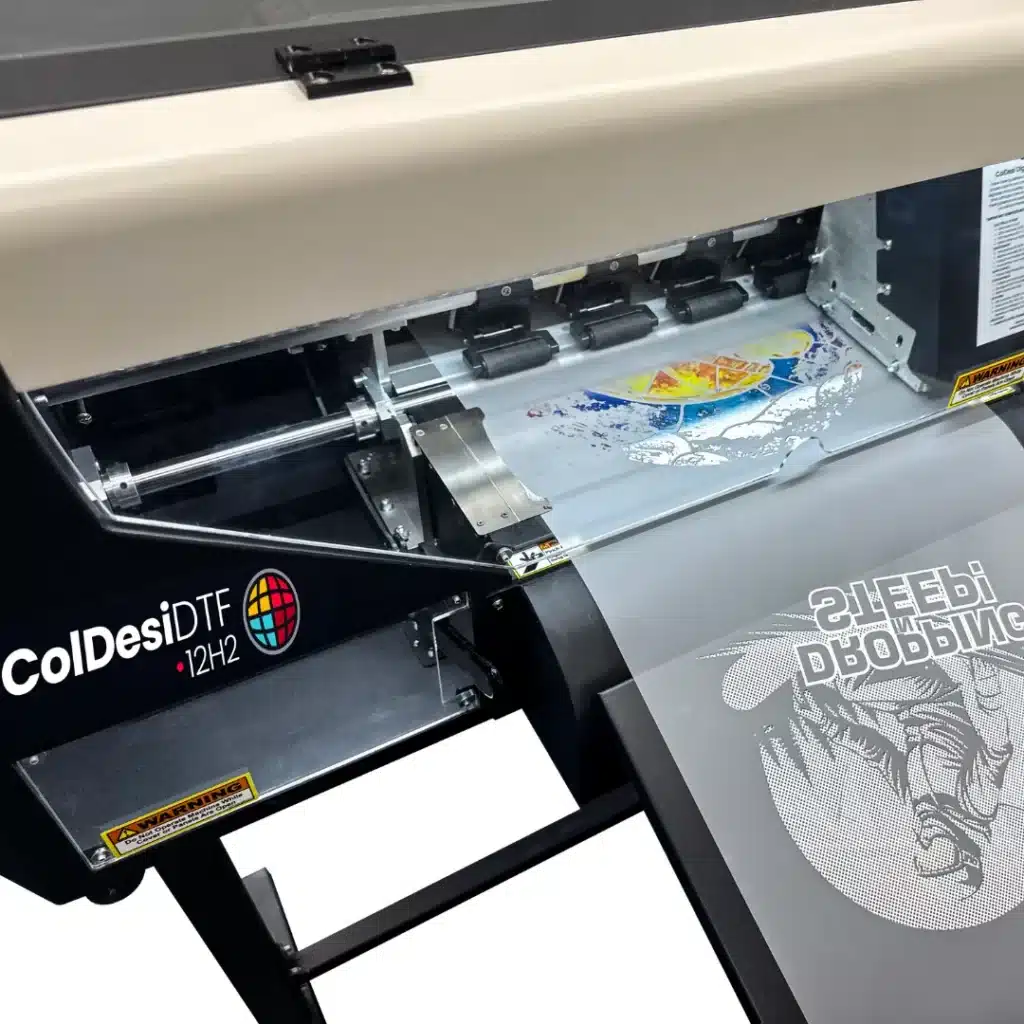
ColDesi DTF 12H2: Commercial DTF for Smaller Spaces
For businesses entering DTF or bringing outsourced transfer production in-house, the ColDesi DTF 12H2 proves just how productive a compact system can be.
The 12H2 offers a 12-inch maximum print width and can produce around 50 8″ x 10″ transfers per hour, giving startups and smaller shops a legitimate production platform without immediately moving into a much larger system.
Its footprint is a major part of the story.
The 12H2 printer measures approximately 31″ x 39.5″, while its dryer measures approximately 50″ x 24.5″. The combined configuration is approximately 81″ x 39.5″.
For a shop where every foot matters, those dimensions can change the conversation around bringing DTF in-house.
And compact doesn’t mean giving up meaningful output. ColDesi materials rate the 12H2 at approximately 25–30 linear feet per hour and 50 8″ x 10″ transfers per hour.
That’s why we see the 12H2 as much more than a “small printer.”
It’s a practical entry point into commercial DTF production.
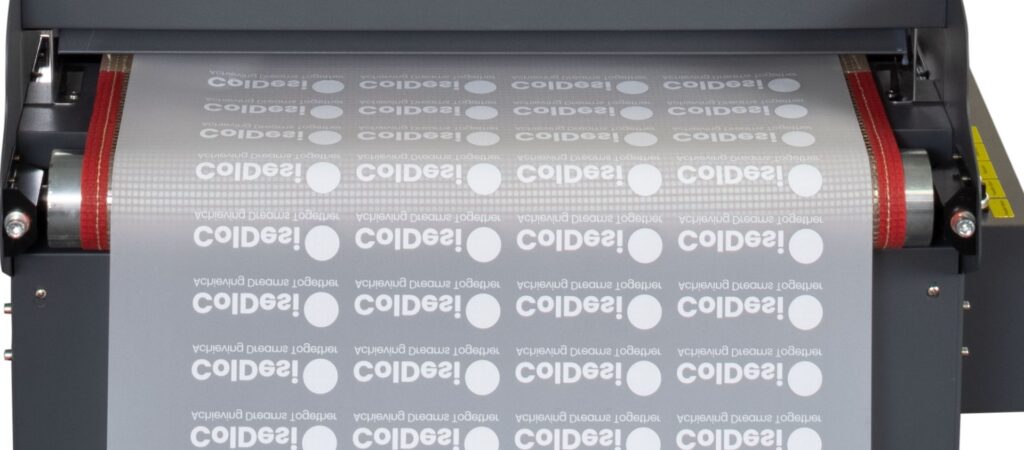
ColDesi DTF 24H2: Commercial Production Meets a Compact Dryer
As production requirements increase, shops face another challenge.
They need more output, but they still may not have unlimited floor space.
That’s where the ColDesi DTF 24H2 becomes particularly interesting.
With a 22.5-inch maximum print width, the 24H2 moves into a different level of commercial production. ColDesi rates the system at approximately 45–55 linear feet per hour, or about 100 8″ x 10″ transfers per hour.
In other words, this isn’t a desktop machine trying to behave like a production printer.
It is a commercial DTF system designed around real daily output.
What makes the configuration especially compelling for space-conscious shops is the compact dryer.
The 24H2 printer measures approximately 29″ x 67.5″, while the compact dryer measures approximately 43″ x 35″. The listed combined footprint is approximately 72″ x 67.5″.
That combination addresses one of the challenges that is sometimes overlooked when shopping for DTF equipment.
The printer is only part of the footprint.
A true DTF production workflow also has to account for powder application, curing, and material handling. A printer may look compact by itself, but the total system can become considerably larger once the complete workflow is installed.
ColDesi’s approach with the 24H2 and compact dryer considers the production cell as a whole.
That’s the more useful way for a business owner to think about DTF space requirements.
Don’t Compare Printers. Compare Complete Workflows.
This may be one of the most important lessons for anyone shopping for DTF equipment.
Don’t ask only: “How big is the printer?”
Ask: “How much space will I need to produce finished, press-ready DTF transfers?”
Those are very different questions.
A DTF printer doesn’t run in isolation. Film needs to move through the printing and curing process. Powder needs to be applied correctly. Transfers need to exit the system ready for the next stage of production.
So a printer with an attractive tabletop footprint can lose some of that advantage if the rest of the workflow requires more equipment, manual steps, or workspace.
The best compact commercial DTF systems should therefore be judged by total workflow efficiency per square foot, not printer dimensions alone.
The 12H2 and 24H2 Represent Two Different Paths to Compact Commercial DTF
There isn’t one definition of the “right” compact DTF system because businesses aren’t all at the same stage.
For a smaller shop, startup, or business moving away from outsourced transfers, the 12H2 provides a compelling balance of manageable footprint, professional, and commercial production capability. ColDesi specifically positions it for startups and smaller shops, with a compact footprint and straightforward operation.
For an established decorator producing DTF transfers every day, the 24H2 provides substantially greater print width and approximately twice the transfer output of the 12H2, while still emphasizing intelligent use of production space.
That creates a natural progression:
Start with the production capacity your business needs today—but choose a DTF partner that understands where your business may be going tomorrow.
Compact Doesn't Mean Compromised
For years, equipment buying often forced decorators into an uncomfortable choice.
Buy smaller equipment and accept limited production capabilities.
Or buy commercial equipment and find room for a much larger production system.
Compact commercial DTF is changing that equation.
The right system can provide meaningful commercial production without forcing a growing business into a machine that’s too small for its orders or too large for its facility.
That’s the opportunity ColDesi sees in this category.
We don’t believe every business needs the largest DTF printer available.
We believe businesses need the right DTF production system for their space, volume, customers and growth plans.
The ColDesi DTF lineup reflects that philosophy, extending from the compact 12H2 through systems designed for progressively higher production levels. ColDesi’s current lineup positions the 12H2 at approximately 50 transfers per hour and the 24H2 at approximately 100 transfers per hour, before moving into systems built for significantly higher production volumes.
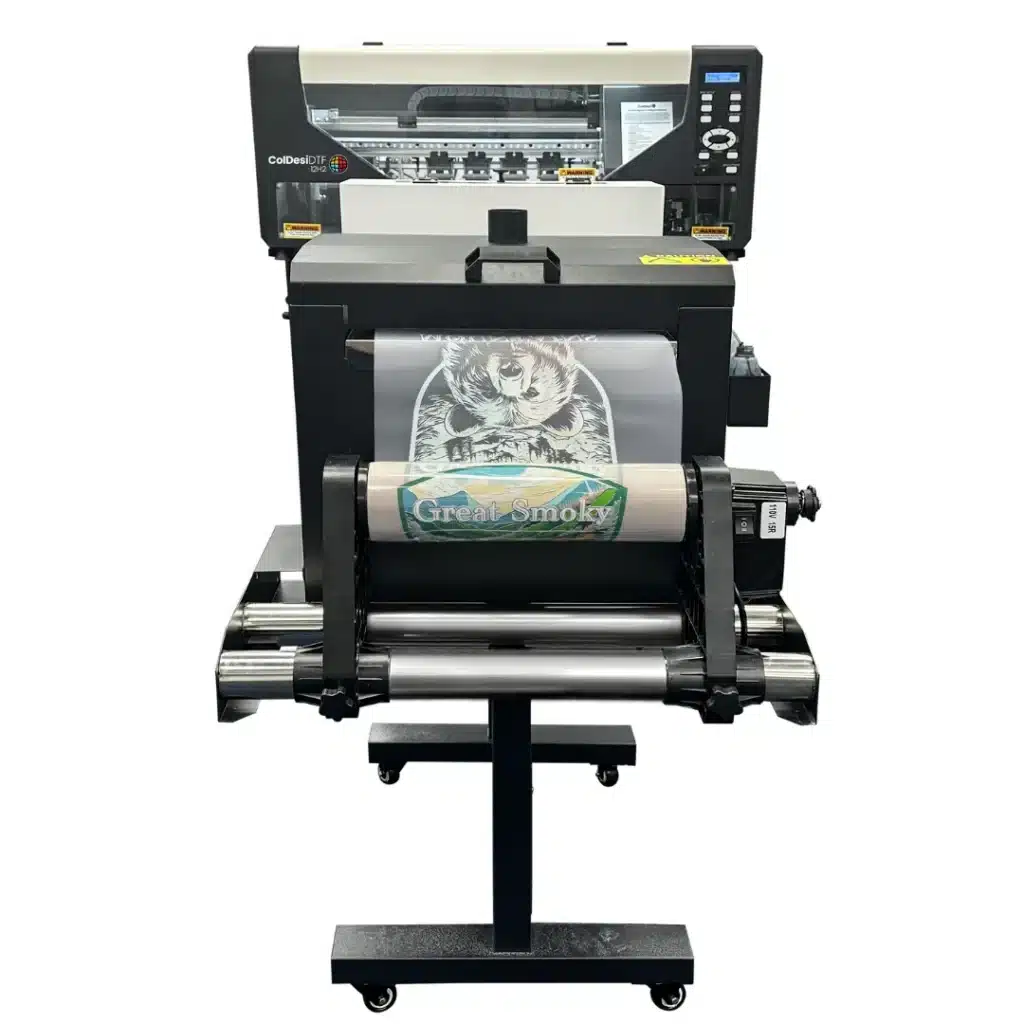
Is a Compact Commercial DTF Printer Right for Your Shop?
A compact commercial system deserves serious consideration if your business is:
- Buying enough transfers that bringing production in-house is becoming attractive.
- Running out of room but still needs more production capacity.
- Adding DTF alongside screen printing or embroidery.
- Moving beyond hobby or occasional DTF production.
- Producing short runs, custom orders, or print-on-demand work regularly.
- Looking for commercial output without committing floor space to a much larger system.
- Planning for growth and needing equipment that fits into a broader DTF production strategy.
The decision shouldn’t start with the smallest machine or the fastest machine.
It should start with your business.
How many transfers do you need to produce? How much room do you have? What types of orders are you trying to win? How quickly are you growing? And what does your production workflow need to look like a year from now?
Those are the questions that lead to the right equipment decision.
ColDesi's Approach to Compact Commercial DTF
DTF equipment has evolved quickly, but buying a DTF printer should never be reduced to comparing specifications on a webpage.
A successful DTF operation brings together equipment, workflow, training, support, and a clear understanding of production goals.
ColDesi’s approach is to help decorators find the system that fits the business—not simply sell them the biggest machine possible.
For some businesses, that system is the ColDesi DTF 12H2, bringing professional DTF production into a remarkably accessible footprint.
For others, it’s the ColDesi DTF 24H2 paired with its compact dryer, delivering the width and throughput expected from commercial DTF production while making smarter use of valuable shop space.
And as those businesses grow, ColDesi offers a broader family of DTF systems designed for increasing levels of production.
Because the future of DTF isn’t just about printing faster.
It’s about building smarter, more efficient, and more profitable production environments.
And sometimes, the smartest production system is the one that can do more—without taking over your shop.
Find the Right Compact Commercial DTF System for Your Shop
Ready to bring DTF production in-house, increase capacity, or make better use of your available floor space? Fill out the form below to connect with a ColDesi DTF specialist.