
Choosing an embroidery machine for a small business is different from choosing one for a hobby. A business needs equipment that can produce consistently, handle diverse types of orders, support repeatable workflows, and keep up as order volume increases.
That does not necessarily mean buying the largest or fastest embroidery machine available. The best commercial embroidery machine for a small business is the one that fits the products you plan to sell, your available workspace, expected production volume, and plans for growth.
For businesses starting embroidery or moving beyond hobby equipment, understanding the differences between machines and the company supporting that equipment is an important part of making the right investment.
What Makes an Embroidery Machine Commercial?
Commercial embroidery machines are designed around production.
Unlike many single-needle hobby machines, a commercial multi-needle embroidery machine can hold multiple thread colors at once. The machine can automatically move from one needle and thread color to another as the design is embroidered, reducing the need for manual thread changes.
-
Commercial machines are also built to accommodate the types of products businesses commonly decorate, including:
-
Polos
-
Sweatshirts
-
Jackets
-
Hats
-
Backpacks
-
Towels
-
Uniforms
For a business, these capabilities can affect how quickly orders move through production, the range of products you can offer, and how efficiently an operator can manage multiple jobs.
Hobby vs. Commercial Embroidery Machines
One of the first questions new embroidery businesses should consider is whether they need commercial equipment.
A hobby machine can be a practical way to learn embroidery or produce occasional personalized items. However, its limitations can become more noticeable when embroidery becomes a revenue-generating operation.
A growing business may need to produce dozens of garments instead of one or two. Customers may request designs containing numerous colors. Corporate customers may want embroidered polos, jackets, and caps. Deadlines have also become more important.
Commercial equipment is designed with these production requirements in mind.
If you are regularly turning down orders, spending too much time changing thread, struggling with certain garments, or reaching the production limits of your existing machine, it may be time to consider moving to a commercial embroidery machine.
How Many Needles Does a Small Embroidery Business Need?
Needle count is an important consideration when comparing machines.
A multi-needle embroidery machine allows you to keep several thread colors loaded simultaneously. For example, a 12-needle machine can accommodate up to 12 thread colors, while a 15-needle machine provides three additional positions.
More needles do not automatically make one machine better than another. The right number depends on the work you expect to produce.
If most of your designs use few colors, a 12-needle commercial machine may provide everything you need. Businesses working with more complex logos, frequently changing jobs, or a wider range of designs may benefit from the additional flexibility of a 15-needle machine.
The goal is to reduce unnecessary interruptions while maintaining an efficient production workflow.
Consider What You Plan to Embroider
Don’t choose an embroidery machine based solely on stitch speed.
Start with your products.
A business specializing in left-chest corporate logos has different requirements from one producing large jacket backs. A company primarily decorating caps needs different capabilities from a shop specializing in personalized towels and bags.
Before purchasing an embroidery machine, consider what percentage of your expected orders will include:
- Flat garments: polos, shirts, jackets, and sweatshirts.
- Caps: structured and unstructured hats.
- Bags and accessories: totes, backpacks, and similar products.
- Large designs: jacket backs and other applications requiring a larger embroidery field.
- Personalization: names, monograms, and individual customization.
Your anticipated product mix should help determine the embroidery field, hoops, cap capabilities, and accessories you will need.
Is a Single-Head Embroidery Machine Good for a Small Business?
For many new and growing embroidery businesses, a single-head commercial embroidery machine can be a logical starting point.
A single-head machine produces one embroidered item at a time, but that does not mean it is limited to low-volume hobby production.
It allows businesses to take individual orders, produce samples, personalize garments, and fulfill small-to-medium production runs without committing the floor space or investment required for a multi-head machine.
It can also provide flexibility as a business grows.
A shop can start with one commercial machine, develop its customer base, and establish its production processes before determining whether additional capacity is necessary.

Do not Overlook Cap Embroidery
If you plan to sell embroidered merchandise, caps deserve thoughtful consideration.
Embroidered hats are used across corporate apparel, sports, schools, clubs, promotional products, fashion brands, restaurants, contractors, and local businesses.
However, embroidering a finished cap is different from embroidering a flat shirt.
When comparing machines, look beyond whether the manufacturer simply states that the machine can embroider caps. Consider the cap frame system, available sewing area and how easily operators can move between flat goods and cap production.
Being able to produce both flats and caps gives small embroidery business access to a much broader range of potential orders.
How Fast Should a Commercial Embroidery Machine Be?
Stitches per minute are useful when comparing embroidery equipment but advertised maximum speed does not tell you exactly how many finished products your business can produce in an hour.
Production time depends on factors including:
- Design stitch count
- Number of color changes
- Garment type
- Hooping
- Thread breaks
- Loading and unloading
- Operator experience
- Finishing requirements
A 10,000-stitch design will naturally take longer to produce than a 3,000-stitch design.
Instead of asking only, “How fast is the machine?”, a better question is:
“How efficiently can this machine produce the types of orders my business expects to receive?”
That shifts the purchasing decision from a single specification to overall productivity.
Choosing Between the Avancé 1201C and Avancé 1501C
ColDesi offers two Avancé commercial embroidery machines designed for businesses with different production needs.
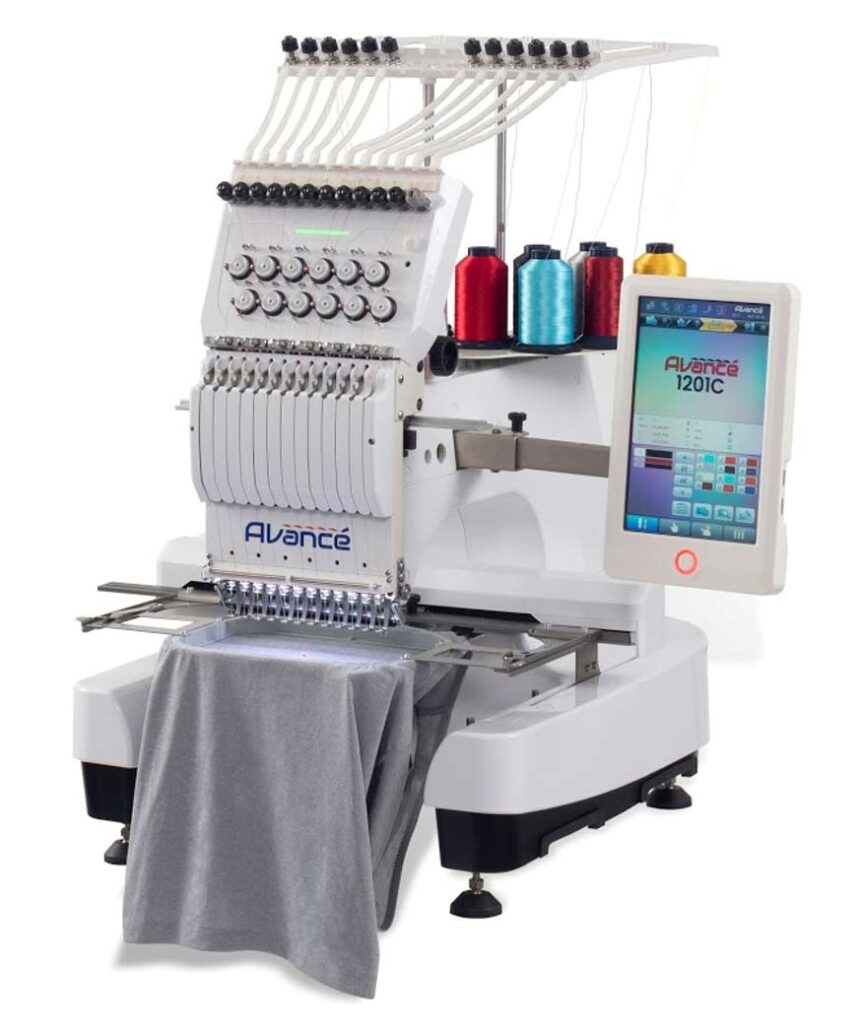
Avancé 1201C Commercial Embroidery Machine
The Avancé 1201C is a 12-needle commercial embroidery machine with a compact footprint, making it an option for businesses that need commercial capabilities but have limited production space.
It can be a strong fit for entrepreneurs starting an embroidery business, home-based businesses transitioning into commercial production, or established customization businesses adding embroidery to their existing services.
With multiple needles and support for both flat embroidery and caps, the 1201C gives businesses the ability to produce a broad range of commercially viable products without requiring a large production environment.
Avancé 1501C Commercial Embroidery Machine
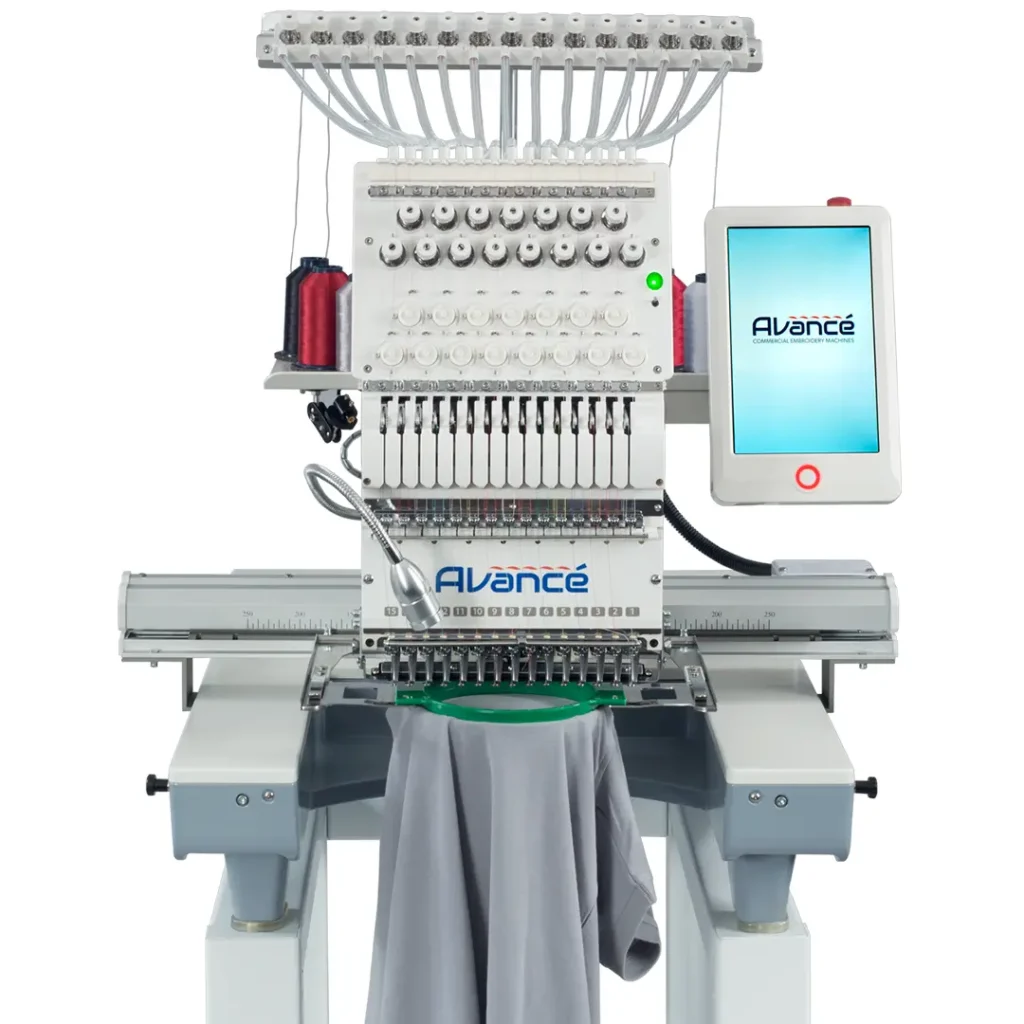
For businesses that need additional capabilities, the Avancé 1501C provides 15 needles and a larger embroidery area.
The additional needle positions provide more flexibility for multi-color designs, while the larger sewing field expands the types and sizes of embroidery projects a business can accept.
The 1501C is worth considering for businesses anticipating higher production demands, more complex designs, or a broader range of embroidery applications.
Neither machine is automatically the right choice for every business.
The better question is which system matches your customers, applications, available space, budget, and expected production volume.
How Much Does a Commercial Embroidery Machine Cost?
Price is naturally one of the biggest considerations when starting or expanding an embroidery business.
However, comparing machines based only on purchase price can leave out some of the most important costs of owning production equipment.
Consider:
- Training: How will you learn to operate the equipment correctly?
- Technical support: Who do you contact when you have a production question or technical problem?
- Warranty: What protection is included with your investment?
- Software: What software will you need to prepare and manage embroidery files?
- Accessories: Are the hoops, cap equipment and other items needed for your intended applications included or available?
- Supplies: Where will you purchase thread, backing, bobbins, needles, and other consumables?
- Digitizing: How will customer artwork be converted into files the embroidery machine can sew?
The lowest initial equipment price does not necessarily result in the lowest overall cost of ownership.
Why Who You Buy Your Embroidery Machine from Matters
The embroidery machine itself is only one part of building a reliable production operation.
When businesses compare commercial embroidery equipment, they should also evaluate the company behind it.
ColDesi takes a consultative approach to commercial equipment. Instead of simply choosing a machine online based on a list of specifications, prospective customers can discuss their business, applications, production expectations, and goals with an equipment specialist.
That becomes particularly valuable for first-time commercial embroidery buyers who may not yet know which specifications matter most.
ColDesi also provides resources that extend beyond the initial equipment purchase, including training, technical support, customer success resources, supplies, and embroidery digitizing services.
The objective is not simply to get a machine delivered. It is to help customers get into production and continue producing.
With decades of experience in the customization industry and tens of thousands of equipment installations, ColDesi supports businesses ranging from entrepreneurs purchasing their first commercial system to established customization companies expanding their production capabilities.
Think About the Business You Want to Have Next
It is easy to choose equipment based entirely on today’s order volume.
Consider where you expect the business to be in the next few years as well.
If you currently produce five embroidered garments per day but plan to pursue corporate accounts, schools, sports organizations or contract work, your future production requirements could look vastly different.
Question | Hobby Embroidery Machine | Commercial Embroidery Machine |
What products do I want to sell? | Best if you are making occasional personalized items, gifts, monograms, or small craft projects. | Better for producing a broad range of products for sale, including uniforms, workwear, polos, jackets, hats, bags, and branded apparel. |
Who are my target customers? | Individuals, friends and family, Etsy customers, or customers placing occasional one-off orders. | Businesses, schools, teams, organizations, brands, and customers who may need to repeat larger-volume orders. |
What size orders do I want to accept? | Best for one-offs and small quantities where production speed is less important. | Designed for larger orders, repeat business, and situations where faster production directly affects profitability. |
Will I need cap embroidery? | Some hobby machines offer limited cap capabilities, but hats can be more difficult to produce consistently. | Commercial machines are better suited for structured caps and regular hat production when equipped with the appropriate cap system. |
How much production space do I have? | Ideal when space is limited, or the machine needs to fit into a home or craft room. | Requires more dedicated production space, although single-head commercial machines can still have compact footprints. |
Could I add another machine as the business grows? | You can add equipment, but multiple hobby machines may become inefficient as order volume increases. | Commercial equipment gives a clearer path to scaling-adding additional single-head machines or moving into multi-head production. |
What level of training and technical support will I need? | Appropriate if you are comfortable learning independently and troubleshooting through manuals, videos, or online communities. | Better when embroidery is part of your income and you need professional training, technical support, and assistance keeping production running. |
The answers will help determine whether a particular embroidery machine is simply affordable today or capable of supporting where you want the business to go.
What Is the Best Embroidery Machine for a Small Business?
There is not one commercial embroidery machine that is best for every small business.
A home-based entrepreneur entering commercial embroidery may prioritize footprint, ease of operation and investment level. An established apparel decorator adding embroidery may care more about production speed, sewing area and versatility. A growing embroidery company may be thinking about how easily it can add capacity in the future.
That is why the decision should begin with business, not machines.
Define the products you want to offer, the customers you want to serve, and the volume you expect to produce. Then compare commercial embroidery machines based on how well they support those requirements.
Ready to Find the Right Commercial Embroidery Machine?
Fill out the form below to speak with a ColDesi embroidery specialist about your production goals and whether the Avancé 1201C or Avancé 1501C is the right fit for your business.