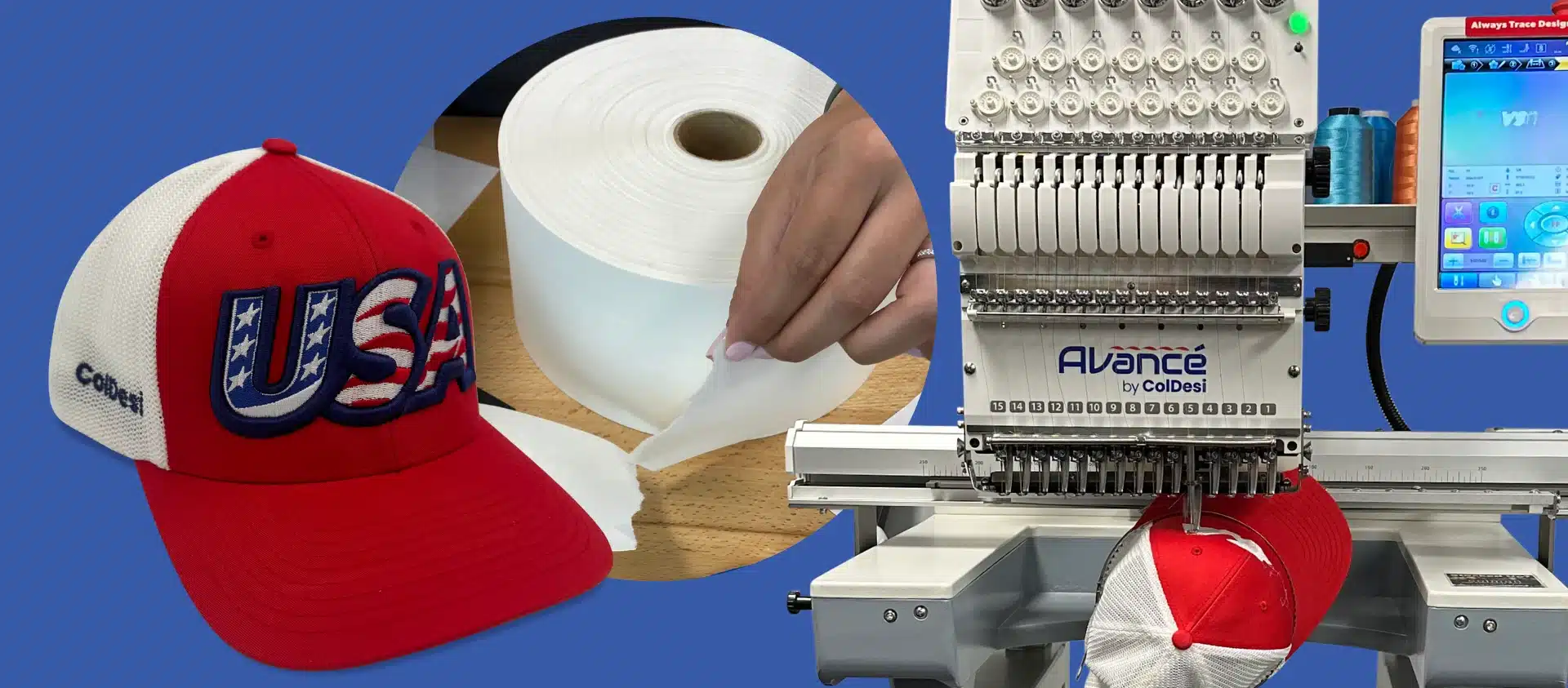
Cap embroidery is one of the most challenging but rewarding areas in commercial embroidery. The curved surface, thick fabrics, and built-in buckram support make hooping and stabilizing hats more difficult than flat garments. The wrong choice of backing or needle can lead to puckering, thread breaks, or poor design registration. That’s why selecting the best embroidery stabilizer for caps and pairing it with the right needle is essential for clean, professional stitching.
Why Stabilizer Choice Matters for Cap Embroidery
- Fabric type: The material you’re embroidering on (whether it’s knit, woven, thick, or thin) will help determine if you need a cut-away, tear-away, or specialty stabilizer.
- Design type: Heavy, dense designs require stronger stabilizers than lighter, airier ones. Think of the density and stitch count as factors that influence the weight of the stabilizer you’ll need.
Types of Embroidery Stabilizers for Caps
Tearaway Stabilizer for Caps
- Best for: Structured caps and standard designs.
- Pros: Easy to remove, provides strong temporary support, minimal residue.
- Cons: May tear prematurely if the fabric isn’t hooped tightly.
For most structured caps, a single sheet of medium-weight tearaway stabilizer is the best choice.
Cutaway Stabilizer for Caps
- Best for: Unstructured caps, soft fabrics, and performance wear.
- Pros: Long-term support, prevents puckering, holds fine details.
- Cons: More difficult to trim; some backing remains inside the cap.
Water-Soluble Film for Cap Embroidery
- Best for: Puff embroidery, designs over seams, and detailed logos.
- Pros: Prevents stitches from sinking, washes away completely.
- Cons: Not strong enough to serve as the only stabilizer.
Embroidery Adhesive Spray for Cap Embroidery
Embroidery adhesive spray is a handy alternative to stabilizer. It provides a temporary hold for fabrics, making it ideal for delicate materials, appliqué, or floating items in the hoop.
- Best for: Delicate fabrics, appliqué, floating fabric in the hoop.
- Pros: Quick setup, prevents fabric distortion, reduces stabilizer waste.
- Cons: Can leave residue if overused; not strong enough for dense stitch designs.
The Right Stabilizer and the Right Machine
Using the right stabilizer is important for cap embroidery, but it’s only part of the solution. To achieve professional results, you also need an industrial embroidery machine built specifically for caps.
Caps present unique challenges such as curved surfaces, sweatbands, thick seams, and structured crowns. Standard embroidery machines are not designed to handle these demands.
Key Machine Features for Cap Embroidery
- Cap frames and hoop systems: A 270° (ear-to-ear) design accommodates curved surfaces and allows embroidery across the front and sides of caps.
- Cylindrical lower arms: Match the natural shape of caps, providing consistent pressure and stitch quality.
- High stitch speeds: Machines that reach up to 1,200 stitches per minute handle large production runs efficiently.
- Multi-needle setups: A 15-needle configuration reduces downtime from color changes, critical for varied designs.
- Modular systems: Commercial machines with modular designs allow one head to stop for maintenance while others keep running, maximizing productivity.
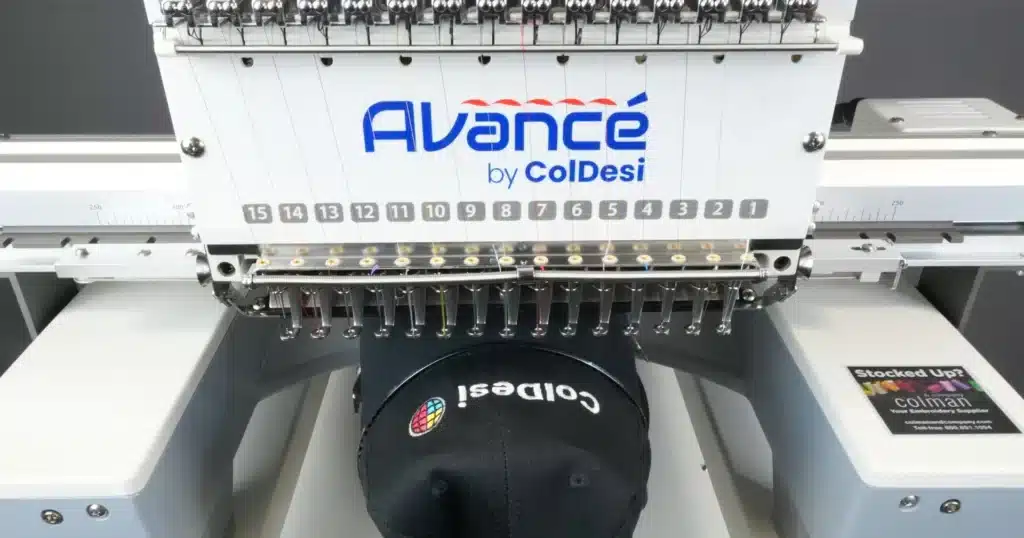
Avancé 1501C Built for Cap Embroidery
The Avancé 1501C is engineered specifically for cap embroidery, combining speed, accuracy, and ease of use.
Cap-Focused Enhancements
- Improved needle stability: Reduces deflection and breakage when working on curved cap surfaces.
- Better seam performance: Produces cleaner results along seams with fewer skipped stitches.
- Expanded embroidery area: Enlarged from 270 mm × 60 mm to 270 mm × 65–68 mm for greater design flexibility.
- Closer cap frame positioning: Adjusts to within 2.5 mm of the embroidery surface, doubling precision compared to the previous 5 mm gap.
These upgrades make cap embroidery faster, more accurate, and less prone to errors.

Additional Features Supporting Production
- 15-needle setup: Ready for multiple thread colors without constant rethreading.
- High-speed output: Up to 1,200 stitches per minute for fast, efficient production.
- Proven durability: Each unit is tested with more than 300,000 stitches and backed by a 5-year warranty.
- Complete package: Ships with cap frames, hoops, 4,000 designs, digitizing software, and training, so it’s production-ready from day one.
The Avancé 1501C is more than a general commercial embroidery machine—it is a specialized solution for cap embroidery. With targeted engineering enhancements and a full feature set, it delivers the speed, quality, and reliability businesses need to succeed in headwear production.
Quick Tips to Improve Cap Embroidery Results
- Slow machine speed slightly to reduce vibration.
- Double up on stabilizer for dense stitch counts.
- Always test-stitch new cap styles before full production.
- Keep spare needles ready, caps wear them out faster than flat garments.
Best Embroidery Needles for Caps
- 75/11 or 80/12 sharp point needles are ideal for most cap embroidery.
- Use sharp points for structured caps and buckram, as they penetrate tough fabric without deflection.
- Ballpoint needles may be used on soft or knit-style caps to prevent snagging.
- For specialty threads like metallic or thick polyester, consider sizing up to prevent thread breaks.
How to Hoop a Cap for Embroidery (Step-by-Step)
- Select the right cap frame designed for structured hats.
- Insert the stabilizer—usually one sheet of medium tear-away or light cut-away.
- Hoop the cap tightly, ensuring the fabric is flat against the frame.
- Secure the brim so it doesn’t shift during stitching.
- Run a test stitch to confirm alignment before starting production.
Stabilizer Comparison Table: Tear-Away vs. Cut-Away vs. Specialty
|
Stabilizer Type
|
Best For
|
Pros
|
Cons
|
Cap Embroidery Recommendation
|
|---|---|---|---|---|
|
Tear-Away |
Structured caps, medium-to-heavy fabrics |
Easy to remove, strong temporary support |
Can tear too soon if the fabric isn’t hooped tightly |
Best for most structured caps |
|
Cut-Away |
Unstructured caps, softer fabrics, performance wear |
Provides lasting support, prevents puckering |
Leaves backing inside cap, harder to trim |
Great for soft or low-profile caps |
|
Water-Soluble Film |
3D puff embroidery, topping seams |
Prevents thread sinking, washes away |
Not supportive enough alone |
Use as a topping only |
Frequently Asked Questions About Embroidery Stabilizer for Caps
What is the best embroidery stabilizer for caps?
The best stabilizer for caps is usually a medium-weight tear-away stabilizer for structured caps. For unstructured hats, a light cut-away stabilizer works best.
Can I use cut-away stabilizer on caps?
What needle size should I use for embroidering caps?
A 75/11 or 80/12 sharp point needle is recommended for cap embroidery.
How do I prevent registration issues when embroidering on caps?
Should I use more than one layer of stabilizer on caps?
Do different cap styles need different stabilizers?
Choosing the Best Stabilizer and Needle for Caps
Cap embroidery doesn’t have to be intimidating. With the right stabilizer and needle, you can achieve crisp, professional results on both structured and unstructured hats. For most projects, medium tear-away stabilizer and a sharp 75/11 needle will give you reliable, consistent quality. Adjust your approach for specialty caps and designs, and you’ll deliver embroidery that looks great every time.
For more information on the best embroidery stabilizer for caps, fill out the form below or call 877-793-3278.