Expanding the Capabilities of UV-Flatbed Printing
UV-flatbed printers do an amazing job printing on large, flat items that can easily be placed on the bed and targeted with simple math. However, when working with smaller or irregularly shaped products, 3D printed jigs for UV-flatbed printers can dramatically improve placement accuracy and efficiency.
The Challenge of Printing Small or Dimensional Items
To maximize image quality and increase productivity, many shops are turning to 3D printed jigs for UV-flatbed printers to ensure items are consistently positioned for accurate printing. It is important to consistently hold items to be printed in the best orientation possible and allow for easy and accurate targeting.
Why Jigs Are Essential for UV Printing Accuracy
The best way to guarantee this is to place your item(s) in a jig configured to hold the items with the surface to be printed parallel to the travel of the print head. Many shops now use 3D printed jigs for UV-flatbed printers to achieve this consistency quickly and affordably.
Traditional Jig Options for UV Printers
Your options for jigs for your UV-flatbed printer are basically limited to either buying jigs – either pre-made jigs for standard items like golf balls and the like, or custom jigs made to fit specific items. Both can be expensive, and having custom jigs made is not only pricey but can also be time-consuming. The second option is to produce jigs in-house. Depending on your current equipment, that can be simple, just requiring a little practice to get consistent results, or more complex (and more expensive) if you need to purchase and learn how to operate another piece of equipment. Increasingly, shops are choosing 3D printed jigs for UV-flatbed printers as a more flexible and cost-effective solution.

CNC and Laser-Cut Jig Production
Historically, UV-flatbed jigs have been produced on CNC machines, routers, and laser cutters/engravers, but many shops are now replacing these methods with 3D printed jigs for UV-flatbed printers due to lower costs and faster turnaround. The accuracy of these machines has been very good, but they can come with a healthy price tag, oftentimes making them an unrealistic option for many UV-flatbed printing shops. A good, mid-sized, commercial laser cutter/engraver can cost from just under $10,000 to over $20,000. A good quality, commercial CNC machine/router will start at about the same price and range higher depending on several factors like speed, precision, repeatability and bed size. While both options are very viable as add-ons to a shop that runs a UV-flatbed printer, they are not practical additions if the main purpose is the creation of jigs for your UV printer.
Affordable 3D Printing Custom Jigs
With the associated costs and space constraints listed above, there has been a need for an affordable, small-footprint solution for producing custom jigs for UV-flatbed printers. Fortunately, for shops running a UV printer, there is a solution. 3D printers have become an increasingly popular way to produce 3D printed jigs for UV-flatbed printers, giving shops the ability to create custom fixtures quickly and affordably. The first industrial printers hit the market in the latter part of the 1980s, and consumer 3D printers became available between 2006 and 2010 but still held hefty price tags in the $10,000-20,000+ range. But, as with many technologies, time, technology and competition have brought the price on these printers down significantly. A good-quality 3D printer like the Bambu Lab X1C, fully bundled, can be added to a shop for less than $2,000 and under $1,500 with promotions. These machines have a small footprint and have no special power requirements, and the materials needed to produce items are very inexpensive.
Multi-Purpose 3D Printed Jigs
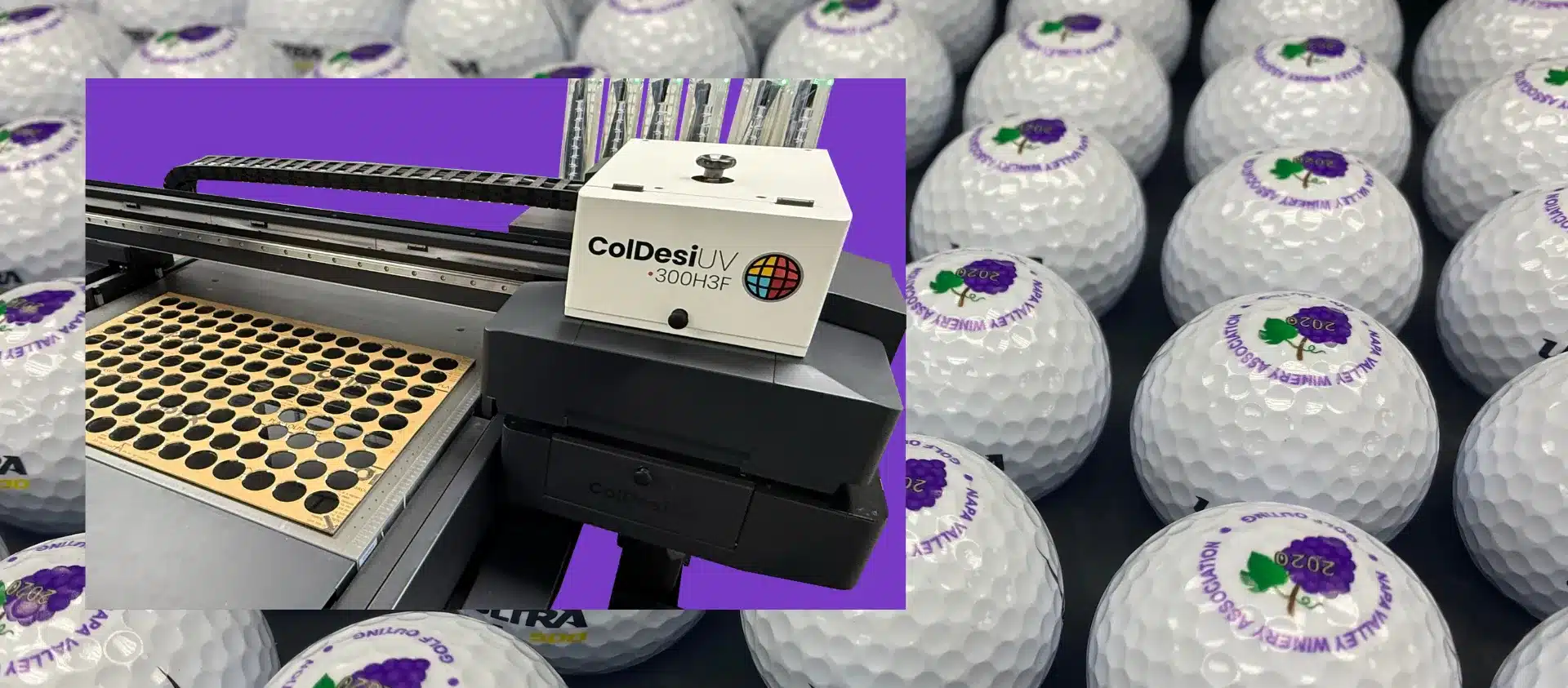
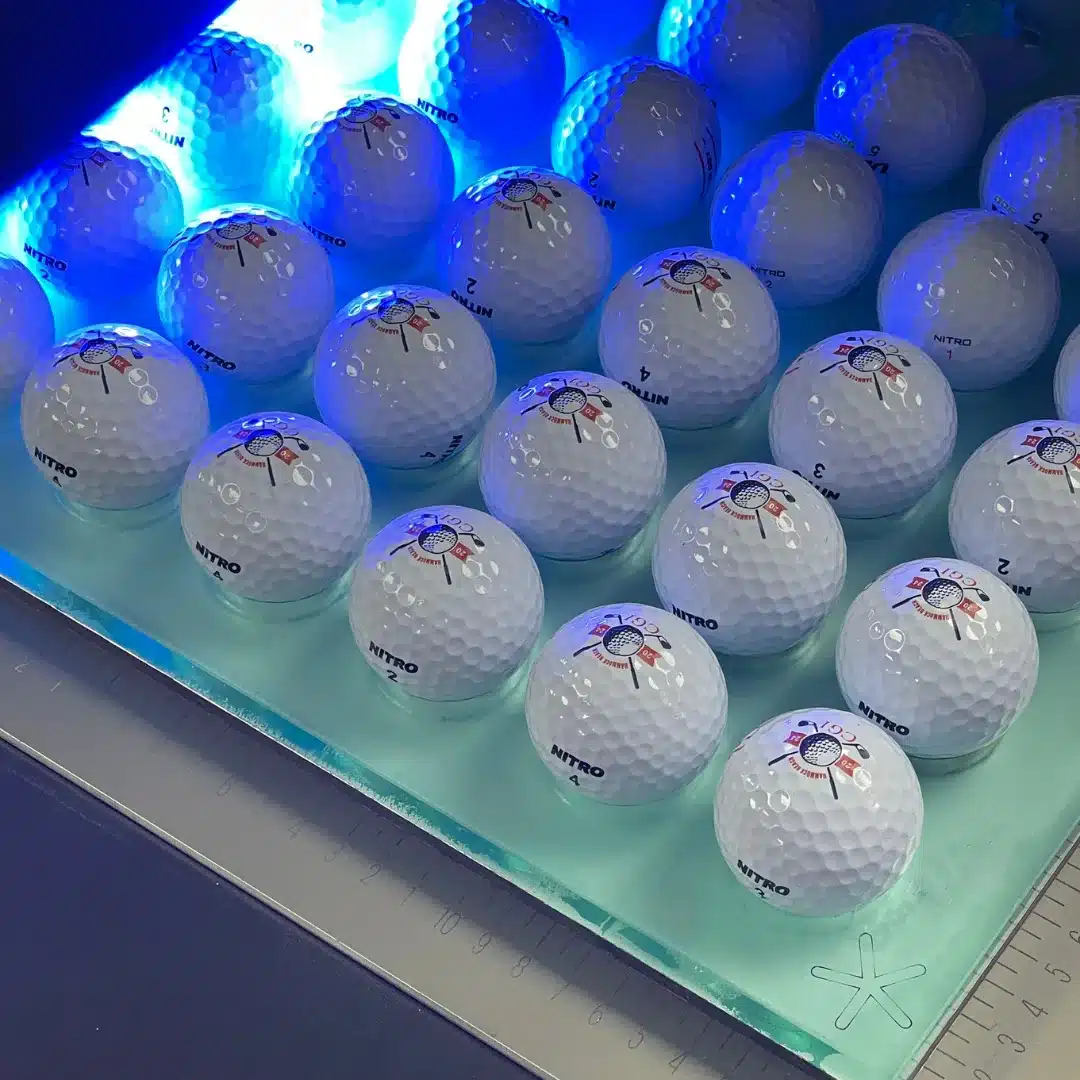
With a little creativity, 3D printed jigs for UV-flatbed printers can be designed to hold multiple items such as golf balls, poker chips, or baseballs in precise positions. An example (pictured below) is a jig that holds golf balls but also has a recess around each hole that allows for a poker chip to be printed as well. This makes good use of 3D material and simplifies the process of positioning in the RIP software, as the slots on the jig are on the same center for both the balls and the poker chips. Secondarily, baseballs can be printed using every other hole on a 3D printed jig designed for golf balls, or every third hole for larger balls like softballs.