
How many tools are you duct-taping together just to run your print shop?
You add one method to handle one type of job, then another to just keep up with something else.
And just when you think you’ve got it figured out, a customer walks in asking for something new. Of course they do!
At some point, the reality sets in: one decoration method isn’t enough anymore.
But it’s also not realistic to keep adding equipment every time a new job comes in.
That’s how shops turn into warehouses (and still don’t end up fully covered).
What makes sense is finding the right combination of tools that can realistically handle 90–99% of what customers actually ask for.
So what could that look like?
Embroidery + UV DTF.
And if your first reaction was “oh, that actually makes sense”… that’s kind of the point.
This combination covers most of what comes through a typical shop.
Embroidery naturally handles apparel—your hats, polos, jackets, uniforms, basically anything fabric-based.
UV DTF takes care of hard goods—tumblers, acrylics, promotional items, signage, and all those odd one-off requests that don’t really fit in traditional apparel workflows.
Together, they cover a wide range of what most customers actually ask for.
In the next few minutes, you’ll see how combining embroidery and UV DTF can help you:
- Cover a much wider range of customer requests
- Reduce the number of “we can’t do that” conversations.
- Tap into new niches and product categories you might currently be missing
- Build a broader customer base that comes back because you can handle more of what they need in one place
- And ultimately improve your bottom line and increase your earnings
If some of this sounds almost too good to be true, it might just mean your setup is overdue for a rethink.
Now feels like as good a time as any to take a closer look at how this combination actually works in practice.
And why this pairing makes so much sense for modern print shops.
Let’s map it out!
Introduction: Why Customers Now Expect One Shop to Do It All
Play along with us here.
Imagine you’re trying to get a simple order done. A few hoodies, maybe a hat, and a couple of branded items for an event. Nothing complicated, nothing unusual.
On paper, this should be a straightforward, one-stop kind of job.
But somehow it always turns into a back-and-forth between different shops, and different people who all “don’t do that part.”
If you’ve ever tried to coordinate something like this before, you know the feeling. It feels less like placing an order and more like managing a project.
And that’s not how it should be. Which is really the point of this example.
Because customers don’t want to deal with that kind of friction anymore. They expect one place that can handle everything.
So if customers already expect one shop to do it all, then the question is: which businesses are set up to actually deliver on that expectation? And which ones are still forcing customers to piece it together themselves?
Just something to think about.
And if you follow that line of thought, you begin to notice how much of that experience comes down to the individual parts of the process.
Embroidery is a good place to start.
What Is Commercial Embroidery for Business
In the previous section, we framed the problem as “unnecessary friction” in what should be a simple ordering process.
Customers do not want to piece things together themselves. They want a single place that can handle everything for them.
And that’s where the idea of combining different production methods like embroidery and UV DTF comes in.
But instead of thinking of it as one big process, it makes more sense to look at the parts one by one.
And what better place to start than with embroidery.
So what exactly is machine embroidery?
In simple terms, machine embroidery is the process of using a computerized embroidery machine (such as that of Avancé) to stitch a design directly into fabric rather than by hand.
In practice, it’s most commonly used for logos and branding on items like hats, polos, hoodies, jackets, and uniforms.
We’ll get into specific use cases and applications later in the piece, but for now it’s enough to understand what it is and where it’s commonly used.
So where does embroidery fit into a typical print shop?
In most print shops, embroidery sits alongside printing as one of the core ways to decorate apparel.
As we’ve already mentioned, you’ll typically see it used for hats, polos, hoodies, jackets, and uniforms.
So in that sense, it’s just one of the standard ways shops handle branded apparel.
And while that works well in a lot of cases, it doesn’t cover everything. Some jobs naturally go to print, some go to embroidery, and a lot of it comes down to what the product requires.
And that’s where a UV DTF printer comes in.
What Is UV DTF Printing for Business
So what exactly is UV DTF printing?
UV DTF (Ultraviolet Direct-to-Film) is a hybrid printing process used to create durable, full-colour decals for hard, smooth surfaces where embroidery or traditional fabric printing cannot be used.
The process works by printing a design onto a special film using UV-curable inks. These inks are instantly cured under UV light, meaning the design is ready to use immediately after printing.
Once printed, the design is transferred onto a product using pressure only. There is no need for heat pressing, vinyl cutting, or weeding. It is essentially a ready-made adhesive decal that can be applied by hand or with a simple squeegee.
In practice, this makes it useful for custom products and branding applications such as drinkware, packaging, signage, promotional items, and small merchandise runs.
Anywhere a full-colour logo or graphic is needed on a hard surface, UV DTF is a practical option.
So where does UV DTF fit into a print shop?
In most print shops, UV DTF sits alongside embroidery, screen printing, and other decoration methods as another production tool rather than a replacement.
It does not compete with embroidery or garment printing because it serves a different category of products entirely.
Embroidery is primarily used for fabric and apparel, while UV DTF is designed for hard goods such as glass, plastic, metal, and coated materials.
This distinction is what makes it unique and useful. It allows shops to handle work that would otherwise sit outside their usual production methods.
And in that sense, it fills a different gap in the workflow.
Some projects are best suited to embroidery, others belong to garment printing, and others naturally fall into UV DTF. And some do not fit either of those at all.
That, in a nutshell, is what embroidery and UV DTF printing are all about, as well as how they differ from and complement each other.
With that foundation in place, let’s look at how UV DTF printing is being used in apparel applications.
UV DTF on Apparel
We’ve built a solid foundation so far, and if it’s felt like a lot to take in, that’s completely normal. If anything, that’s to be expected at this stage.
That said, this is still just the beginning and there is plenty more to build on from here.
Next, we can briefly look at how UV DTF printing is being used in apparel, particularly for adding detailed graphics, logos, and embellishments in areas that are either too difficult or simply impossible to achieve with embroidery.
While still relatively new and not yet fully mainstream, this method is already being used in a number of specific applications.
So what does that look like in practice?
In some cases, for example, it can be applied to items where you want the look of embroidery, but the design cannot be realistically produced using traditional stitching because of technical limitations.
At this point, it is helpful to introduce a term you may come across: “digital embroidery.”
In simple terms, what people often call “digital embroidery” is really a print-based method that recreates the look of stitched embroidery without using any thread or needle work.
Instead of physical stitching, the design is created digitally and then printed in a way that builds up texture, giving it a slightly raised, 3D, embroidery-like effect. You may also see terms like “3D faux embroidery” and “3D silicone stickers” used online to describe similar effects or applications.
This is one of the areas where UV DTF can be applied, although it’s still fairly niche and not a mainstream replacement for embroidery.
On apparel specifically, however, UV DTF has more limited, situational use, especially compared to textile-specific methods that are designed to handle movement, stretch, and repeated washing.
We mainly wanted to share this so you’re aware it exists. From here, you can do your own research if you want to explore it further and look into it more on your own. For example, video below demonstrates UV Flex technique.
Why Embroidery and UV DTF Printing Work Together
If you’re still here and reading this, you’re going to love what’s coming next, because this is where things start coming together.
By now, it should be clear that the real advantage comes from using each method for what it does best and letting them complement each other instead of compete.
Embroidery brings texture, durability, and that premium stitched look that people can see and feel right away. UV DTF, on the other hand, delivers full color detail, fine graphics, and the flexibility to apply designs to surfaces where embroidery just wouldn’t work.
On their own, each method is powerful. But together, they open up far more creative and commercial possibilities.
When you combine the two, you’re no longer limited to just apparel or just hard goods. You can expand across both, and even start blending techniques on the same product to create something that stands out in a way neither method could achieve alone.
For example, you might embroider a clean, high-end logo on a cap while adding a vibrant UV DTF graphic to packaging or accessories that go with it.
Or think of it this way. Use embroidery for your apparel, and UV DTF decals to carry that same design onto bottles, boxes, and other complementary items.
Once you start working with both, you naturally find more ways to use them together.
And over time, that starts to show up in your product range, your pricing, and the kind of orders you can take on.
This is where it starts to pay off on the business side, which is exactly what we will cover next.
Benefits for Existing Businesses
So what does all of this actually mean for you (and your business)?
We’ve covered a lot so far, and you can probably connect the dots. But at the end of the day, if you’re investing in new equipment, whether that’s embroidery, UV DTF, or both, it has to make financial sense.
These are not small purchases. They should generate a return, increase your margins, and ultimately put more money in your pocket.
So what are the actual benefits? Where do you see real improvements, and how does this translate into measurable business growth?
Let’s be honest. At this stage, it all comes down to results and numbers.
That’s what this is about.
So where do those results actually show up?
It usually comes down to a few key areas:
Expanded product offerings across apparel and hard goods
Before, you may have had to turn work down. Maybe outsourcing wasn’t worth it, margins were too tight, or it simply wasn’t something you offered.
Now, you can bring more of that work in-house.
You’re no longer limited to garments or a single decoration method. With embroidery and UV DTF, you can offer everything from branded apparel to drinkware, accessories, and promotional items, allowing you to say “yes” more often instead of turning opportunities away.
Higher average order value through combined decoration methods
When you combine decoration methods, the value of each order naturally increases.
Instead of a single product, customers are more likely to bundle—adding embroidery to apparel, or pairing garments with branded hard goods. The result is larger orders without needing more customers.
Ability to upsell customers with more customization options
Customers don’t always ask for it, but when you show them what’s possible, they often go for it.
Someone might come in for shirts and leave with shirts, hats, and a few branded extras.
Expanding your capabilities makes it easier to guide those decisions and increase order value without feeling pushy.
Reduced need to outsource specialty products
Work that previously had to be sent out can now be produced in-house. That means no waiting on other shops, no guessing on quality, and no giving up a chunk of your profit.
It also speeds everything up, which customers notice.
When you step back and look at it, those are really the areas where you’ll start to see the improvements, and the more they build on each other, the more noticeable the results become.
These aren’t overnight changes, but as you learn the systems and get more confident using them, it all becomes manageable and well within reach.
That naturally leads into the next question: what can you actually create with embroidery and UV DTF, and what can you realistically start selling?

Use Cases and Product Opportunities
We’re all creative people. We like to push limits and try new things, that’s part of why we do this.
But when it comes to business, it’s not really about us. It’s about the person on the other end and what they actually want.
So before getting into ideas and possibilities, it comes back to a simple question: what are customers actually buying?
Because once you know that, you know exactly what to create.
And we’re not going to leave you to figure that out on your own.
We’ll go through it together, focusing on products that have been selling for years. Things customers already understand, already want, and are actively looking for.
Machine Embroidery Product Opportunities:
Branded apparel
Polo shirts, t-shirts, hoodies, workwear, and uniforms for construction, hospitality, retail, and various other industries.
Headwear
Baseball caps,snapbacks, beanies, berets, bucket caps.
Corporate & Workwear
Company logos on polos, jackets, fleeces, and button-ups for employees, teams, and corporate events.
Service Uniforms
Aprons, chef coats, and uniforms for hospitality, food service, and customer-facing staff.
Bags and accessories
Tote bags, backpacks, duffel bags, purses, clutches, and gym bags.
Baby and kids items
Onesies, bibs, blankets, and small apparel often used for personalized gifts.
Personalized gifts
Monogrammed towels, robes, blankets, and pillowcases for weddings, birthdays, and holidays.
Event and promotional items
Custom apparel and accessories for events, giveaways, and branded merchandise.
UV DTF Product Opportunities:
Drinkware and hard goods
Tumblers, mugs, water bottles, glassware, and flasks.
Expanded product offerings across apparel and hard goods Higher average order value through combined decoration methods Ability to upsell customers with more customization options Reduced need to outsource specialty products.
Laptop and tech decals
Custom decals for laptops, tablets, gaming consoles, and other electronics.
Business branding materials
Branded decals for packaging, product labeling, thank-you cards, and small business branding.
Automotive decals
Stickers and decals for cars, windows, toolboxes, and equipment.
Packaging and product labeling
Branding and labeling for retail products, handmade goods, and small business packaging.
This is what customers are already buying, whether it’s embroidered, printed, or customized with UV DTF.
Now it’s on you: which one are you going to run with?
Pick one, and get it in front of customers. The rest gets figured out along the way.
From here, it’s about selecting equipment that sets you up to produce these products, scale efficiently, and expand your business.
Choosing the Right Equipment
Once you know what you want to produce, the next step is choosing equipment that can help you do it.
For apparel, that means a reliable embroidery machine that can handle consistent, repeatable output.
For hard goods, it means a UV DTF printer that allows you to apply designs across a wide range of surfaces (and expand into new product categories).
Together, this combination sets you up to cover almost everything customers typically come in looking for.
Rather than going down the rabbit hole of researching every machine out there on your own, we’ve narrowed it down to options that are actually worth looking at.

Avancé 1201C – A 12-needle commercial embroidery machine designed for small businesses, startups, and home-based studios. With 12 needles, it can sew up to 1,000 stitches per minute, which is impressive for such a compact machine.
You get everything you need right out of the box, including a 10.1″ touchscreen control panel, 28 built-in fonts, and 4,000 designs.
Avancé 1501C – A 15-needle commercial embroidery machine that can be thought of as the “bigger brother” of the Avancé 1201C. It is faster, larger, and more capable, offering improvements in nearly every area. Namely, it’s equipped with 15 needles that can sew up to 1,200 stitches per minute!
You also get a larger embroidery area that gives you more freedom and flexibility in the types of projects you can take on and handle. On top of that, the machine includes a strong selection of pre-loaded fonts and designs to help you get started right away.

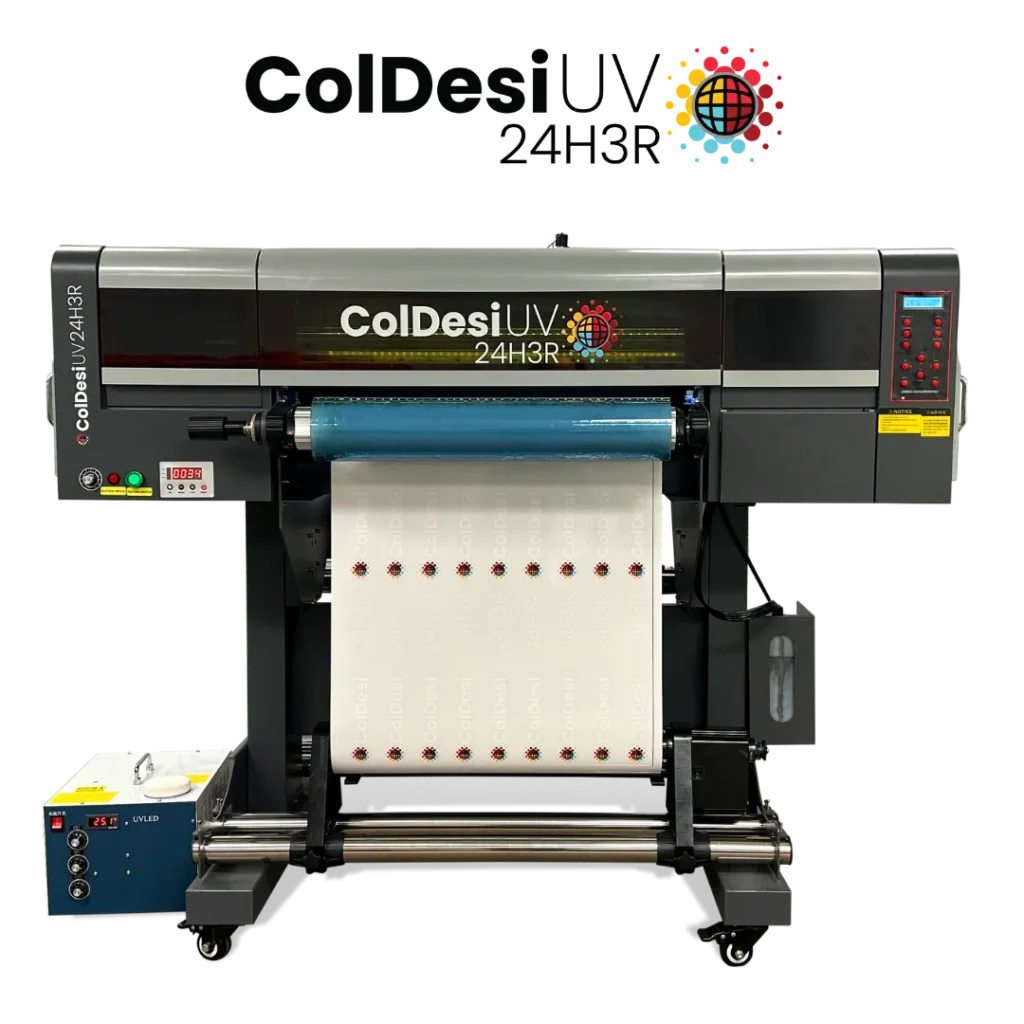
ColDesi UV 24H3R – A roll-fed UV DTF (Direct-to-Film) printer used for creating durable, full-color decals and adhesive transfers for a wide range of hard surfaces like plastic, glass, metal, wood, and ceramic.
The model name 24H3R, gets its name from three main features: number 24 for its maximum 24-inch print width, H3 indicating it’s a 3-head printer, and the R at the end telling us that it’s a roll-fed UV printer.
It’s designed for high-speed production, allowing businesses to customize items like tumblers, awards, and equipment efficiently without needing separate steps for weeding or lamination, as the process is handled all in one go.