
Let’s start with a quick question.
Have you ever spoken to a fellow printer, decorator, or supplier and realized halfway through the conversation that they were speaking an entirely different language?
In the world of custom printing, terms like ‘DTF’, ‘UV’, and ‘UV DTF’ are used constantly, as if everyone is expected to know exactly what they mean.
The truth is, most people DO NOT.
That’s because custom printing really does have its own language.
And that’s a problem. Without understanding it, you can’t fully follow the discussion, make informed decisions, or even ask the right questions.
Say ‘DTF,’ ‘UV,’ or ‘UV DTF’ out loud and half the time no one knows what the other is talking about.
That’s why this glossary exists.
Inside, you’ll find clear, straightforward definitions for the most common (and often misunderstood) terms used in modern custom printing and product decoration industry. Terms and phrases that regularly trip people up.
Whether you’re new to the industry, trying to catch up, or just tired of nodding and smiling, this glossary gives you one thing most people in this industry never have:
Clarity.
Read through it once, and you’ll finally speak the same language as everyone in the industry.
Who are we , what we do, and why are we here?
Now, if you’re even halfway skeptical (and you should be), you’re probably thinking:
Wait a second… Where is this list coming from? Why should I believe a word on this page?
Fair questions. Smart questions, actually.
Because the truth is, nobody should blindly follow a list of claims from a stranger. You don’t know us.
So here’s a better idea.
Before we drown you in terms, acronyms, and industry mumbo-jumbo…
Before we ask you to accept anything at face value…
Why don’t you get to know us first?
Then, after you know who we are, what we stand for, we can circle back and walk through the list together.
And you can decide from there what’s true and what isn’t. Sounds reasonable?
So… who are we?
Well, the page you’re (we hope) looking at right now, is www.coldesi.com, the homepage for ColDesi’s brand.
In a sentence, our company provides equipment, supplies, software, and training for the custom product decoration industry.
And we’ve been doing it for over 20 years.
These days, we work with customers around the world from our Florida headquarters. And we’ve become a global leader in the industry with our not too distant expansion into Europe.
Along the way, we’ve invested heavily in automation, smart design, and technology that actually makes production easier.
We hold multiple patents, and we’re regularly developing new products to help you work faster, more precisely, and spend less doing it.
We’re here for the long run. For you, your team, and your business!
In short, that’s us.
Now that we’re better acquainted, it’s time to get our hands on the list we promised.
Terms & Phrases Used in the Modern Custom Printing and Product Decoration Industry
Printing & Decoration Methods
List of Terms & Phrases
Screen Printing
Screen printing, also called silkscreening or serigraphy, is a versatile stencil-based printing method that pushes ink through a stenciled mesh screen onto a surface, transferring a design with a rubber squeegee. It’s popular for bold, graphic designs on fabrics, paper, wood, plastics, and metal.
Sublimation Printing
A printing process where special sublimation ink is transferred onto polyester fabrics or specially coated hard surfaces using heat and pressure.
DTG (Direct-to-Garment)
DTG stands for “direct-to-garment” printing, and the name says it all. This method uses specialized inkjet technology to spray your design directly onto textiles and garments with water-based inks.
DTG is ideal for small runs, typically anywhere from a single shirt up to around 100 garments, making it perfect for custom orders or small batches. It works especially well for designs with multiple colors, gradients, or fine details.
DTG printing is perfect for fabrics like t-shirts, hoodies, and other apparel. You can print on black or dark polyesters, cotton, and blends, as well as whites. Whether it’s the front, back, sleeves, collars, or even shirt tags, DTG can handle it all.
DTF (Direct to Film)
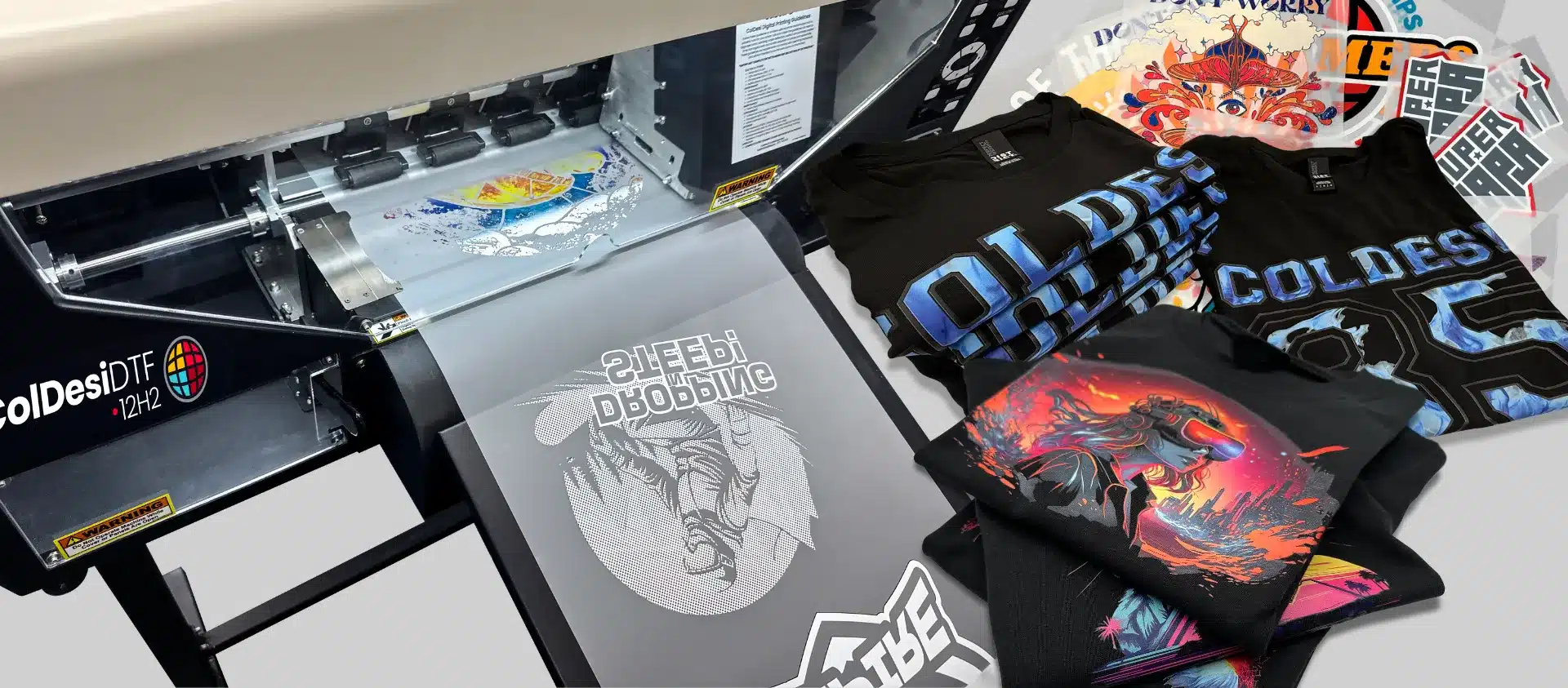
DTF, or Direct-to-Film, is a modern printing process used mainly in the textile and apparel industry to print designs onto fabrics, especially T-shirts, hoodies, and other garments.
In DTF, a design is first printed onto a special film using water-based pigment inks, with white ink as an underbase. While the ink is still wet, a special adhesive powder is applied, and the film is briefly heated to cure the powder. Finally, the film is heat-pressed onto the fabric.
DTF works on any fabric type, including cotton, polyester, blends, and more, without the need for pretreatment. It produces vivid, detailed, and durable prints with a soft feel.
Machine Embroidery
Machine embroidery is the process of creating designs on fabric using a computerized embroidery machine, rather than by hand. Unlike traditional hand embroidery, machine embroidery allows for precise, consistent, and fast production of patterns, logos, text, or decorative designs.
Typically, you start by creating a digitized design in embroidery software, which is then imported or loaded into your embroidery machine via USB or network. The machine reads the design file and follows its instructions, converting the digital data into precise mechanical movements of the needle and carriage.
UV DTF (Ultraviolet Direct-to-Film)
UV DTF is a modern hybrid printing process used mainly for making durable, vibrant decals for hard, smooth surfaces.
It’s widely used for custom products, such as promotional items, signage, small-scale merchandise, and personalized goods.
The process involves printing directly onto a special film using UV-curable inks, which cure instantly under UV light, making the printed design ready for use immediately.
No heat press or external heating is required.
Once printed, the film can be applied like a sticker using finger pressure or a squeegee.
UV Printing
UV printing, in essence, is a technology that combines ultraviolet (UV) light with UV-curable inks to print directly onto a wide range of materials, dimensional objects, or transfer films.
Unlike traditional printing, it bypasses steps like cutting, weeding, layering, heat pressing, and waiting for inks to air dry.
It prints directly onto the object, eliminating the need for all those steps.
The key component is ultraviolet (UV) light. Inside every UV printer, there are several UV lamps that emit photons that interact with these specialized, fast-drying UV-curable inks.
As soon as the ink makes contact with the surface, the UV lamps immediately expose the ink to UV light.
This triggers a chemical reaction in the ink, causing it to harden and cure almost instantly. As a result, the ink dries rapidly and adheres to the substrate surface.
The result is ready-to-use, durable prints.
Heat Transfer Vinyl (HTV)
Heat Transfer Vinyl (HTV) printing is a method for creating custom designs on fabrics (or other materials), using a specialized vinyl with a heat-activated adhesive that’s cut into shapes, weeded , and then permanently bonded to items like T-shirts, hats, bags, or sportswear using heat and pressure from a heat press.
Heat Transfer Rhinestone Printing
Heat Transfer Rhinestone Printing is a decoration method in which hot-fix rhinestones (small, three-dimensional glass or acrylic stones) are precisely placed using an automatic rhinestone setting machine.
The machine reads a digital design file and picks, flips, and positions the stones onto a heat-transfer adhesive film, ensuring accurate placement, uniform spacing, and consistent quality, even for complex or multi-size designs.
Once the transfer sheet is completed, it is applied to the fabric using a heat press, where controlled heat activates the adhesive, permanently bonding the stones to the garment.
Spangle Transfers
Spangle printing, or more accurately spangle application, is a custom apparel decorating technique that uses specialized machines (such as ProSpangle or SpangleElite) to create rhinestone-like designs using small, flat, circular discs called spangles.
Spangles are often holographic or metallic plastic discs that come on a roll. They are punched out of a roll of spangle tape and placed onto a sticky transfer sheet, forming a design that can later be heat-pressed onto garments.
These characteristics make spangles not only more affordable than rhinestones but also significantly lighter on the garment and faster to produce.
White Toner Printing
White toner printing is a way to print full-color designs onto items like t-shirts, hats, bags, and even hard surfaces like wood, metal, glass, and acrylic. You just print your design onto transfer paper with a DigitalHeat FX printer, then heat-press it onto your item.
Additionally, you can print on regular white paper, invitations, envelopes, and promotional items, like flyers or banners, too.
The name of the method gives the simplest definition. The key feature is white toner. These systems use a CMYK+W color model, which includes a set of cyan, magenta, yellow, black, plus an additional white toner cartridge.
This configuration enables you to make custom full-color transfer sheets and apply them on both light and dark-colored substrates, as well as transparent surfaces. The process is simple. The printer first prints your graphics onto a special translucent PET film. This film acts as a stencil, and when heat-pressed, it transfers the design onto the chosen material.
Ink, Film, Consumables & Supporting Materials
VOC (Volatile Organic Compounds)
Volatile organic compounds, or VOCs, are gases that can easily vaporize into the air from products or processes.
In the custom printing and product decoration industry, VOCs are most commonly found in inks, solvents, cleaners, and curing additives. When released into the air, they can affect air quality, worker health, and the environment.
That’s why many print shops and decorators use low-VOC or VOC-free inks and eco-friendly consumables to reduce emissions while still producing high-quality prints.
OEKO-TEX® Certified
Every item bearing the OEKO-TEX® label has been tested and verified to be free of harmful chemicals, making it safe for skin contact.
In the modern custom printing and product decoration industry, this includes fabrics, threads, heat transfer films, and DTF inks, ensuring that printed garments and products are safe for consumers.
Print shops and decorators use these certified materials and compatible inks to guarantee safety, comply with health standards, and appeal to eco- and health-conscious customers.
DTF Powder
DTF Powder, also called Adhesive Powder or Hot-Melt Powder, is a thermoplastic powder used in Direct-to-Film (DTF) printing. After a design is printed onto a special transfer film, the powder is applied evenly over the wet ink using a shaker/dryer unit. When heat-pressed onto a garment, the powder melts and bonds the ink to the fabric, ensuring a strong, durable, and flexible print.
PET Film
PET Film is a thin, transparent plastic film used primarily in Direct-to-Film (DTF) printing. Designs are printed onto the PET film, coated with adhesive powder, and then heat-pressed onto garments. Designs are printed onto the PET film, and then the film is used to transfer the ink or design onto fabrics or other substrates via heat pressing.
Plastisol Ink
Plastisol ink is a type of ink commonly used in screen printing. It’s made of PVC (polyvinyl chloride) resin particles. Or in more understandable language, it’s a thick, plastic-like ink that sits on top of the fabric instead of soaking in, creating bright, opaque colors that really pop, even on dark garments. The ink needs to be heated (cured) to around 320°F/160°C to become permanent, and once set, it’s durable, flexible, and long-lasting.
Water-Based Ink
Water-based ink is a type of ink in which water is the primary solvent carrying pigments or dyes as colorants. Compared to solvent-based or UV-curable inks, it is generally lower in toxicity, easier to clean, and more environmentally friendly, though drying times can vary and coatings may be required for durability on certain surfaces. Water-based inks are commonly used in screen printing, inkjet printing, flexography, pad printing, and textile printing on materials such as textiles, paper, cardboard, and with appropriate formulations, on wood and some plastics.
UV Curable Ink
UV-curable ink is a special type of ink that dries instantly when exposed to UV light. Unlike conventional inks, which rely on evaporation or absorption to dry, UV-curable inks undergo a photochemical reaction that hardens the ink almost immediately.
Additionally, UV-curable inks can be used on a wide range of materials, including plastics, glass, metals, and other surfaces. However, UV-curable inks require specialized printing equipment with UV lamps to properly cure.
DTF Ink
DTF printing inks are specially formulated to work with PET film as part of the direct-to-film printing process. The inks are printed onto the PET film, coated with hot-melt adhesive powder, and cured.
When heat pressed, the ink transfers from the film and bonds to the garment.
Emulsion
A light-sensitive liquid or paste applied to a screen mesh to create a stencil or mask in screen printing. It blocks non-image areas so ink passes only through the design.
After application and drying, the emulsion is exposed to UV light, which hardens the areas hit by light. The unexposed portions are then washed away, forming the stencil for printing.
Substrate
The base material or surface onto which inks, films, decals, or other decorations are applied in printing and product decoration.
Blank Garments / Blanks
Blank garments (often called blanks or wholesale blanks) are undecorated apparel or products made for customization.
These items, such as T-shirts, hoodies, hats, tote bags, or uniforms, are produced without logos, graphics, or branding so they can serve as a neutral base for decoration methods like screen printing, embroidery, direct-to-garment (DTG), heat transfer, or sublimation.
Production & Workflow Terms
Resolution (DPI)
DPI, or Dots Per Inch is a measurement of image resolution that describes how many individual dots of ink or toner a printer places within one inch. In the modern custom printing and product decoration industry, DPI directly affects print clarity, detail, and sharpness.
Higher DPI values produce smoother edges and finer detail, which is especially important for logos, small text, and detailed artwork.
Lower DPI may be acceptable for large-format prints viewed from a distance but can result in pixelation or blurred edges on close-viewed or decorated products.
Proper resolution ensures artwork prints accurately across methods such as DTG, DTF, sublimation, and UV printing.
Throughput
Throughput refers to the amount of finished, usable product a printing system can produce within a given period of time, under normal operating conditions. Throughput is commonly measured in units such as sheets per hour, linear feet per hour, or completed transfers per hour.
Cost Per Print (CPP)
Cost Per Print (CPP) is the average cost to produce a single printed output.It typically includes ink or toner, media, and other print-related consumables. CPP is primarily used to compare operating costs and determine pricing and profitability. For example, if a DTF transfer uses $0.50 of ink and $0.30 of film, the CPP would be $0.80 per print.
Weeding
Weeding is the process of removing unwanted material from a cut design, leaving only the parts that will be transferred or applied to the final product. In heat transfer vinyl (HTV), this involves pulling away excess vinyl around and inside letters or shapes.
For example, after cutting a T-shirt design, the small inner pieces of letters like “O” or “A” are removed so only the intended design remains for pressing.
Lamination
Lamination is the process of applying a thin protective layer, often a plastic film, over a printed design or transfer to improve durability, appearance, and resistance to wear, moisture, and UV exposure.
Cold peel
A method of removing a transfer’s carrier sheet only after the printed or applied material has cooled following heat application. This technique is commonly used with plastisol transfers, specialty inks, and some heat transfer vinyls (HTV) to ensure the design fully adheres and avoids smudging, lifting, or distortion. For example, after pressing a plastisol transfer at 330°F (165°C) for 12 seconds, allow it to cool to touch before peeling off the carrier sheet. Whether a cold peel is required depends on the type of material and ink used.
Hot peel
A method of removing a transfer’s carrier sheet (PET film) off the fabric immediately after heat application, while the transfer is still hot. Hot peel transfers are formulated to release from the carrier at high temperature.
White Layer (White Underbase)
A white ink or toner component placed beneath or behind colored elements of a design to improve opacity, brightness, and color accuracy on dark or colored substrates. White underbases are applied in various printing methods whenever the color of the substrate might affect the appearance of the printed design. How the underbase is applied varies by printing technique and product.
RIP Software
Proprietary software that gives you full control over your printing projects. With it, you can fine-tune colors, resize or reposition artwork, and manage print jobs all from one place. It also lets you tweak designs and settings for the best results, making it easier than ever to get your prints looking just right. Think of it as the command center for your shop.
Press Time
The amount of time a heat press applies heat and pressure to a transfer or substrate during printing. Proper press time is crucial to ensure the ink, vinyl, or transfer fully adheres without smudging, peeling, or scorching. The exact duration depends on the type of transfer, ink, material, and manufacturer’s recommendations.
Embroidery Digitizing
The process of converting artwork or a design into a digital file that an embroidery machine can read and stitch. The file tells the machine exactly how to sew the design, including stitch type, direction, density, and underlays. It also guides the machine on stitch order, thread changes, and positioning to accurately reproduce the design on the fabric.
SPM (stitches per minute)
SPM refers to the speed at which an embroidery machine can sew stitches. It measures how many individual stitches the machine can complete in one minute, which affects production time and efficiency.
DTF Halftoning
Halftoning is the process of converting your image, graphic, or artwork into tiny dots or other shapes that vary in size or spacing. When printed, your eyes seamlessly blend these dots together into smooth gradients, shadows, and solid colors that visually read as a complete image even though the printer is actually laying down a series of individual dots. This helps the final print feel more flexible and less stiff on the garment. The ultimate goal of halftoning is to achieve detailed, smooth-looking prints while maintaining a softer, more comfortable finish on the fabric.
DTF Gang Sheet
A DTF gang sheet is a layout used in Direct-to-Film (DTF) printing where multiple designs, or multiple copies of the same design, are grouped on a single sheet of transfer film. Instead of printing each logo or graphic individually, several images are “ganged” together and printed in one pass, then cut apart and heat-pressed onto garments as needed. Gang sheets help maximize print space, reduce material waste, and lower production costs.
Pretreatment
Pretreatment is a preparatory process used in garment printing, where a special liquid solution is applied to fabric before printing. It is most commonly used in direct-to-garment (DTG) printing to help the ink properly bond with the fibers of the garment. The solution is typically sprayed onto the garment and either left to air dry or dried using a blow dryer or heat press.
Pre‑Press
A preparatory step in transfer-based printing methods (such as DTF, white toner, or sublimation) that readies the substrate for printing. It flattens the surface to ensure even adhesion, removes moisture to prevent bubbles, and improves durability so the transfer lasts longer. For most garments, a quick 5-second “hover” with the heat press is usually enough.
CMYK
A four-channel color model (Cyan, Magenta, Yellow, Black) used in printing to produce full-color images. It works by layering these four inks in varying percentages to generate a wide range of color.
3D Puff Embroidery
A decorative embroidery technique that creates a raised, three-dimensional effect by placing a special foam layer beneath the stitches. When the embroidery machine stitches over the foam, the thread covers and compresses it, producing a bold, eye-catching design that stands out significantly more than traditional flat embroidery. This technique is commonly used for logos, lettering, and other prominent design elements.
Reprints
Reprints are when a design needs to be printed again because something went wrong the first time, such as color issues, misalignment, or defects. This can apply to garments, DTF transfers, or other printed products.
Print Area
Print area is the maximum size a printing machine can print a design on a garment or product. The print area depends on the printer model.
Test Print
A test print is a sample made to check that the design, colors, and placement look right before the final print run. It helps catch mistakes so the finished products come out correctly.
100% Cotton
100% cotton refers to fabric made entirely from natural cotton fibers, without any synthetic blends. It is soft, breathable, and comfortable, making it a popular choice for T-shirts, hoodies, and other apparel. Cotton also absorbs inks well, which makes it ideal for screen printing and other decoration methods.
Cotton-Poly Blend
A cotton-poly blend is a fabric made by combining cotton fibers with polyester fibers, usually in varying ratios like 50/50 or 60/40. This blend combines the softness and breathability of cotton with the durability, wrinkle resistance, and shrink resistance of polyester.
Tri-Blend
Tri-blend fabric is made by combining three fibers, usually cotton, polyester, and rayon. This mix creates a shirt that is softer, lighter, and more stretchable than 100% cotton.
Polyester
Polyester is a synthetic fabric made from man-made fibers rather than natural materials. It’s a dominant fabric for activewear, sports jerseys, and performance fabrics due to its durable, lightweight, and hydrophobic (water-repelling) nature.
Ghosting
The appearance of ghosting is like a fuzzy or slightly blurry area in your design. It makes colors look a bit off, and the whole design can appear slightly shifted from the main print, creating a “double-print” effect.
It usually happens in transfer-based methods like DTF, sublimation, or white toner printing. The simplest way to prevent it is to secure your transfer with heat-resistant tape so it doesn’t move while pressing.
Stitch Count
The total number of stitches in an embroidery design, which determines its detail, density, and coverage. Higher stitch counts can make a design more intricate but may also stiffen the fabric or increase production time.
Soft-Hand Feel
Describes how soft and flexible a printed or decorated garment feels to the touch. A soft-hand print feels soft, smooth, and comfortable to the touch. Prints with a soft-hand finish move naturally with the fabric, keeping the garment lightweight and comfortable to wear. This is often achieved using thin ink layers or techniques like halftone printing.
Heat Gun
A handheld tool that blows hot air at controlled temperatures, used to cure, shape, or activate materials.
Bling
A casual term for sparkling or shiny decorative elements like rhinestones, spangles, studs, or glitter used to embellish garments, accessories, and crafts.
Spangle
Small, flat, often holographic discs punched from a larger roll of spangle tape cartridge. Spangles mimic rhinestones, but instead of having a three-dimensional, faceted form like gemstones, they are flat, circular pieces of material used to add sparkle and decorative element to clothing, costumes, accessories, and promotional items.
Hotfix Rhinestones
Rhinestones that have a special heat-activated adhesive on the back, allowing them to bond to fabric or other materials when pressed with a heat source, such as a heat press or iron.
Equipment and Machinery Terms
Heat Press
A machine that applies heat and pressure to transfer designs, images, or vinyl onto a variety of surfaces, such as garments, bags, mousepads, or other promotional products. Commonly used with heat transfer vinyl, sublimation prints, or transfer paper to permanently bond the design to the product. Specialized versions, like mug or hat presses, are curved to fit cylindrical or rounded items.
Heat Press Platen
A heat press platen is a flat, often metal plate with padding that forms the main working surface of a heat press machine. Heat press machines have two platens, an upper and a lower, that work together to apply the right amount of heat, pressure, and time to transfer designs onto items like T-shirts, hats, mugs, and bags. The lower platen is often interchangeable, allowing the machine to accommodate different shapes and sizes of products. Platens come in different shapes and dimensions, from flat rectangular platens for apparel to cylindrical or curved platens for mugs and hats, to suit the type of product being decorated.
Platen
The flat surface of a printing or heat press machine that holds the garment or product during printing.
Vinyl Cutter/Plotter
A vinyl cutter (also called a plotter) is a computer-controlled machine that uses a small precision blade, guided by vector graphics software, to cut letters, logos, and intricate designs from thin, flexible materials such as adhesive vinyl, heat-transfer vinyl (HTV), or paper.
DTG Printer
A digital printer that uses inkjet technology to spray microscopic droplets of water-based ink directly onto fabric garments, mainly cotton or cotton blends. DTG stands for Direct-to-Garment.
UV Printer
Equipment that uses ultraviolet (UV) light to instantly cure or dry specialized inks as they are applied directly onto materials. UV printers can print on a wide variety of rigid and flexible materials, including plastic, glass, metal, wood, leather, and even certain types of fabric.
Embroidery Machine
An embroidery machine is equipment that uses computerized or mechanical controls to stitch patterns, designs, logos, or text directly onto fabric. Embroidery machines can work on a wide range of materials, including cotton, polyester, denim, leather, and blends, and are commonly used for custom apparel, hats, patches, and promotional items.
Pre-Treatment Machine
A pre-treatment machine (PTM) is an automated, enclosed device used in direct-to-garment (DTG) printing to evenly spray a pre-treatment solution to garments before printing.
DTF Powder Shaker and Dryer
A DTF Powder Shaker and Dryer is an external peripheral unit used with Direct-to-Film (DTF) printers to apply hot-melt adhesive powder to freshly printed designs on transfer film, remove the excess, and cure the powder with heat. The powder shaker evenly coats the printed ink, and the dryer melts and sets the adhesive, ensuring the design can later be transferred cleanly and permanently onto garments or other substrates.
Machine Embroidery Hoop
A machine embroidery hoop is a two-part frame with an inner and outer ring that holds fabric and stabilizer drum-tight. This keeps the fabric flat and secure, allowing the embroidery machine to stitch designs accurately without puckering or misalignment.
Squeegee
A handheld tool with a flat, flexible rubber or silicone blade used to apply even pressure across a surface.
Fixture/ Jig
A custom tray or frame used to secure, position, or align one or more objects during printing or decoration. For example, a jig may hold several mugs at once in a UV printer, allowing multiple items to be printed simultaneously with precise alignment.
Backing/Stabilizer
A material placed behind or under fabric during embroidery to provide support and prevent stretching, puckering, or distortion while stitching. Stabilizers can be tear-away, cut-away, or wash-away, depending on the fabric and design.
Teflon Sheet
A reusable protective sheet made from heat-resistant polytetrafluoroethylene (PTFE) used during heat pressing and transfer applications. It is typically placed between the upper heat press platen and the printed material to act as a protective barrier between the heat press and the garment.
Bobbin
The bobbin is a small spool of thread installed in the embroidery machine that creates consistent thread delivery during the embroidery process.
Platen Cover
A protective cover placed over the lower or upper platen of a heat press to protect the platen surface from residue, ink, and adhesives during pressing.
Print Head
A print head is a component of a printer that deposits ink onto the film or garment to create a design. Depending on the model, a printer can have multiple print heads, such as two or four, to increase printing speed.
Heat Tape
A heat-resistant tape that holds transfers in place while using a heat press.
Automatic Rhinestone Setting Machine
A machine that places hotfix rhinestones, rhinestuds, or nailheads of different sizes, colors, or shapes onto a transfer sheet for later application to fabric or other surfaces.
Spangle Transfer Machine
A desktop machine that creates ready-to-apply spangle transfers. It automatically punches and applies small, holographic discs called spangles onto transfer tape, which you can then press onto garments.