
Up for a little guessing game? Take a wild guess as to which apparel niche is booming in 2026.
Did DTF come to mind first? Embroidery? Or perhaps traditional screen printing?
All good guesses, but none of them are the answer.
Believe it or not, the answer is custom rhinestone apparel!
Now you might be thinking: why rhinestones, of all things?
Perhaps part of the answer is nostalgia. Part of it is timing. Or maybe the stars simply aligned. Go figure!
Although if you ask anyone who’s been decorating rhinestone apparel for the past decade, they’ll probably tell you the trend never left.
And they may have a point.
For decades, people have happily bought rhinestone and spangle apparel for concerts, festivals, competitions, events, and just about any other occasion where an outfit plays a central role.
So while the recent surge in popularity may come as a surprise to some, it likely comes as no surprise to longtime rhinestone decorators.
Which raises an interesting question: if customers have been buying rhinestone apparel for years, why aren’t more apparel decorators selling it?
More often than not, it’s because they haven’t looked into what’s actually involved. Others assume rhinestone production is complicated, expensive, or difficult to learn.
Some even view it as a process that requires a completely different skill set from the decorating methods they already know.
And that’s understandable.
From the outside, rhinestone decorating can look like a completely different world compared to printing or embroidery.
But once you actually see how the process works, it’s surprisingly approachable.
In fact, many apparel decorators already own some of the equipment needed to get started.
So if you’ve been curious about rhinestones but haven’t taken the plunge, you’re in the right place.
Let’s take a look at the equipment, materials, and production process behind one of the fastest-growing decoration niches in apparel.
Why Rhinestone and Spangle Apparel Is Growing Right Now
We could spend the next twenty minutes debating exactly why rhinestone and spangle apparel is having a moment right now.
And that conversation could easily become an article of its own. In fact, it already has!
So rather than taking a detour, we’ll point you in that direction instead.
If you’re curious about the trends driving demand, give it a read. Then come right back. We’ve got plenty more to cover here.

Wonder why rhinestone or spangle transfers are suddenly trending again? Make sure you read this article.
3 Ways to Decorate Apparel With Bling
Now, where were we?
Ah yes, bling.
Today, decorators typically create bling apparel using one of three methods:
- Traditional Rhinestone Templates (often called stencils or guides)
- Spangle Machines
- Automatic rhinestone setting machines
Now, if you’re completely new to rhinestones, simply listing these three methods doesn’t tell us much.
In fact, they probably sound like three different ways of doing the exact same thing.
And to a certain extent, they are. All three can produce bling apparel.
So does it really matter which method you choose?
Absolutely.
Each production method comes with its own costs, learning curve, production speed, and equipment requirements.
The method that’s perfect for a hobbyist creating a handful of custom shirts each week may be completely impractical for a shop producing hundreds of them a month.
Likewise, investing in advanced equipment too early can leave you with expensive machinery long before you have the order volume to justify it.
That’s why understanding the three primary production methods is so important.
Not because you need to master all of them.
But because choosing the right starting point can save you a tremendous amount of time, money, and frustration.
So before you begin shopping for equipment, let’s take a closer look at each method, how it works, and which one makes the most sense for where your business is today.
Understanding the Differences Between the Three Bling Production Methods
At this point, you may be wondering what separates these three methods and whether one is better than the others?
At a high level, they all accomplish the same thing: they apply rhinestones or spangles to apparel.
The differences lie in how they achieve that result, as well as the equipment, labor, production speed, and costs involved.
If there were a single best way to produce bling apparel, this article would be a lot shorter.
Instead, each method comes with its own advantages, disadvantages, startup costs, and production capabilities.
The method that’s perfect for someone producing a few custom shirts each week may be completely impractical for a shop fulfilling hundreds of orders a month.
Likewise, the equipment that makes perfect sense for an established decorator can be difficult to justify when you’re just getting started.
That’s why comparing these methods isn’t really about determining which one is best.
It’s about determining which one is best for you.
So as we work through each production method, think about a few key questions:
How much equipment is required?
How quickly can orders be produced?
How much hands-on labor is involved?
And perhaps most importantly, how much are you willing to invest to get started?
Once you understand those differences, choosing a production method becomes a whole lot easier.
Let’s start with the approach that introduces most decorators to the world of rhinestones: traditional rhinestone templates.
Traditional Rhinestone Templates
At its core, a traditional rhinestone template is simply a guide that helps arrange rhinestones into a design quickly and accurately. The template contains hundreds or even thousands of small holes, each sized to hold a specific rhinestone. Rather than placing each stone by hand, decorators simply brush rhinestones across the template until they fall into the correct positions.
Most templates are made from flock material, a fuzzy, velvet-like, heat-resistant material, and are typically created using a vinyl cutter such as a Cricut or Silhouette.
Once the template is filled, the rhinestones are lifted with transfer tape and then heat applied to the garment, creating a finished rhinestone transfer.
Because the equipment requirements are relatively modest, traditional templates remain a popular option for custom orders, short production runs, and decorators looking to add rhinestones to their existing business.
Spangle Machines
The second method takes a different approach to creating bling apparel by using spangles instead of rhinestones.
Before we talk about the machines themselves, it’s helpful to understand what a spangle actually is.
Spangles are small, flat, often holographic discs punched from a larger roll of spangle tape cartridge. Spangles mimic rhinestones, but instead of having a three-dimensional, faceted form like gemstones, they are flat, circular pieces of material used to add sparkle and decorative elements to clothing, costumes, accessories, and promotional items.
To apply these embellishments, decorators use specialized machines such as ProSpangle or SpangleElite. These machines automatically punch spangles from a roll and place them onto transfer tape, creating a design that can later be heat-pressed onto a garment.
Because spangles are lightweight and easy to apply, they are typically more affordable than rhinestones, add less weight to garments, and can be produced much faster.
For decorators focused on production speed and cost efficiency, that can be a major advantage.
Automatic rhinestone setting machines
The third method for producing bling apparel is the automatic rhinestone setting machine.
While traditional templates rely on brushing stones into position and spangle machines work with flat decorative discs, automatic rhinestone setting machines automate the process of creating rhinestone transfers.
Popular systems such as the CAMS 1V-6P use this technology, and we’ll take a closer look at these machines later in this guide.
Rather than relying on a physical template, these machines read a digital design file and automatically select, orient, and place rhinestones, rhinestuds, or nailheads onto a heat-transfer adhesive film. They can handle multiple stone sizes, colors, and shapes while maintaining accurate placement and consistent spacing throughout the design.
This level of automation allows decorators to produce complex designs with exceptional consistency while dramatically reducing the labor required to create each transfer.
Once the transfer is complete, it is applied to the garment using a heat press. The heat activates the adhesive and permanently bonds the stones to the fabric, creating a durable finished design.
By now, you’ve probably noticed that choosing a bling production method has less to do with rhinestones and spangles than it does with how you want to run your business.
The right choice depends on the kinds of orders you plan to produce, the amount of production you expect to handle, and the level of investment you’re prepared to make.
Understanding those factors is what ultimately determines which method makes the most sense for your business.
The Competitive Advantage of Offering Bling Apparel
Here’s something worth considering…
While there are thousands of businesses offering screen printing, DTF printing, embroidery, and other traditional decoration services, far fewer offer professional bling apparel.
Screen printing is everywhere. Embroidery is widely available. DTF continues to grow in popularity. But professional rhinestone and spangle decoration? That’s still a specialty.
Put yourself in the customer’s shoes for a moment. If a customer wants a screen printed shirt, they can probably find dozens of local shops willing to produce it. But if they’re looking for a custom rhinestone design, the list of available providers becomes much shorter.
That’s one of the reasons bling apparel represents such an attractive opportunity.
Because fewer decorators offer rhinestone and spangle decoration, you’re simply not competing against as many businesses. Instead of fighting to be the cheapest option in a crowded market, you have the opportunity to offer something that many competitors simply can’t.
The opportunity becomes even more appealing when you consider how customers view bling apparel. Rhinestones and spangles naturally create a premium look. They stand out. They catch attention. And because of that, customers are often willing to pay more for them than they would for a standard printed design.
The result is a product that not only helps you differentiate your business, but can also deliver stronger profit margins at the same time.
Another advantage is the variety of markets you can serve.
Rhinestones and spangles have found a place in everything from cheer and dance apparel to school spirit wear, boutique fashion brands, sororities, fundraisers, concert merchandise, and personalized gifts.
That’s important because it allows decorators to serve multiple markets rather than relying on a single customer base. And in many of those markets, customers are actively looking for something more distinctive and eye-catching than a standard printed shirt.
In an industry where many decorators compete for the same customers using the same services, bling apparel offers a practical way to stand apart.
It can help attract new customers, create additional revenue opportunities, and position your business as a provider of unique products that not everyone else can offer.

Do you want to see a rhinestone or spangle transfer system in action? Watch demo videos by clicking here.
Getting Started Is Easier Than Most People Think
One of the biggest misconceptions about rhinestone and spangle apparel is that it requires a huge investment, specialized expertise, or years of experience to get started.
In reality, getting into bling decoration is often much more approachable than people expect.
Many decorators assume rhinestone production involves complicated equipment and a steep learning curve.
While there is a learning process, today’s technology has made rhinestone and spangle production far more accessible than it was years ago.
With the right equipment and a little training, most apparel decorators can begin producing professional-quality rhinestone and spangle designs much faster than they imagine.
What surprises many people is that they often already possess some of the skills needed to succeed.
In fact, many of the skills you already use in your apparel business transfer naturally into bling production.
If you’re familiar with creating artwork, working with customers, producing transfers, or applying heat-applied graphics, you’re already familiar with many of the same concepts used in bling decoration.
Another reason getting started is easier than expected is that you don’t have to completely change your business model.
You don’t need to stop offering screen printing, embroidery, DTF, or any of the services you currently provide.
Bling apparel can simply become another decoration option you offer your customers.
Think about it this way: every time a customer asks for something a little more eye-catching, a little more premium, or a little more unique, you’ll have another solution available.
Many decorators begin by offering rhinestone designs to existing customers first. A dance studio, cheer team, boutique, fundraiser, or school spirit program that already buys apparel from you may be excited to add a little sparkle to their next order.
That means your first bling sales may come from customers you already have rather than customers you have to go out and find.
That means you can begin testing and growing this new service without the pressure of constantly searching for new business.
The key is to start simple.
You don’t need hundreds of designs. You don’t need shelves full of inventory. And you certainly don’t need to become an expert overnight.
Like any new service, you learn by doing the work. Start with a few projects, gain confidence with the process, and expand from there. Each order teaches you something new and makes the next one a little easier.
Before long, you’ll realize that producing rhinestone and spangle apparel isn’t nearly as complicated as it looked from the outside.
Spangle & Rhinestone Machines from ColDesi
So, let’s say you’re reading this and thinking, “Okay, I’m interested. But what do I actually need to get started?”
Well, that’s exactly what this section is for.
If you’ve spent any time researching rhinestone or spangle equipment, you’ve probably already discovered that there are quite a few options out there. And if you’re new to all of this, figuring out which machine makes sense can feel a little overwhelming.
But it doesn’t have to be.
To help make that decision a little easier, let’s take a look at three of ColDesi’s most popular bling machines: the CAMS 1V-6P, SpangleElite, and the ProSpangle spangle transfer machine.
Each serves a slightly different purpose, and depending on your goals, one may make more sense than the others.
We’ll help you understand what each one is designed to do, who it’s best suited for, and where it fits into your business as you grow.
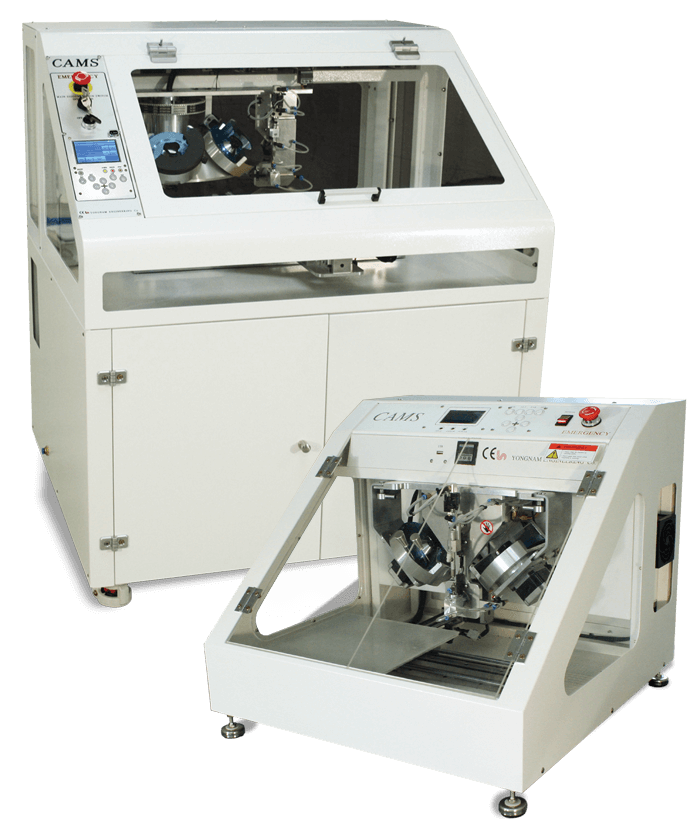
CAMS 1V-6P – So, what’s the machine you see pictured on the left? It’s the CAMS 1V-6P, one of the most capable automatic rhinestone setting machines available today.
At around $37,999, this isn’t a “test the waters” kind of machine. It’s built for decorators who want to produce multicolor rhinestone transfers at a professional level—and at volume.
Think dance costumes, skating apparel, team wear, boutique fashion, couture pieces, souvenir shirts, and uniforms. If rhinestones are part of your business plan, this machine opens the door to all of those markets.
The six-hopper system is what makes it special. Each hopper holds a different size or color of rhinestones, rhinestuds, or nailheads. That means you can load up six at once and let the machine switch automatically as your design calls for it.
Compare that to a single or two-hopper system, and the difference is night and day. A one-color transfer looks nice. A six-color transfer? It has THREE TIMES THE IMPACT. It can create a level of depth, contrast, and visual impact that’s difficult to achieve any other way. And yes—you can charge accordingly.
Performance-wise, the CAMS 1V-6P sets rhinestones at a speed of 170 stones per minute. Now, that number might not sound as flashy as “1,000 spangles per minute,” but remember—these are three-dimensional stones that require precise placement. For rhinestones, that’s fast.
You also get a 15.75″ x 15.75″ working area, large enough for bold statement designs yet practical for everyday jobs. And it’s versatile. This system handles rhinestones, rhinestones, rhinestuds, and nailheads ranging from 2mm all the way up to 5mm. That covers everything from delicate detail work to big, bold statement designs.
To help users get started quickly, the CAMS 1V-6P also includes Hotfix Era software, a starter kit, and essential supplies.
And here’s another big plus: it comes backed by a 3-year parts and labor warranty, so you’ll have support if anything goes wrong.
All in all, the CAMS 1V-6P is the professional’s choice for rhinestone decoration. If your business needs high-volume, multicolor rhinestone production, this machine has the capabilities to help get you there.
SpangleElite – The CAMS 1V-6P is an impressive machine, but not every decorator needs multicolor rhinestone production right out of the gate.
For those looking for a more affordable way to enter the bling business, the SpangleElite offers an attractive alternative.
Moreover, if you’re just toying around with the idea of starting a bling business and just want to test the waters without having to commit too much capital, then you might want to give it some serious thought.
It comes in at around $6,995, as of this writing, and offers a great deal of capability. To start with, it operates at a speed of up to 900 spangles per minute.
To put that number into perspective, an average (and relatively simple) design might use anywhere from 500 to 1,000 spangles.
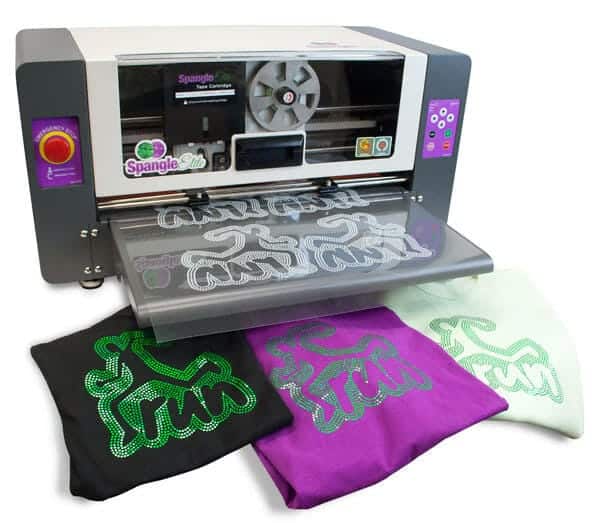
That means you could potentially produce a design like that in about a minute or less. For that alone, this machine is worth its price.
But it’s not the only area where it stands out!
The working area is another highlight. It accommodates designs up to 13″ x 10.25″ in size, giving you plenty of flexibility for a wide range of projects.
The system also comes bundled with a starter kit, supplies, and Hotfix Era software, allowing you to create, edit, and fine-tune your designs.
To help you get up and running quickly, you’ll also receive one day of online one-on-one training, access to self-paced instructional videos, and a 1-year parts and labor warranty.
Overall, the SpangleElite is an excellent all-around package for anyone who wants to enter the bling business.
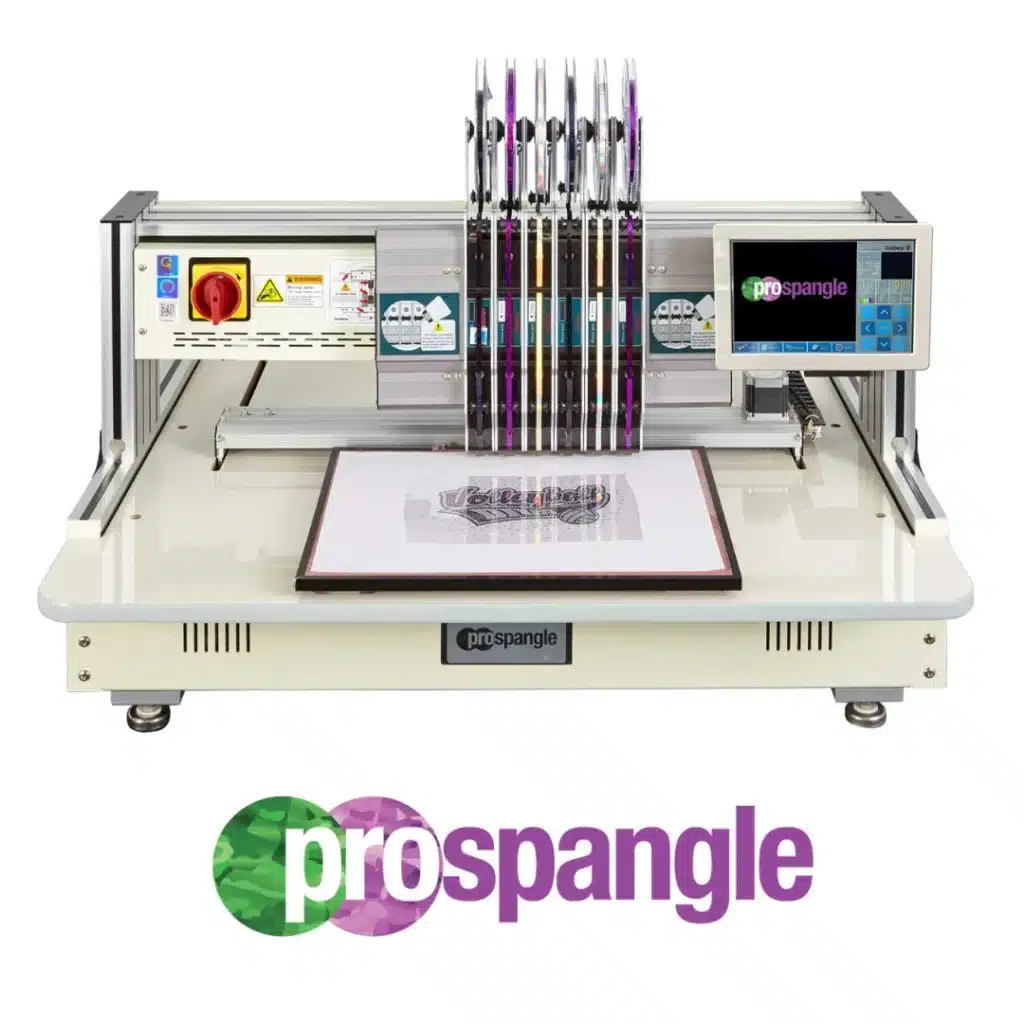
ProSpangle – If the SpangleElite is your introduction to bling production, the ProSpangle is where things start getting serious.
In fact, one could argue that the ProSpangle is the endgame for most bling decorators. Priced at around $19,995 (as of this writing), it is a serious step up from the SpangleElite in both speed and functionality.
And for businesses producing bling transfers on a regular basis, those upgrades can make a real difference.
For starters, it offers a larger 13.5″ x 17.5″ working area, giving you more room to create larger, more intricate designs.
It also delivers output speeds of up to 1,000 spangles per minute. A welcome boost over the SpangleElite’s already impressive production rate.
One of the ProSpangle’s biggest advantages is its six-color wheel system. That means you can combine multiple colors and sizes within a single design without constantly stopping to reload materials.
Right out of the box, the system can run two 2mm, three 3mm, and one 4mm reel of ProSpangle holographic material, and it can handle up to 5mm (that’s the equivalent of an SS20 sized rhinestone!).
Pair that with a choice of 27 holographic finishes and colors across the ProSpangle reel lineup, and you’ve got virtually unlimited creative options. (better yet, spangle transfers are so cost-effective you can afford to have them ALL on hand).
Like its sibling, the ProSpangle comes bundled with Hotfix Era software, a starter kit, and supplies, so you can start producing transfers right away.
To make sure you’re set up for success, the package includes one day of online one-on-one training, plus access to self-paced videos, all backed by U.S.-based support and a two-year parts and labor warranty.
As for which machine to choose, both are excellent spangle systems. The ProSpangle comes out on top, but the SpangleElite’s price tag makes more sense for newcomers given the features it offers. Ultimately, your decision should be based on your specific needs and business goals.
So which machine is right for you?
That really depends on what you’re looking to accomplish. If you want to create spangle designs, then both the SpangleElite and ProSpangle are worth considering. On the other hand, if rhinestones are more your thing, then the CAMS 1V-6P may be the better fit.
Of course, you could always place every rhinestone by hand with a picker tool or manually brush them into the template grooves… but do you want to? Absolutely not.
So take some time to think about your budget, the types of products you’d like to offer, and your long-term goals.
Once you have a clear picture of where you want to go, choosing the right machine becomes a whole lot easier.