
For decades, screen printing has been one of the foundations of the decorated apparel industry. It is still an efficient and profitable production method, especially for larger orders with relatively limited color counts.
But something important is transforming inside print shops across the country.
The artwork is changing.
Customers now have access to generative AI tools capable of creating sophisticated designs almost instantly. Someone who once walked into a shop with a two- or three-color logo may now arrive with artwork containing gradients, shadows, textures, photographic elements, subtle color transitions, and extensive detail.
That rise in AI-driven artwork is changing customer expectations, and it is creating an important opportunity for screen printers willing to adapt their production strategy.
RJ Rickert, VP of Client Success at ColDesi, sees this firsthand. RJ spends considerable time visiting screen printing and customization businesses across the country and speaking directly with owners about their production challenges, customer demands, and plans for growth. A common theme has appeared from those conversations: customers want more complex artwork, smaller quantities, and faster turnaround times.
For screen printers, the answer isn’t abandoning screen printing. It’s having more production options available and knowing when to use each one.
AI-Driven Artwork Is Changing What Walks Through the Door
It wasn’t long ago that many customers approached a screen printer with relatively straightforward artwork.
A local business might need a two-color logo printed on 100 shirts. A school might order several hundred event shirts featuring the same three-color design. A contractor might need a simple company logo printed across multiple garment styles.
Those orders aren’t going away.
But now that same customer can open an AI application and create a highly detailed, full-color illustration before contacting a printer.
AI-generated designs can incorporate gradients, shadows, highlights, textures, photographic details, and numerous color transitions.
The question isn’t simply “Can we screen print this?”
The better question is:
“Does it make financial sense to screen print this particular order?”
If a customer wants 300 pieces, the setup may make perfect sense.
If that customer wants 12 shirts featuring highly detailed, full-color AI-driven artwork, the economics can look very different.
That’s where DTF printing becomes an increasingly valuable production tool.
DTF Changes the Economics of Complex Artwork
Traditional spot-color screen printing generally requires additional separations and screens as the number of ink colors increases.
More colors can mean more films, screens, coating, exposure, washout, registration, flashing, setup, and cleanup.
DTF approaches full-color production differently.
A detailed photographic image can move through the same CMYK-plus-white workflow as a simpler full-color graphic. Adding more visible colors to the artwork doesn’t mean creating more physical screens.
For screen printers, that can make DTF particularly useful for jobs such as short runs, complex full-color artwork, photographic designs, AI-generated graphics, personalization, names and numbers, samples, rush orders, reorders, and replacement pieces.
The important distinction is that DTF doesn’t have to replace screen printing.
It can fill the production gaps where screen printing becomes harder to justify economically.
Consider the 24-Shirt Order
Imagine two orders coming into your shop. The first is 500 shirts with a two-color design. That can be exactly the type of job a screen printing operation wants.
Now imagine the second customer needs only 24 shirts, but the artwork has eight colors, gradients, shadows, and fine details.
Before pricing that job, the shop must consider more than the ink that ultimately lands on the garment. There may be separations, films, screens, registration, press setup, flashing, cleanup, and labor involved before those 24 shirts are finished.
DTF gives the shop another choice. The same design can be processed digitally without creating eight physical screens.
That doesn’t automatically make every high-color-count job a DTF job. Quantity, garment, artwork, desired feel, durability requirements, production schedule, and other factors still matter.
But it does establish a valuable rule for shops to consider:
As quantities decrease and artwork complexity increases, DTF deserves a place in the production conversation.
As AI-driven artwork becomes more common, that conversation is likely to happen much more often.

What Screen Printers Are Saying About DTF
One of the advantages ColDesi has in understanding this market is the amount of time our team spends inside actual production businesses.
RJ’s conversations with hundreds of print shops and decorators aren’t typically centered around replacing screen printing.
They’re about solving problems.
Shop owners talk about orders they have to turn away. They want to offer lower minimums without losing money. They need ways to produce complex artwork efficiently. They want to handle rush orders, create samples for prospective customers, and produce a handful of replacement garments without setting up an entire screen printing job.
Those are exactly the types of production gaps DTF can help fill.
There’s also a change happening on the customer side.
A customer can now look at an elaborate image on a phone and simply ask:
“Can you put this on a shirt?”
The business that can confidently say yes and then route that order to the production method that makes financial sense has an advantage.
And that small order shouldn’t necessarily be viewed as just a small order.
Today’s 12-piece order could turn into a 500-piece reorder or a 5,000-piece opportunity.
Sometimes the ability to profitably say yes to the first order is what gets you the larger one.

Outsourcing DTF Can Be the Right First Step
For many screen printers, outsourcing DTF transfers is an excellent way to enter the market.
It allows the shop to begin accepting full-color and short-run work without immediately investing in equipment. It also gives the business time to establish demand.
But eventually, the numbers may start telling a different story.
When RJ visits businesses already buying transfers, one of the questions worth asking is:
How much manufacturing margin are you paying to another company every month?
ColDesi has published production examples using material costs ranging from approximately $0.40 to $0.75 per transfer under different sizes and operating assumptions. These are examples rather than universal costs. Actual production costs depend on transfer size, ink coverage, white ink usage, waste, labor, maintenance, electricity, equipment, financing, and other factors.
But the comparison is still worth making.
In some businesses RJ has visited, outsourced transfer pricing has been 10 to 15 times the potential internal material cost, particularly with individually priced or lower-volume transfers.

That doesn’t mean producing transfers in-house costs 10 to 15 times less overall. Labor, maintenance, waste, equipment, financing, and overhead projections still have to be considered.
It means a shop buying a meaningful volume of transfers should know its numbers.
Compare the landed cost of the transfers you’re buying against the fully loaded cost of producing those same usable transfers internally.
Once volume reaches a certain point, outsourcing may no longer simply be convenient. It may represent manufacturing margin that could potentially remain inside your business.
ColDesi Transfer Packages make it easier to start offering custom apparel without investing in a DTF printer right away. Each package combines a professional heat press with blank apparel, DTF transfer credits, supplies, exclusive discounts, and rewards that can be applied toward a future DTF printer. It’s a practical way to start selling, build your customer base, and grow into in-house DTF production when your business is ready. Explore ColDesi DTF Transfer Packages
In-House DTF Gives You Something Else: Control
Cost per transfer isn’t the only reason businesses consider bringing DTF production in-house.
There’s also control.
A customer realizes they forgot six shirts.
You can print six transfers.
Someone calls the day after an order is completed because they need another 3XL.
You can print one.
A salesperson has an opportunity with a large customer but needs a sample first.
You can produce the sample without creating screens and setting up the press.
Rush work, replacement pieces, revised artwork, last-minute additions, and samples all become easier to manage when the equipment, materials, and production capacity are inside your facility.
For a growing customization business, that flexibility can be worth much more than the difference in consumable costs.


Screen Printing and DTF Are Stronger Together
Treating screen printing and DTF as competing technologies misses the larger opportunity.
They’re production tools.
And good businesses use the right tool for the right job.
A high-quantity order with a low color count may be an excellent screen printing job. A low-quantity order with complex AI-driven artwork might make more sense with DTF. Large-volume simulated-process work could remain on the screen printing press, while a six-piece replacement order goes to DTF.
The goal isn’t to force every order through the newest technology.
The goal is to create a production environment where you can evaluate an order and ask:
What’s the most profitable way for us to produce this?
That’s production strategy.
Why ColDesi Continues to Invest in DTF
ColDesi has been part of the DTF market from its earliest commercial growth in the United States, and that experience has shaped how we approach the technology today.
We don’t believe every business needs the same printer.
A startup producing its first transfers has very different requirements from an established screen printer bringing outsourced production in-house. And both have different requirements from a high-production operation processing hundreds of transfers per hour.
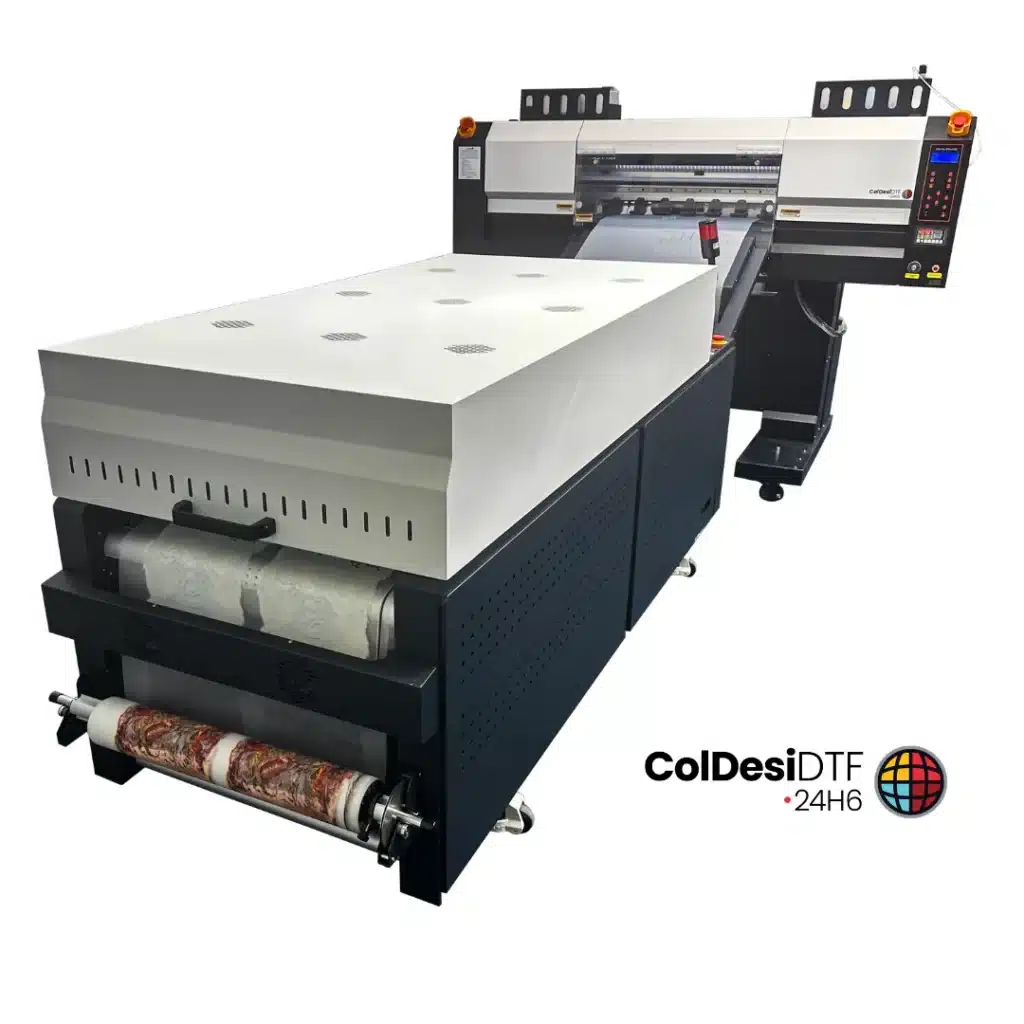
That’s why ColDesi has built one of the industry’s largest selections of commercial DTF printing solutions, spanning compact commercial systems through high-production printer and dryer configurations.
The goal isn’t simply to sell a printer. It’s to help businesses build a production workflow right for their current volume while giving them a path to growth.
If you’re beginning that evaluation, our guide to “Buying a DTF Printer – What Businesses Should Know Before Investing” looks at many of the considerations that should be part of the decision.
The Printer Is Only One Part of High-Production DTF
As DTF businesses grow, the bottleneck often moves.
First, the challenge may be printing enough transfers.
Then it becomes handling the printed film.
Then cutting.
Then pressing.
Then labor.
That’s why some of ColDesi’s most advanced DTF technology focuses on the entire production workflow, not simply print speed.
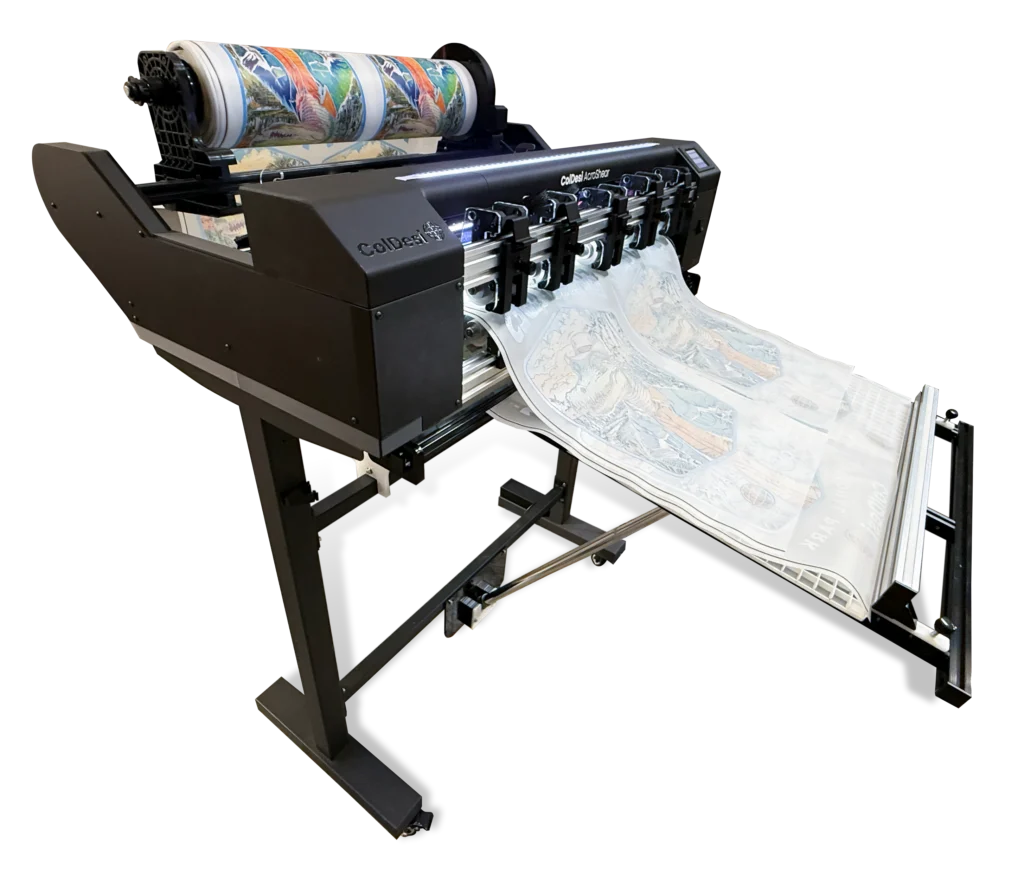
The AcroShear DTF Transfer Cutting System, for example, is designed to address the cutting and slitting stage of DTF production, reducing the manual work required after transfers leave the printer and dryer.
At the application stage, the ColDesi AP360 6-Station Automatic DTF Heat Press provides another path for businesses looking to increase throughput while reducing the amount of manual pressing needed in higher-volume production.
DTF Expertise Has to Go Beyond Equipment Specifications
DTF technology continues to advance quickly.
Printers are becoming faster. Workflows are becoming more sophisticated. Cutting and pressing equipment are reducing manual production steps. And AI-driven artwork is changing the type of designs customers expect businesses to reproduce.
That’s why choosing a DTF partner should involve more than comparing printer specifications.
The conversations RJ has with businesses across the country often begin with questions rather than equipment recommendations.
- What are you outsourcing every month?
- What types of orders are you turning away?
- Where is production slowing down?
- How often do you get short-run, high-color requests?
- How much are you spending on outsourced transfers?
- What would faster turnaround allow your sales team to offer?
- What happens if your volume doubles?
Those questions matter because the best DTF solution isn’t simply the machine with the biggest specification.
It’s the solution that helps a business become more productive, keep more profitable work, serve its customers better, and create room for growth.
That’s where ColDesi’s experience matters.
Our team works with businesses at virtually every stage of DTF production, from companies evaluating their first commercial printer to high-volume operations looking for some of the most advanced DTF production technology available today.

AI Is Changing Artwork. Screen Printers Have an Opportunity.
Screen printing isn’t going away because customers have access to artificial intelligence.
It is still one of the most powerful production methods in the customization industry.
But AI-driven artwork is changing what customers expect from their decorators.
More detail. More colors. More variations. Smaller initial orders. Faster turnaround.
Screen printers who can combine the strengths of their existing production capabilities with DTF are positioned to respond to those changes instead of being limited by them.
Keep screen printing the jobs it does exceptionally well.
Use DTF where digital production improves the economics.
Bring transfer production in-house when your numbers support it. And as production grows, build a workflow capable of growing with it. Because ultimately, the opportunity isn’t simply about adopting another printing technology.
It’s about giving your business more opportunities to say yes and still make money when you do.

Ready to Explore DTF for Your Business?
ColDesi offers DTF solutions for businesses ranging from first-time commercial DTF users to some of the industry’s highest-production environments.
Explore ColDesi’s DTF printing solutions or fill out the form below to speak with a ColDesi specialist about your current production, outsourced transfer volume, and plans for growth.

