
Buying a DTF printer can give an apparel customization business more control over production, open the door to new types of orders, and create opportunities to increase capacity. But choosing the right DTF printer isn’t simply a matter of finding the fastest machine or the lowest price.
The right DTF solution depends on what your business produces, how many transfers you need, the size of the jobs you typically accept, available production space, labor, and where you expect your business to go next.
At ColDesi, we work with businesses at very different stages of DTF production, from companies bringing commercial DTF production in-house for the first time to established decorators producing hundreds of transfers per hour.
If you’re buying a DTF printer, here are some of the most important questions to answer before making your investment.
What Should You Look for When Buying a DTF Printer?
When buying a DTF printer for a business, start with production requirements rather than printer specifications.
Ask:
- How many transfers do we currently need each day?
- What size transfers do we typically produce?
- Are we currently outsourcing transfers?
- How quickly do orders need to move through production?
- How much production space is available?
- How many employees will operate the equipment?
- Do we expect order volume to increase?
- Will we eventually need automation?
These questions can help narrow your choices considerably.
A startup customization business and a high-volume screen-printing operation may both benefit from DTF, but they probably shouldn’t buy the same equipment.
That’s one reason ColDesi offers multiple commercial DTF solutions instead of trying to make one printer fit every business.

What Size DTF Printer Should I Buy?
The right DTF printer size depends on more than the physical dimensions of the machine.
Print width, production speed, and expected order volume should all factor into your decision.
A smaller commercial system can make sense for a business entering DTF or working with lower daily volumes. As orders increase, wider and faster systems can allow a business to place more transfers across the film and process significantly more work.
ColDesi’s current DTF lineup provides multiple production levels.
ColDesi 12H2
The ColDesi 12H2 provides a compact entry point into commercial DTF production.
With approximately a 12-inch print width and production of around 50 standard-size transfers per hour, it can be a practical option for businesses that want professional DTF capabilities without immediately moving into a larger production system.
ColDesi 19H2
Businesses that need additional print width and production capacity can move up to the ColDesi 19H2.
Its wider format gives growing customization businesses more room for production while filling the gap between compact commercial equipment and larger DTF systems.
ColDesi 24H2
The ColDesi 24H2 moves into a larger commercial production category.
It is designed for larger businesses that need steady daily DTF output while still considering production-floor space. Pairing the printer with a compact dryer such as the 24POWC can create a capable commercial workflow without requiring the footprint associated with some larger systems.
ColDesi 30H2
For businesses where print width is a priority, the ColDesi 30H2 provides additional room across the film.
That extra width can help businesses optimize gang sheets and place more transfers across each section of film, an increasingly important consideration as daily transfer volume grows.
Higher-Production DTF Systems
ColDesi also offers DTF equipment designed for businesses moving into significantly higher production volumes.
For these shops, the buying decision starts changing. Instead of asking only about print width or entry price, businesses should begin looking at total hourly production, labor requirements, and workflow automation.
ColDesi 24H4
The ColDesi 24H4 is built for businesses that need to increase DTF production without moving immediately into the highest-volume systems.
Its four-head configuration supports faster production and makes it a strong fit for established apparel decorators that are regularly handling larger order volumes.
For a growing screen-printing or customization business, the 24H4 can provide the added speed needed to move more full-color and short-run work through production each day.
ColDesi 24H5
The ColDesi 24H5 is designed for businesses that have moved beyond basic commercial DTF production and need a system built around higher daily output.
It can be a strong fit for established apparel decorators, transfer producers, and production shops where DTF has become a major part of the workflow.
At this production level, businesses should also start looking beyond printer speed and consider how cutting, curing, and heat application will keep up with the increased output.
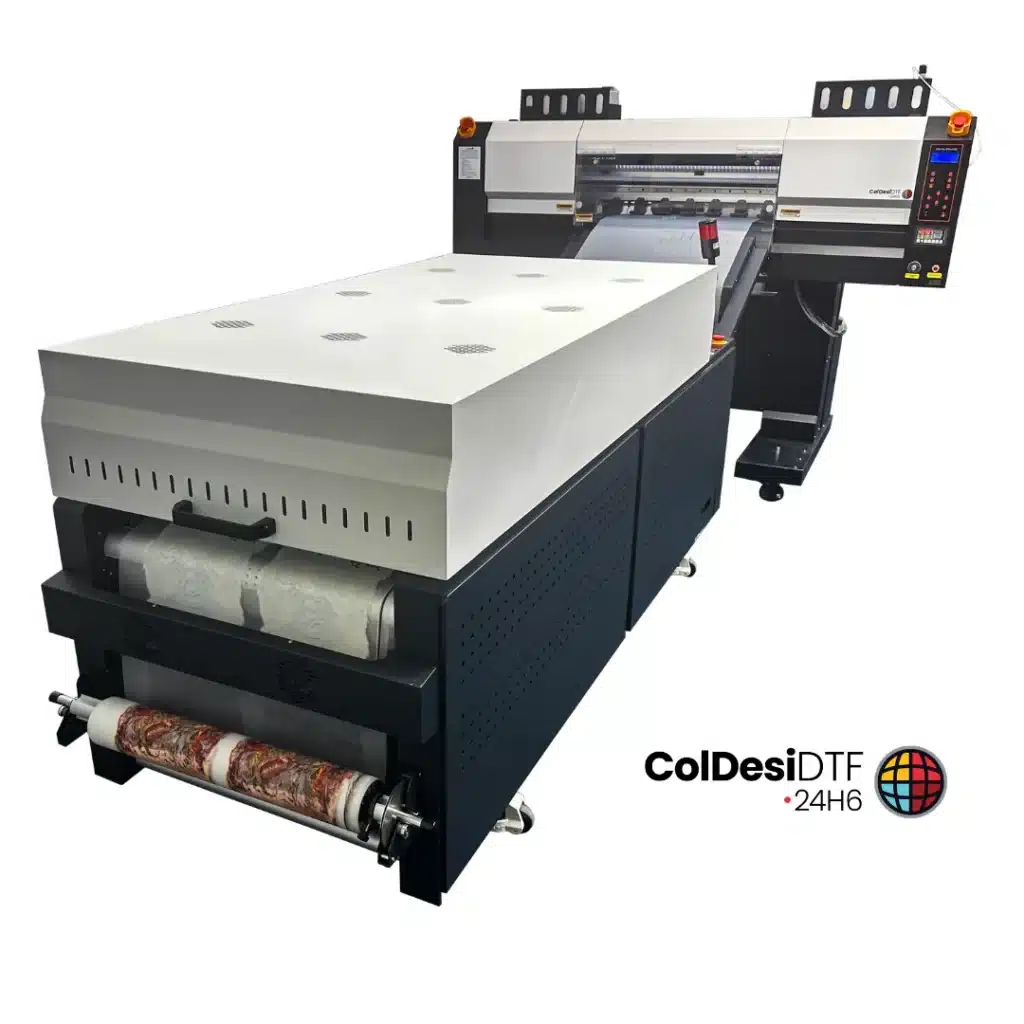
ColDesi 24H6
The ColDesi 24H6 is designed for demanding production environments that need greater speed, flexibility, and color configuration options.
With a six-head platform and support for both CMYK+W and CMYKOG+W configurations, it gives businesses the ability to choose between maximum production speed and an expanded color gamut.
It is a strong option for high-volume shops that need DTF equipment capable of supporting larger workloads while leaving room for continued growth.
ColDesi 24H6E
The ColDesi 24H6E moves further into high-production DTF by combining high output with additional workflow automation.
It is designed for larger production environments where efficiency, consistency, and reduced operator involvement become increasingly important.
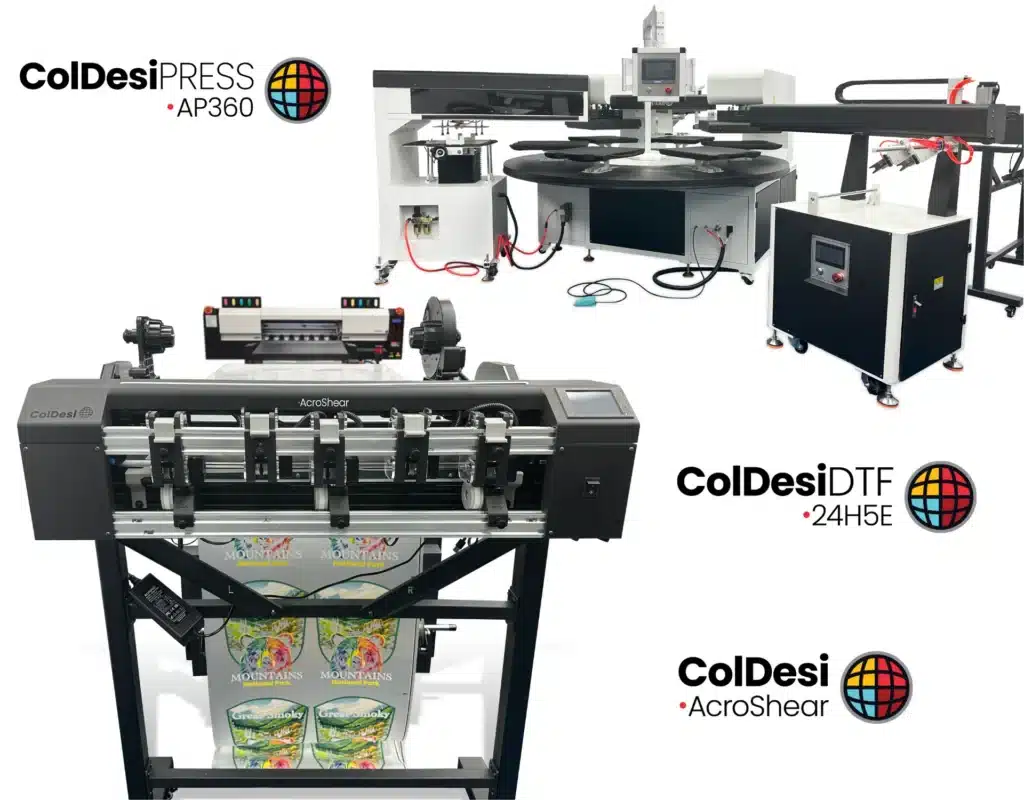
For businesses producing DTF at scale, the 24H6E can be part of a more automated production workflow that includes cutting solutions such as AcroShear and automated heat application with the AP360.
How Many DTF Transfers Do I Need to Produce?
One of the best ways to determine which DTF printer to buy is to calculate how many transfers your business needs to produce.
For example, ColDesi’s DTF solutions range from compact systems capable of approximately 50 standard-size transfers per hour to production configurations capable of hundreds of transfers per hour.
But maximum printer output shouldn’t be your only consideration.
Ask yourself:
What happens to those transfers after they’re printed?
A printer capable of producing hundreds of transfers per hour doesn’t automatically mean your business can produce hundreds of finished shirts per hour.
Printing is only one part of the DTF workflow.
What Equipment Do I Need Along with a DTF Printer?
A commercial DTF operation typically requires more than the printer itself.
The complete production process can include:
DTF Printer → Powder/Shaker/Dryer → Cutting → Heat Application
You will also need DTF film, inks, powder and other consumables to keep production running.
This is an important distinction when comparing DTF equipment.
Instead of asking only:
“How much does the printer cost?”
Consider asking:
“What will I need to create a complete production workflow?”
Understanding the entire system before purchasing can help prevent a business from investing in a printer only to discover that another part of production can’t keep up.
How Fast Should My DTF Printer Be?
Your DTF printer should be fast enough to handle current demand while providing reasonable room for growth.
Buying considerably more production capacity than you need can mean investing in equipment your business isn’t ready to utilize. Buying too little capacity can create another problem: you may quickly outgrow the equipment.
A useful approach is to consider three numbers:
Current production → Expected production → Future capacity
If you’re currently outsourcing 50 transfers per day but expect volume to increase substantially, your requirements will be different from those of a contract decorator already processing hundreds or thousands of transfers.
This is where working with a company that offers multiple DTF production levels can be valuable.
The goal shouldn’t automatically be to purchase the largest printer available.
The goal should be to find the right production solution for your business.
How Much Does Labor Matter When Buying a DTF Printer?
Labor becomes increasingly important as DTF production increases.
At lower volumes, manually handling, cutting, and pressing transfers may be manageable.
At higher volumes, those same tasks can become production bottlenecks.
Imagine increasing printer output dramatically but still having employees manually cut hundreds of individual transfers.
The printer got faster.
Your overall production process may not have.
That’s why businesses evaluating higher-production DTF equipment should calculate more than printer speed. Consider how many employees are required to move an order from artwork to a finished garment.
Should I Consider DTF Automation?
Businesses producing larger volumes should consider how automation could affect labor and overall throughput.
ColDesi has expanded its DTF solutions beyond printers and dryers to address other stages of production.
Automating DTF Cutting with AcroShear
AcroShear is designed to automate cutting and slitting after DTF transfers have been printed and cured.
Instead of requiring employees to manually trim individual transfers, AcroShear can help move printed output through the cutting stage more efficiently.
It can operate inline from the dryer or offline with preprinted rolls, giving businesses flexibility in how automation fits into their existing workflow.
Automating DTF Heat Application with the AP360
After printing, curing, and cutting comes another labor-intensive step: applying transfers to garments.
The ColDesi AP360 Automatic DTF Heat Press uses a six-station carousel designed for continuous production and can support production of 350+ shirts per hour, depending on the application and production environment.
For high-volume operations, that changes the conversation from simply buying a faster DTF printer to creating a more efficient production line. A more automated workflow can look like:
DTF Printer → Powder/Shaker/Dryer → AcroShear → AP360
At that point, you’re evaluating the productivity of the entire operation instead of one machine.
Is Buying a DTF Printer Better Than Outsourcing Transfers?
Buying a DTF printer can make sense when outsourcing begins limiting your margins, turnaround time, production control, or ability to respond quickly to customers. Bringing production in-house can give businesses greater control over:
- Turnaround times
- Production scheduling
- Print quality
- Reprints
- Small orders
- Rush jobs
- Inventory
- Production capacity
But outsourcing still has a place. Businesses with occasional DTF orders may find purchasing transfers more practical than immediately investing in equipment.
The important question is how frequently your business uses DTF and what outsourcing is currently costing you in money, time, and opportunity. As volume grows, those numbers can help determine when bringing production in-house deserves serious consideration.
Should a Screen-Printing Business Buy a DTF Printer?
DTF can complement screen printing rather than replace it.
Screen printing can remain extremely efficient for the right high-volume jobs. DTF gives screen printers another way to handle orders that may not fit efficiently into their traditional production process.
For example, DTF can be useful for:
- Shorter production runs
- Detailed full-color artwork
- Personalized apparel
- Small reorders
- Rush orders
- Jobs that require more screen-printing setup
Instead of forcing every order through one production method, a screen-printing business can route jobs according to the production technology that makes the most sense.
For an established screen printer, the question may therefore be less about DTF versus screen printing and more about where DTF fits into the existing production mix.

What Are the Ongoing Costs of Owning a DTF Printer?
Purchase price is only one part of a DTF investment.
Businesses should also account for ongoing costs such as:
- DTF ink
- Film
- Powder
- Cleaning and maintenance supplies
- Replacement consumable components
- Electricity
- Labor
- Garments
- Production waste
Then compare those expenses against production capacity and the amount the business can charge for finished products.
A lower-priced printer isn’t necessarily the lowest-cost solution if it requires significantly more labor or can’t keep up with demand.
The better question is:
What will it cost my business to produce each finished product?
How Much Maintenance Does a DTF Printer Require?
DTF printers are commercial production equipment and require regular maintenance.
Maintenance can include cleaning, monitoring ink systems, maintaining print heads, and following recommended startup, shutdown, and environmental procedures.
Businesses considering DTF should think realistically about who will be responsible for those procedures.
That makes training and technical support important parts of the buying decision, not extras to consider after the equipment arrives.

Why Do Training and Support Matter When Buying a DTF Printer?
The relationship with your equipment provider doesn’t end when the machine arrives.
When DTF becomes part of daily production, downtime can affect orders, employees, deadlines, and customers.
Before buying, ask:
- What training is included?
- Who helps us get started?
- Where do we buy our consumables?
- Who do we contact when we have a technical question?
- Can the equipment provider help us as production grows?
ColDesi customers have access to onboarding, training, and technical support along with DTF inks, films, powders, and other consumables.
That allows businesses to look beyond the individual machine and think about the infrastructure supporting it.
Is Buying a DTF Printer Worth It?
Buying a DTF printer can be worthwhile when your order volume, outsourcing costs, production requirements, and growth plans justify bringing or expanding DTF production in-house.
The answer will be different for every business.
Instead of making the decision based on the purchase price alone, evaluate:
Production capacity + labor + consumables + turnaround + margins + growth potential
Those factors provide a much clearer picture of the potential value of a DTF investment.
Questions to Ask Before Buying a DTF Printer
Before making a final decision, use this checklist:
- How many transfers do we need to produce each day?
- What transfer sizes do we produce most frequently?
- How much print width do we need?
- What production speed makes sense for our current volume?
- How quickly could we outgrow that capacity?
- How much floor space is available?
- What dryer or curing equipment is required?
- How many employees will operate the system?
- How will transfers be cut?
- How will finished transfers be applied?
- What consumables will we need?
- What regular maintenance is required?
- What training is included?
- What technical support is available?
- Can the workflow be automated as volume increases?
- What is our estimated cost per finished product?
- What would bringing production in-house save compared with outsourcing?
- Can this system grow with our business?
Find the Right DTF Solution for Your Business
Buying a DTF printer shouldn’t start with choosing a machine.
It should start with understanding your business.
ColDesi offers commercial DTF solutions across multiple production levels, from compact systems for businesses entering commercial DTF to high-production printers and automated cutting and heat application solutions.
That means a conversation with ColDesi can begin with what you’re trying to produce rather than simply which printer you’re trying to buy.
If you’re considering buying a DTF printer, talk with a ColDesi product expert about your current order volume, production goals, available space, and plans for growth.
Explore ColDesi DTF Solutions or schedule a demonstration to find the DTF production system that fits your business. Fill out the form below to get started.

