
Have you reached the point where your embroidery machine is holding your entire business back?
You know…
The orders are coming in. Customers are ready to buy. But keeping up with demand is becoming harder every month.
At first, that doesn’t sound like a bad problem to have.
At least not until deadlines start piling up and customers are breathing down your neck for updates.
That’s usually when shop owners realize the problem isn’t the team, the workflow, or even getting more business anymore.
It’s the equipment.
And whether it can handle the volume their business now requires.
And in many cases, the real solution is simply upgrading to equipment that can keep up with the growth of the business.
Embroidery machines from brands like HappyJapan are a good example of that.
They’re built for shops that, just like yours, are no longer running a few small jobs here and there, but dealing with larger workloads, tighter turnaround times, and nonstop daily production.
And that’s exactly what we’re going to get into in this guide.
We’re going to break down what separates commercial embroidery equipment from standard machines, what actually matters when choosing one, and how to tell when it’s time to upgrade.
If that’s where you are right now, keep reading.
What Makes a Commercial Embroidery Machine Different?
Before anything else, let’s get on the same page.
If we don’t understand what separates a commercial machine from a hobby or enthusiast model, it’s easy to focus on the wrong things.
Features and specs only matter once you have that baseline.
So we’ll start with the fundamentals and build from there.
The question for this section is simple: what actually makes an embroidery machine “commercial”?
It isn’t just one single spec, feature or capability you can point to and say, that’s the thing. It’s more about how a combination of factors work together.
But underneath all of that, there’s really one defining trait:
How well it performs under real production conditions.
Not on the occasional small order but consistently, hour after hour, day after day.
And that performance comes from a combination of key factors:
The size of the embroidery field
This is essentially the maximum area your embroidery machine can safely sew within a given hoop. A larger embroidery field gives you the flexibility to handle bigger designs without having to re-hoop the garment. And if you’ve ever had to re-hoop mid-design, you already know how quickly things can go sideways.
The number of needles you’re working with
The number of needles affects how the machine handles designs with multiple colors. With more needles, each color is already loaded, so the machine can switch between them automatically as it runs. On machines with fewer needles, those changes take more time and often require manual input, which slows things down over longer production runs. It doesn’t feel like much on one piece. But across dozens of items, it absolutely is.
Your stitch count per minute
Stitch speed, usually measured in stitches per minute (SPM), directly impacts how fast the machine can complete a design. Commercial machines are built to run at higher speeds while still maintaining consistent stitch quality.
Put all of that together, and you start to see the difference.
All of these factors work together to determine how efficiently a machine can handle real production demands when you’ve got real work coming in.
That’s essentially what separates a commercial machine from something built for occasional use.
And in the end, that’s the only thing that matters.
Because when you’ve got orders coming in the last thing you need is something that slows you down or needs constant attention.
So that’s the line between hobby and commercial.
But do you actually need to upgrade to a commercial embroidery machine?
Let’s figure that out next.

Stop struggling with difficult garments! Learn how these supplies can make your embroidery faster, easier, and more profitable. Read THIS.
Do You Actually Need a Commercial Embroidery Machine?
The previous section should’ve given you a clearer perspective on what makes a commercial embroidery machine… well, commercial.
So now the question is:
Do you actually need one?
Because here’s the thing; just because a commercial machine can do more doesn’t automatically mean you need one.
If you’re doing occasional projects, small batches, or mostly personal work, a hobby machine is usually enough. It might be slower, and you’ll need to step in more often, but that’s fine if you’re not trying to push volume.
However…
Let’s be honest, that’s probably not you.
You’re not here because your current setup is handling everything without a problem.
You’re here because it isn’t anymore.
That’s usually what makes people start looking in the direction of a new commercial embroidery machine.
If you recognize yourself in these, it’s a strong sign your current setup is holding you back:
1. You’re constantly babysitting your machine
It feels like you can’t step away for even a minute without worrying something’s going to go wrong. Instead of trusting the machine to do its job, you’re stuck keeping an eye on it the whole time. This limits how much you can actually get done in a day.
2. Orders are starting to stack up
You’re noticing more requests coming in than you can comfortably handle, and it’s starting to create pressure. Maybe you’re pushing deadlines out further than you’d like, or turning down jobs you would’ve taken before. Either way, it’s a sign your current setup isn’t keeping up with the pace anymore.
3. Multi-color designs feel like a chore
Every color change turns into a stop-and-go process that breaks your rhythm. What should be a smooth run ends up feeling slow and fiddly, especially on more detailed designs. Over time, it adds up and makes you think twice before even accepting more complex work.
4. You’re spending more time managing the process than growing the business
Instead of focusing on getting new customers or improving your offerings, most of your energy goes into just keeping production moving. You’re troubleshooting, adjusting, and restarting. Basically putting out fires all day. That’s usually a sign the equipment is running you, not the other way around.
If none of these sound familiar?
You probably don’t need a commercial machine, at least not yet.
But if you found yourself nodding at even two or three of these…
That’s usually when something needs to change.
And that’s exactly where a commercial embroidery machine starts to make sense.
Which brings us to the machines that are actually built for this kind of workload.
Introducing HappyJapan Single-Head & Multi-Head Embroidery Machines
Now feels like as good a time as any to introduce you to HappyJapan’s single-head and multi-head commercial embroidery machines.
These aren’t your weekend hobby machines. Not even close. They’re built specifically for the kind of workload we’ve been talking about.
At this point, you’re not thinking in one-off pieces or small projects anymore.
You’re thinking in runs, volume, and output per day. How much you can produce before the day’s over.
HappyJapan offers several options, and the “right” one ultimately depends on how you work and the volume you’re dealing with.
Not every shop needs the same machine.
What makes sense for you comes down to the type of work you run, how often you run it, and how much you’re trying to push through in a day.
We’ve linked a few options below so you can look through them and see what actually fits your setup.
Each one’s different in terms of specs and features, so it just comes down to what makes the most sense for how you run your shop.
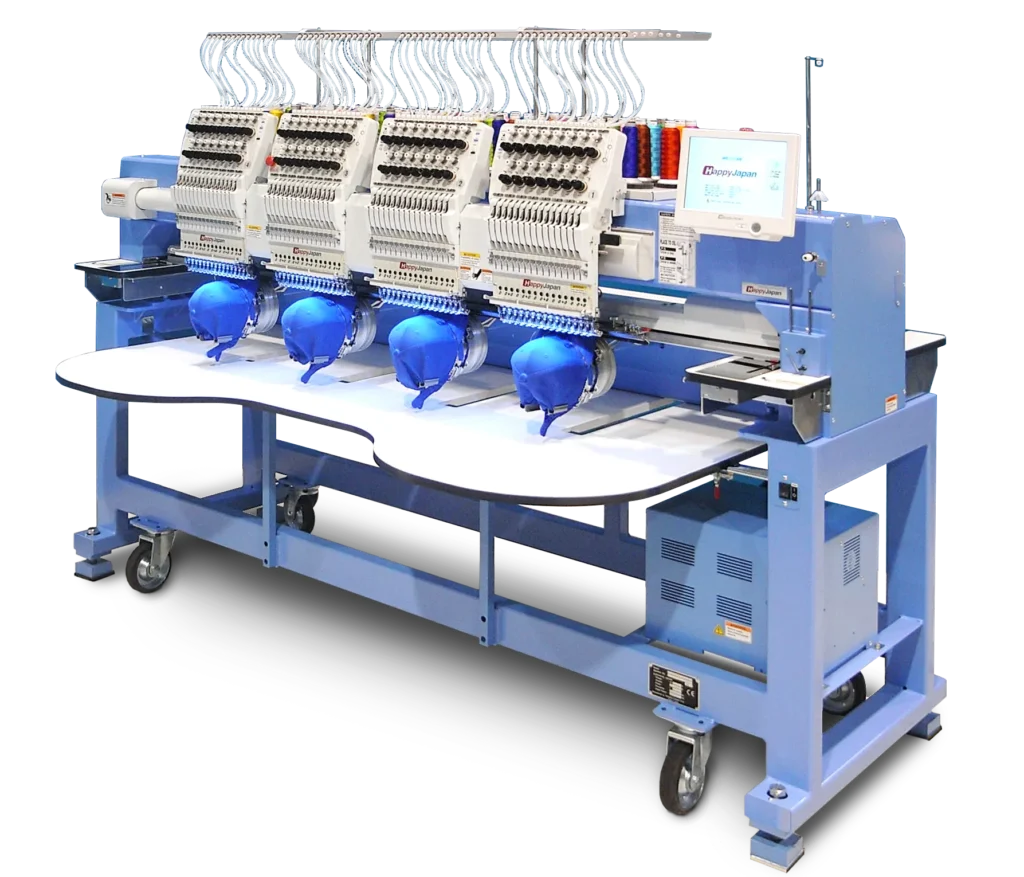
HCR3-1504 – The HCR3-1504 is a compact 4-head embroidery machine designed for efficient production. Equipped with HCR3 technology and a high-speed servo drive, it runs quietly while delivering consistent stitch quality.
Built for reliability, it helps businesses increase production without sacrificing quality.
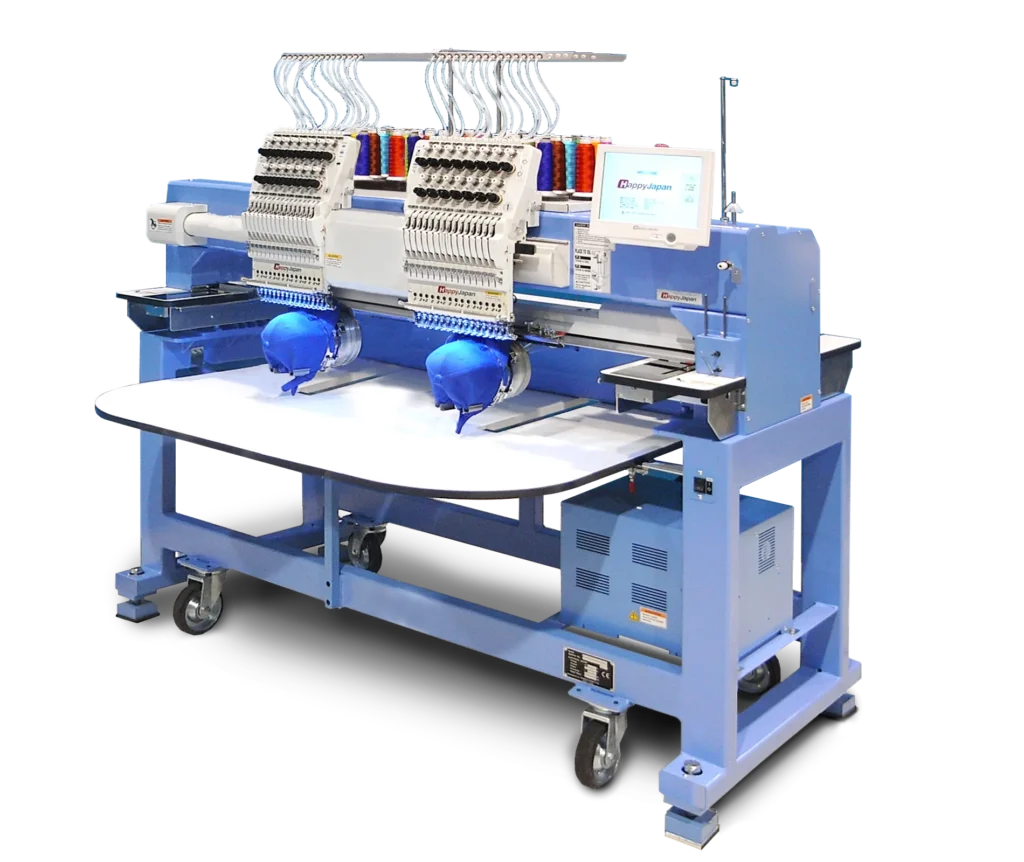
HCR3-1502 – The HCR3-1502 offers the flexibility of a single-head machine with the output of a multi-head system. This 2-head model runs at high speed with an extended sewing range.
Its servo drive ensures smooth, quiet operation, while its sturdy build maintains consistent stitch quality across different materials.
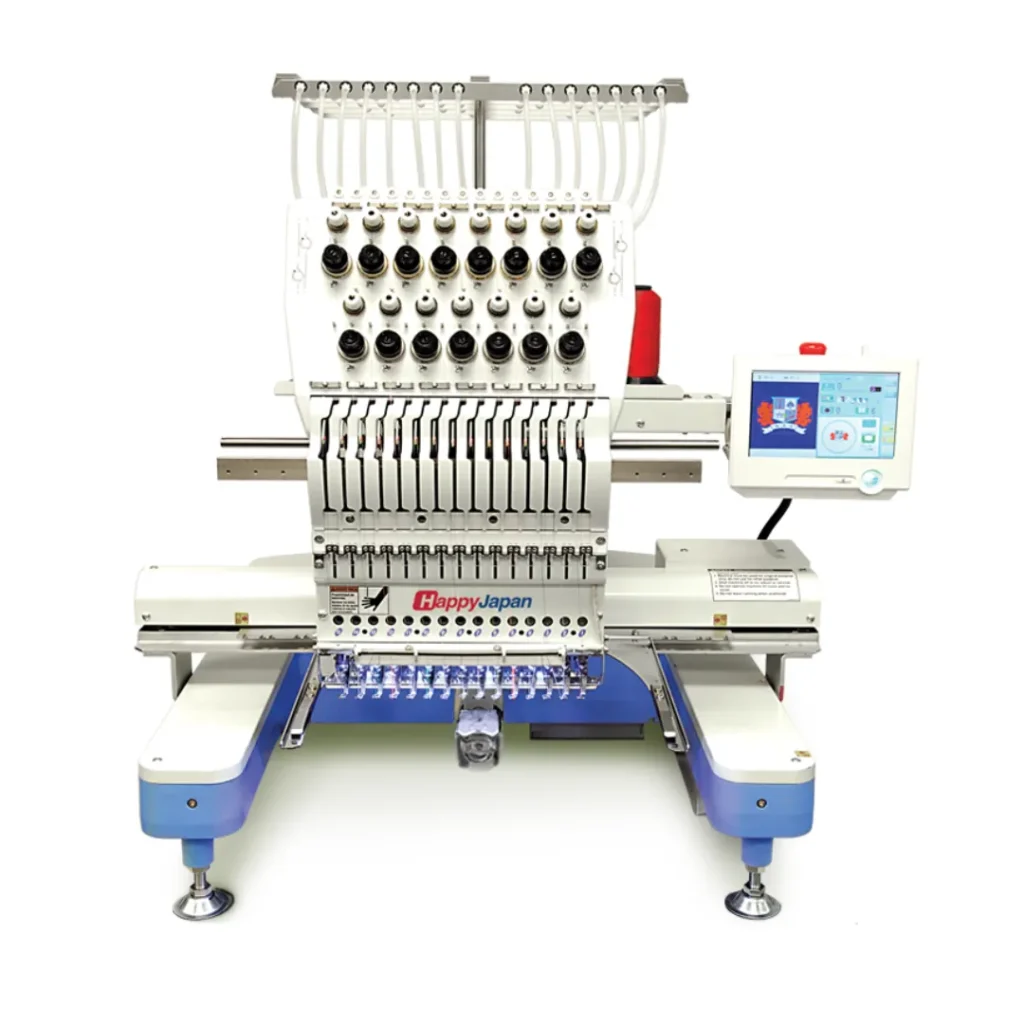
HCD3e-1501 – The HCD3e-1501 is HappyJapan’s best-selling full-size commercial single-head embroidery machine. Designed for versatility, it features a large sewing field (20.5″ W x 15.75″ H), high-speed operation (1,200 stitches per minute), and a heavy-duty drive system.
With a slim sewing arm, it efficiently handles both delicate and heavy materials while maintaining continuous production throughout the year.
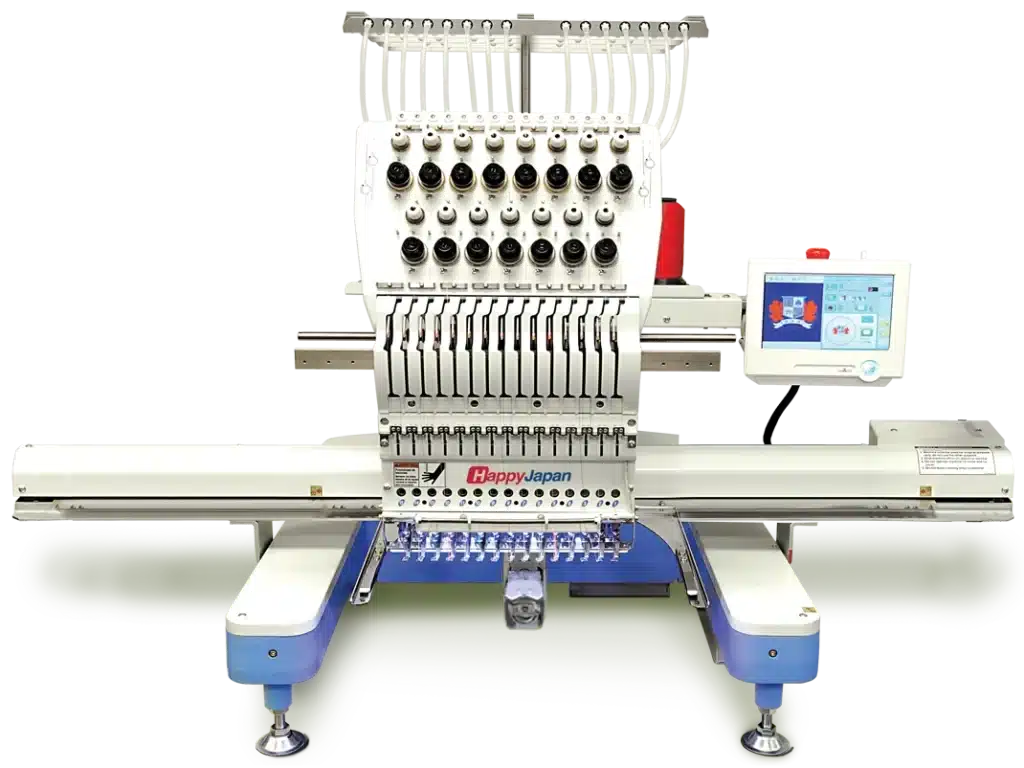
HCD3e-X1501 – The HCD3e-X1501 is a high-performance, single-head embroidery machine with an extra-wide sewing field, making it ideal for large-scale embroidery projects and high-volume patch orders.
Equipped with a color LCD touchscreen, onboard lettering, and advanced editing features, this machine offers precision, efficiency, and versatility for professional embroidery applications.
So, what do you think? Did any of those models catch your eye?
Whichever direction you go, you really can’t go wrong with any of these options. And if you’re coming from something smaller, you’ll wonder how you ever kept up without it.
What Changes When You Upgrade
So let’s say you make the upgrade. What actually changes after that?
You can probably piece some of it together already from what we’ve talked about.
But it goes further than that.
Because the biggest difference isn’t just speed, or the number of heads, or how many colors the commercial embroidery machine can handle.
It’s how your entire shop now runs once the machine is in place.
Here’s what that starts to look like in practice:
1. You’re not constantly waiting on the machine anymore
Before, everything kind of revolved around how fast (or slow) your machine could go. Or how many colors it could handle, or whether you had to split a design and rehoop it. Now it just runs.
You load the job, hit start, and move on to something else that actually needs your attention.
You’re answering messages, lining up the next order, maybe even maybe even stepping away for a minute.
The machine isn’t something you’re working around all day. It’s something that’s finally working with you.
2. The type of orders you take on changes
You also start taking on jobs you used to pass on.
You’re not as picky for the wrong reasons anymore. Before, you might pass on something just because it would take too long or tie up your machine. Now that pressure isn’t there in the same way.
You don’t have to think as hard about whether your machine can handle the job, you already know it can.
3. You start attracting better clients
The kind of work you take on starts to change, and so do the people coming to you.
You’re not just getting one-off, low-margin jobs anymore. You start hearing from people who already know what they want, are ready to move forward, and have clearer expectations.
It’s less back-and-forth, less hand-holding, and more straightforward work that’s actually worth your time.
4. Order sizes get bigger
You start seeing more jobs with actual volume behind them. Not just a few pieces here and there, but runs that make sense for the time it takes to set up.
Before, you might not have taken those jobs at all, or they just weren’t realistic to run. Now you can actually take them on and run them efficiently.
5. Your cashflow becomes more predictable
Because of all this, work starts to come in at a more steady pace, and the numbers make more sense week to week. You’re not as up and down as before. You have a better idea of what’s coming in and what to expect. You can look ahead a bit and know you’ll be busy.
That’s just a few ways things change once a commercial embroidery machine is part of your setup. There’s more, obviously. But this list is a solid start.
So it’s worth asking yourself: what would actually change in your shop if things just ran smoother like this?
Would you take on jobs you usually pass on?
Would you still be planning everything around your machine?
Would you still be avoiding certain jobs because of color changes, design complexity?
Just something to think about as you go about your day…
If You’re Going to Upgrade, Do It Now
You’ve already looked at the machines. You already know what they can do.
So this isn’t about figuring it out anymore. You’re past that point.
What’s left is the decision. So make the move.
Get the machine you’ve been eyeing and put it to work in your shop. Start getting real use out of it instead of just thinking about it.
If you want help before you buy, whether that’s choosing the right model, thinking through your setup, or just getting a second opinion, reach out.
You can email, call, or jump on live chat, whatever works for you. We’ll get back to you and go through it with you.
See you on the other side!