
If you’ve spent the last week trying to figure out what equipment you need to start an embroidery business…
We need to talk.
Because we have a feeling you’re more confused now than when you first started looking.
Please tell us we’re imagining things: you read one article that said you need to buy everything.
Then you found another one that swore you can start with next to nothing.
Somewhere around article number seven, you forgot what you came looking for in the first place.
Sound familiar?
If it does, you’re exactly who we wrote this for.
Because by the time you’re finished reading, you’ll know exactly what equipment you NEED…
And, perhaps more importantly, what you DON’T NEED.
But don’t worry… we’re not here to spoil all the fun! We like shiny new equipment just as much as you do!
In fact, there are a handful of handy accessories, tools, and add-ons we use all the time around here (and, frankly, we’d have a hard time imagining working without them).
Stick around long enough, and we’ll show you those too.
There’s a lot to get through, so we better get going.
Now before we throw a long list of embroidery equipment at you, let’s spend a minute talking about something that can save you a whole lot of money, frustration, and headaches later on.
And that something is…
Understanding just how much the equipment you choose affects everything that goes on in your shop (or wherever you happen to be working from right now) every single day.
You see, the equipment you choose affects how fast you can get work out the door, the quality of that work, and how much your employees can get done in a day.
But that’s only part of it.
Because the equipment you choose also has a direct effect on:
Production speed
This one’s pretty obvious.
As we hinted at just a moment ago, the equipment you choose affects how quickly you can get work out the door.
But what may not be so obvious is just how much time the right equipment can save you over the course of a day.
When you’re repeating the same tasks over and over, even a few seconds saved here and there can add up to a whole lot more than you might think.
Quality
Then there’s the quality of the work you produce, which (…like it or not) is one of the first things your customers will notice.
And it can be the difference between a customer coming back again and again… or taking their business somewhere else.
Your customers may not know much about embroidery. And they may never ask what embroidery machine you use (or what kind of thread you use) but they know good work when they see it.
Reliability
And this is another reason why your equipment choices matter.
Because no matter how fast your equipment is (or how good the work it produces looks), none of that matters much if you can’t count on it to work when you need it.
And as anyone who’s ever had an embroidery machine go down in the middle of a big order can tell you… equipment problems have a funny way of happening at the worst possible time.
Employee efficiency
Remember how we mentioned earlier that your equipment affects how much your employees can get done in a day?
Well, the easier your equipment is to use, the less time your employees have to spend fighting with it (…or trying to figure out how to make it do what it’s supposed to do).
And that means they can spend more time getting actual work done.
Profit margins
And, of course, there’s the effect all of this has on your profit margins.
Every minute of labor, every wasted piece of material, and every job that has to be redone costs you money.
The right equipment can help keep more of that money where it belongs.
In your pocket.
Customer satisfaction
If there’s one thing every successful embroidery shop depends on… it’s happy customers.
When you can deliver high-quality work on time (and without any unpleasant surprises), your customers are far more likely to come back the next time they need something embroidered.
And if they’re really happy with your work… they may even tell a few other people about you.
So, while it may be tempting to think of equipment as nothing more than the tools you need to get the job done, there’s a little more to it than that.
The equipment you choose plays a part in almost everything that happens in your shop (…including a few things you may not have thought about until now).
That doesn’t mean you need to run out and buy every piece of equipment you can get your hands on.
It simply means knowing what you need, why you need it, and which pieces are worth investing in.
So, with that in mind, let’s take a look at the equipment an embroidery business actually needs.
Now for the part you’re probably here for.
The equipment.
But before we get into the list, though, a quick word of warning: depending on the type of embroidery work you plan to do, you may not need all of this equipment on the list right away.
Some of the equipment we’re about to cover is essential. Without it, you don’t have much of an embroidery business.
Some of it will make your life a whole lot easier.
And a few other items?
They may not be worth buying until your orders start piling up (…which, if things go well, they eventually will) and your business begins to grow.
So, as we go through the list, we’ll explain what each piece of equipment does, why (and when) you may need it, and what you should look for before spending your money.
Let’s start with the most important piece of equipment in any embroidery business:
The embroidery machine.
Commercial Embroidery Machine
Commercial Embroidery Machine
Not everyone reading this knows what an embroidery machine is.
So, just to be safe, let’s start with a simple definition.
An embroidery machine is equipment that uses computerized or mechanical controls to stitch patterns, designs, logos, or text directly onto fabric.
Embroidery machines are made to work with a wide range of materials, including cotton, polyester, denim, leather, and fabric blends.
They’re commonly used to create custom shirts, hats, jackets, patches, uniforms, and promotional products.
Now that we’ve gotten the formalities out of the way, let’s talk about the machines themselves.
To keep things simple, commercial embroidery machines can generally be divided into two categories:
Single-head embroidery machines and multi-head embroidery machines.
And the difference between the two is pretty much what the names suggest.
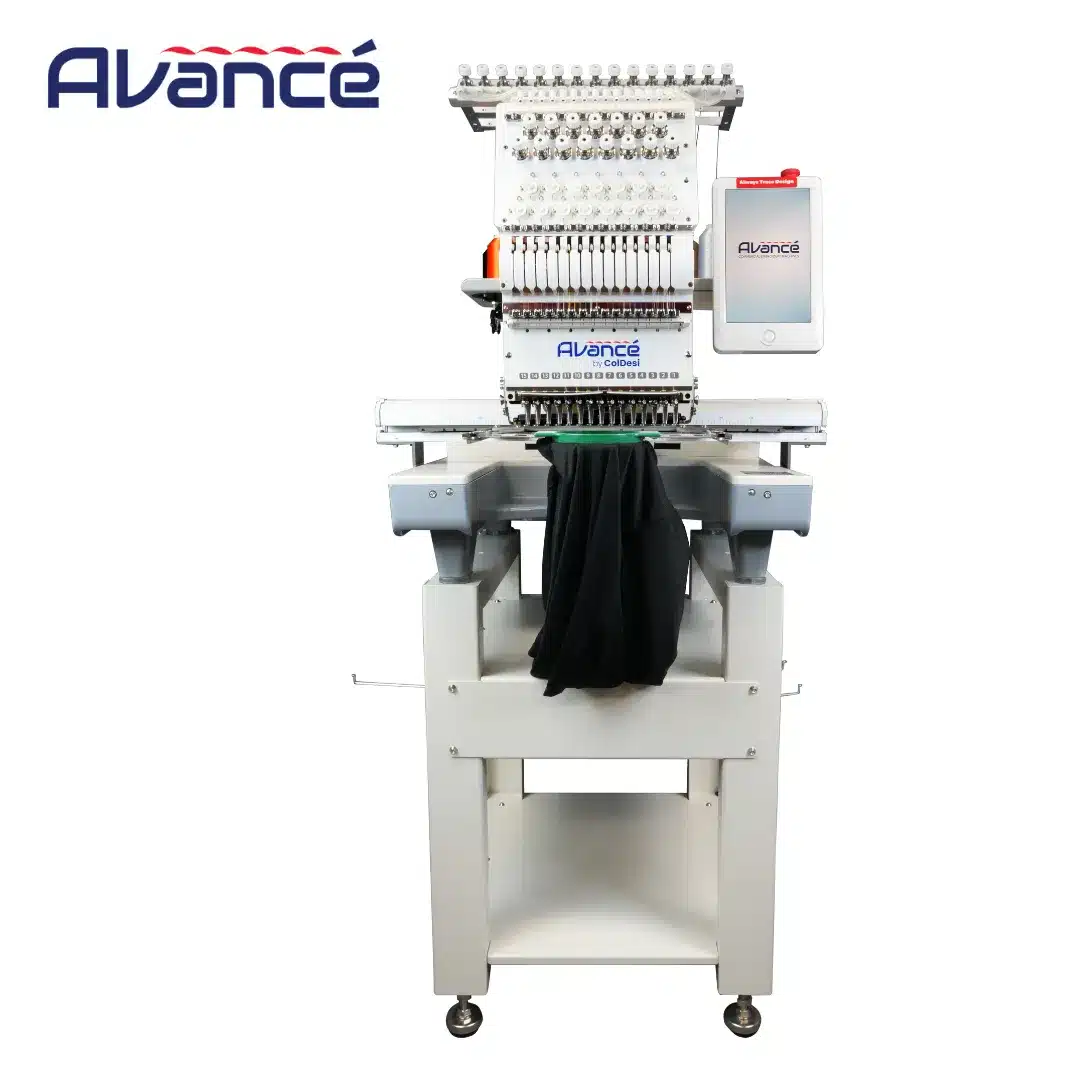
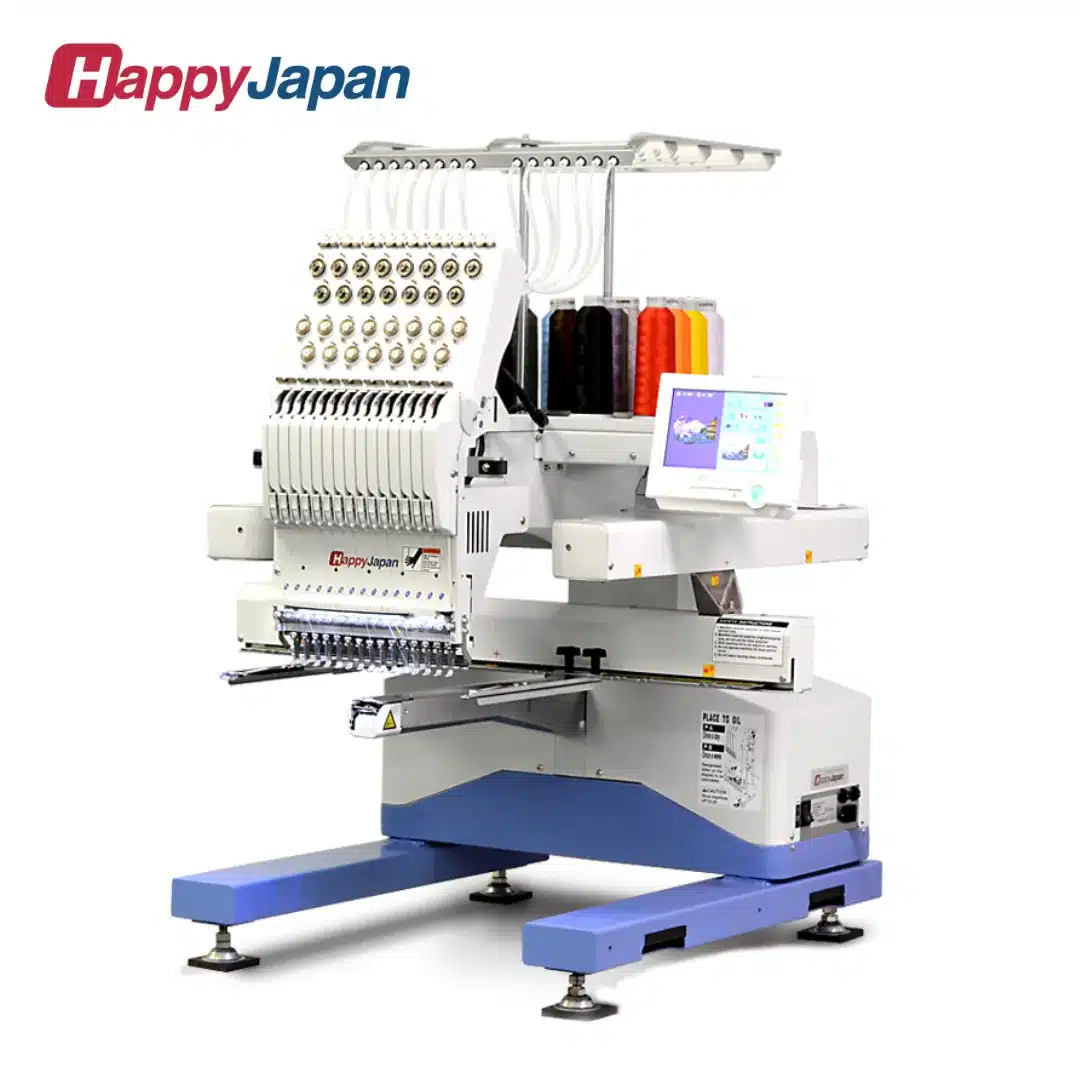
A single-head embroidery machine has one embroidery head and works on one item at a time.
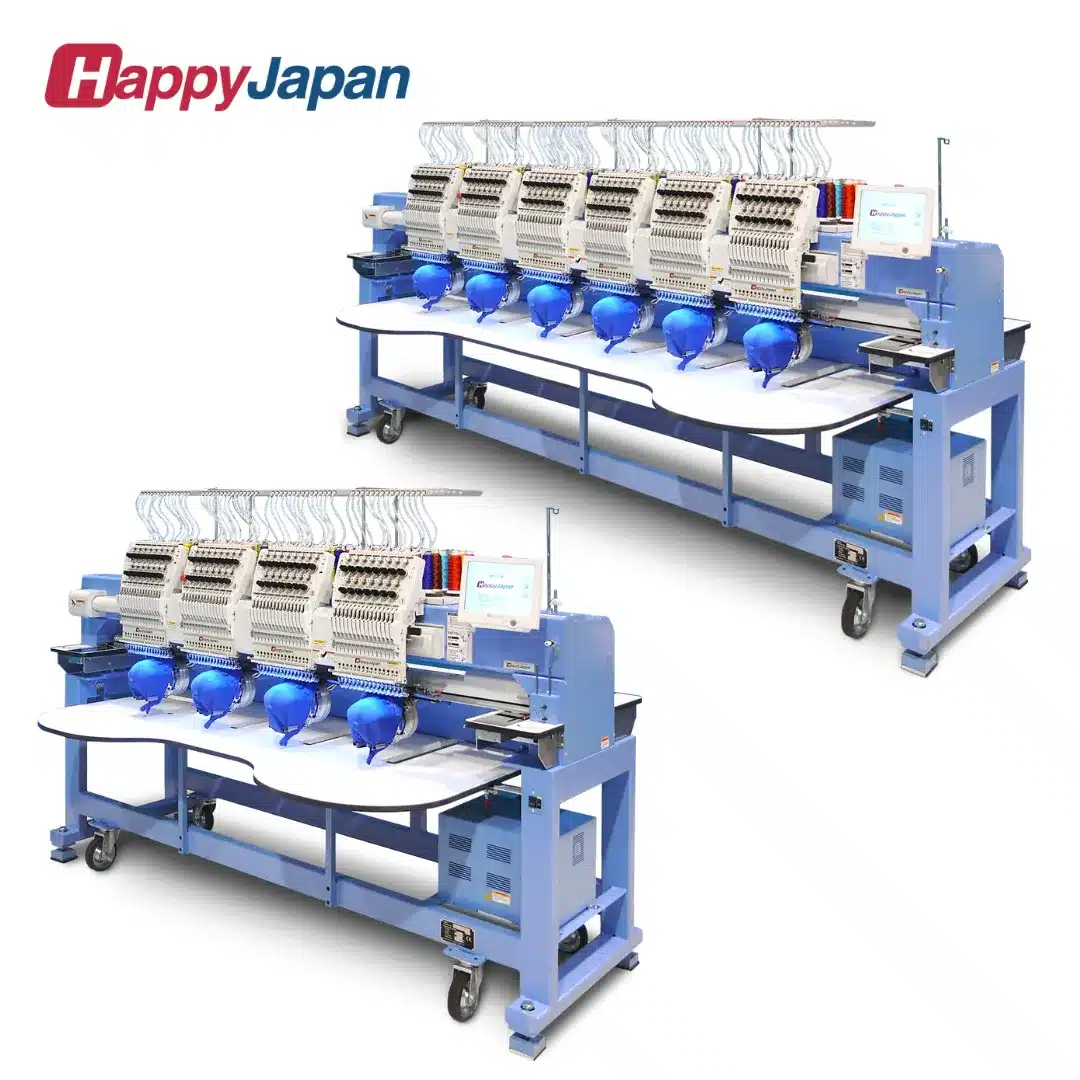
A multi-head embroidery machine has two or more embroidery heads, allowing it to embroider the same (or completely different) design on multiple items at once.
Which one is right for your business?
That depends on how much work you expect to take on, the types of orders you plan to accept, how much money you’re willing to invest upfront, and whether you’re buying for the business you have now or the business you’re working toward.
If you’re starting small, working from home, or expect to take on a variety of custom orders, a single-head machine may be all you need.
Contrary, if you expect to handle large, repeat orders or you’re building a business with higher production volumes in mind, a multi-head embroidery machine may be the better investment.
To help you compare your options, we’ve listed some of the most popular single-head and multi-head commercial embroidery machines below, including models from the Avancé and HappyJapan lineup.

Embroidery Software
Remember how we said embroidery machines use computerized controls to stitch designs, logos, and text onto fabric?
Well, those machines need instructions telling them what to stitch, where to stitch it, and how.
That includes which types of stitches to use, which direction they should run, when to change thread colors, when to trim the thread… and more.
And that’s where embroidery software comes in.
Now, to be clear, the commercial embroidery machines we covered above already come with built-in software that allows them to read and run embroidery files.
The embroidery software we’re talking about here is different.
It’s the software you use on your computer to create, digitize, or edit embroidery files before sending them to your embroidery machine.
But do you need embroidery digitizing software to start an embroidery business?
Not necessarily.
There are several ways to get embroidery-ready design files without creating them yourself.
You can purchase ready-made designs online, download free design packs, use files included with your embroidery machine, or hire a freelance embroidery digitizer to turn custom artwork into machine-ready embroidery files.
Additional Hoops and Specialty Frames
The commercial embroidery machines we covered earlier may already come with a selection of standard hoops and frames in some of the most commonly used sizes.
And for many embroidery jobs, those may be all you need to get started.
In case this is your first time hearing about embroidery hoops and frames, they hold the fabric or product securely in place while the machine stitches the design. Using the right one helps keep the material stable and the design properly aligned throughout the embroidery process.
However, standard hoops aren’t designed for every product.
If you plan to embroider caps, shoes, bags, sleeves, pockets, or other items with unusual shapes or hard-to-reach embroidery areas, you may need to purchase additional specialty hoops or frames.
The same may be true if you want to embroider designs that are larger or smaller than the hoops included with your machine.
Ultimately, the hoops and frames you need will depend on the products you plan to offer.
So, before purchasing any additional options, make sure they’re compatible with your embroidery machine and suitable for the items you expect to work with.
Threads and Stabilizers
Next up are embroidery threads and stabilizers.
And, unlike some of the other items on this list, these supplies are about as close to non-negotiable as it gets.
You need thread to stitch your designs and, in most cases, stabilizer to support the material and help prevent it from shifting, stretching, or puckering during embroidery.
In other words, these supplies are less of a “nice to have” and more of a “you’ll need them from day one.”
However, that doesn’t mean every embroidery business needs every type of thread and stabilizer from day one.
That doesn’t mean, however, that every embroidery business needs every type of thread and stabilizer right away.
The colors, types, and quantities you should keep on hand will depend largely on the materials you work with, the products you offer, and the kinds of designs your customers order.
Embroidery Needles
Of course, your embroidery machine can’t do much without embroidery needles.
And these are not your ordinary sewing needles. Embroidery needles are designed specifically for serious machine embroidery work, with sharper, finer points for piercing through fabrics and larger shanks and eyes to accommodate thicker embroidery threads.
We recommend stocking up on plenty of these, as with time (and use) they wear out.
Thread Nippers
Thread nippers are small handheld tools that work much like regular scissors but are designed for more precise cutting during the embroidery process.
For example, their compact design makes it easier to get close to the fabric and trim thread tails or jump stitches without accidentally cutting the surrounding embroidery.
All in all, they’re usually much more convenient than regular scissors for quick, precise trimming.
Marking Tools
Next on the list of essential embroidery supplies would be marking tools.
Marking tools are essential for positioning and aligning your designs on the fabric. There are all these different ones you can use, like water-soluble pens, markers, or chalk.
What’s great about them is that they can be easily brushed or washed away.
So adding them to your toolkit can be very helpful in a variety of situations.
Bobbins
Next up are bobbins.
Think of a bobbin as a mini spool that holds thread. Without it, your embroidery machine wouldn’t be able to create the stitches needed to make your projects come to life. Pre-wound bobbins are an excellent choice for beginners because they save time and ensure consistent stitch quality.
Machine Oils & Lubricants
Like any piece of equipment with moving parts, an embroidery machine needs proper care to continue performing at its best.
That includes regular oiling and lubrication.
Machine oils and lubricants help reduce friction between moving components, prevent unnecessary wear, protect against rust, and extend the lifespan of your equipment.
Just make sure to follow the manufacturer’s maintenance recommendations, as the type of lubricant you need (and where and how often it should be applied) may vary from one machine to another.
And there you have it.
The equipment and supplies you’ll need to get an embroidery business up and running.
Does that mean you need to rush out and buy everything on this list before taking your first order?
Probably not.
Start with the essentials. Buy for the work you plan to do today, then add new equipment as your orders, services, and business begin to grow.
After all, owning more equipment doesn’t necessarily make for a better embroidery business.
Having the right equipment, knowing how to use it, and putting it to work for your customers does.
And when it comes to choosing that equipment, where you buy it matters just as much as what you buy.
So, before you decide who to buy from, there are a few things you may want to consider beyond the equipment itself.
So let’s talk about that next.

Stop struggling with difficult garments! Learn how these supplies can make your embroidery faster, easier, and more profitable. Read THIS.
Choosing the Right Embroidery Equipment Partner
By now, you probably have a better idea of the equipment you may need to start or grow your embroidery business.
But you also have to decide what products to buy and whom to buy them from.
Now, we could probably save you some time on that second question… because we’d like that company to be us, ColDesi.
But whether you choose ColDesi or someone else, there are a few things you should look for in an embroidery equipment partner before making your decision.
What are they? Let’s take a look.
Experience
Think about the last time you bought something. It could be anything that made you do a little research first… and wasn’t exactly cheap. A TV, a grill, or even a laptop. How was the overall experience? Did the company answer your questions, help you make the right decision, and still pick up the phone after the sale?
When you’re investing in embroidery equipment, you’re not just buying products. You’re choosing a company you’ll be working with for years. That’s why experience is one of the first things you should look for.
Training
Let’s say your equipment arrives on a Friday afternoon. You’re excited to get started… until you open the boxes and realize you’re not entirely sure what comes first.
Which cables go where? What needs to connect to what? What should you set up first?
A good equipment partner won’t leave you to figure it out on your own. They should show you how to get everything set up correctly and, just as importantly, how to get the most out of your equipment once you’re up and running.
Support
Let’s fast forward a few months, when business is good, orders are coming in… and then… something isn’t working quite right.
Maybe it’s a setting you can’t figure out. Maybe it’s an error message you’ve never seen before.
Whatever it is, you want to know there’s someone on the other end of the phone who can help you get back to work.
Financing
If you’ve found the right equipment and the right company, should the price tag be the only thing standing between you and getting started?
For many businesses, the answer is no.
That’s why it’s worth looking for an equipment partner that offers flexible financing options.
The right financing can help you get started sooner while keeping your cash available for everything else your business needs.
Product selection
The more products a company offers, the more likely they are to have exactly what you need. From embroidery machines and hoops to replacement parts, accessories, and supplies, it’s nice knowing you can get everything from one place.
Long-term partnership
So, by now you’ve probably noticed a common theme developing here. And that is, the company you buy from can be just as important as the equipment you buy. Choose wisely, and you’ll have a partner you can rely on for years. Not just for your first machine, but for your next machine, and everything in between.


