

How often do you turn down rush orders, work overtime, or push deadlines just to get everything out on time?
If you’re like most shop owners (or apparel decorators), it’s probably more often than you’d like to admit.
And it’s not because you want to work that way. It’s because, in the moment, it feels like the only way to keep up.
So you do what most of us do… you add hours, lean harder on your team, and hope a little more pressure will smooth things out.
And for a short time… it kind of does.
Until it doesn’t.
For most shops, the real issue isn’t the amount of work coming in. It’s how that work gets handled.
And that’s where things usually get misread.
More often than not, there’s a bottleneck hiding somewhere in the process. In many growing shops, that bottleneck ends up being the decoration method itself or an entry-level DTF printer. The equipment simply can’t scale at the same pace as your incoming orders.
Which creates a quiet paradox: the better your shop does, the more this problem shows up.
At that point, you’re no longer running production. You’re managing friction.
That’s exactly the choke point ColDesi high-volume DTF printers are built to remove.
And if this is your first time hearing the name ColDesi, keep reading, because by the end of this read, you’ll learn why shops that switch never go back.
We’ll introduce you to four high-volume production systems in our lineup, their features and benefits over entry-level machines, and show you—using real specs, metrics, numbers, and charts—why the investment simply makes financial sense.
We know you’ve been ready for this, so let’s get into it.
The Difference Between Entry-Level DTF Printers and Production-Grade Systems
We imagine the logical first step is to look at the difference between entry-level and commercial DTF printers.
Laying those differences out from the start might help you clarify the gap they are designed to fill, the problems they solve, and what type of production environment each one is built for.
That said, if you’re reading this, you probably fall into one of two positions. You’re either still using a traditional printing method, or you’re running an entry-level DTF printer such as the ColDesi DTF 12H2.
Both are common. Both are reasonable starting points.
If you’re coming from a traditional print method (such as direct-to-garment printing, etc.) , DTF will outperform your current process in speed, flexibility, and efficiency almost across the board. If you’re already using an entry-level DTF system, you’re likely beginning to feel its limitations.
And there’s nothing wrong with either one. For where your business was at the time, they were proven workhorses and longtime favorites among decorators. They paid for themselves. They helped get you to where you are today, and they deserve credit for that.
But if you’re reading this now, chances are you’ve outgrown them. And that’s a good place to be. That’s progress.
And that is exactly the gap commercial DTF printers were built to fill.
They are not just a faster version of what you already have. They are intentionally engineered for high-volume, continuous production and all-day output. They’re built for the stage you’re in when orders get bigger, deadlines get tighter, and clients get pickier.
Now let’s look at the measurable differences that high-volume DTF printers bring to the table. We are not getting into model-specific specifications just yet, as that will come later; therefore, this overview will remain at a high level.
Production Speed & Output – High-volume DTF printers typically deliver significantly greater throughput than the entry-level units. As a result, shops can produce up to 2x to 4x more prints per hour and fulfill large orders faster while meeting tight turnaround times.
Print Size & Media Handling – High-volume DTF printers offer a larger maximum print width. In simple terms, this is the widest horizontal area the printer can print on the transfer film. For reference, smaller desktop models (such as the ColDesi DTF 12H2) are usually around 12 inches (A3), while standard production printers are typically 24 or 30 inches wide.
Resolution (DPI) – High-volume DTF printers generally offer higher and more consistent print resolution compared to entry-level models. Resolution, measured in dots per inch (DPI), directly impacts image sharpness, color blending, and fine detail reproduction. While most entry-level DTF printers operate in the 720 x 1080 or 720 x 1440 DPI range, high-volume production units commonly support resolutions of 720 x 2400 DPI and higher. In practical terms, this results in smoother gradients, crisper text, and cleaner edges—especially noticeable on small lettering, detailed logos, and photographic images.
Expanded Color Gamut – Select DTF printers support a broader color gamut than entry-level machines. In marketing material such as product pages, brochures, or downloadable PDFs, you may see this feature referred to as an “Expanded Color Gamut” option. As the name implies, it goes beyond standard CMYK output by incorporating CMYKOG + White (Cyan, Magenta, Yellow, Black, Orange, Green). This extended color range produces richer saturation, smoother gradients, and enhanced tonal depth. It is ideal for applications demanding high visual fidelity, such as photographic imagery, brand-critical logos, and intricate multi-color artwork.
Add-ons – High-volume DTF printers offer far more upgrade and expansion options than entry-level units. Plus, they often include built-in powder recirculation systems (a.k.a. shaker/dryer units) that collect excess powder for refilling and reuse, as well as integrated fume extractors that help absorb and remove smoke or fumes generated during the printing process.
And there you have it; those are some of the most noteworthy differences between entry-level DTF printers and production-grade systems.
Now that you understand what separates the two, it’s important to focus on the real-world benefits of wide-format printing, as these advantages are a major reason many businesses choose to upgrade.

Are you still relying on conventional printing methods and feel like they are holding your business back? Read THIS.
Benefits of Having a Wide-Format DTF Printer
By this point, you’ve probably picked up on a few subtle hints about the advantages of high-volume, wide-format DTF printers.
Now let’s bring them to the forefront of this discussion.
The question is, what real, measurable results can you expect by bringing a high-volume DTF printer in-house?
That’s what this section sets out to answer.
#1: Lower Cost Per Print and Higher Profit Margins
This comes as no surprise, but when you step up from, say, a 12-inch printer to a 24- or 30-inch one (or conventional printing, for that matter), things usually get way more efficient. You can fit more graphics onto the film per run and crank out more transfers at the same time. As a result, your cost per print goes down and margins go up.
#2: Improved Labor Productivity
Another key benefit of high-volume DTF printers is improved labor efficiency. Ask yourself this: is your team currently waiting around on equipment to finish a job? Are they stuck in stop-and-go cycles of loading, waiting, unloading, and immediately starting the next run? That repetitive process creates idle time that adds up quickly over the course of a day. High-volume printers can help cut that downtime in half.
#3: Increased Daily Throughput
With a wide-format, high-volume DTF printer, you simply get more done in the same amount of time. Larger print widths and faster production speeds mean fewer total runs to complete the same workload. Instead of babysitting multiple small batches all day, you’re knocking out bigger jobs in fewer passes. The result is a noticeable jump in daily output without adding extra shifts, overtime, or equipment. More prints per day means more orders fulfilled, faster turnaround times, and more cash flowing through your business each day.
#4: Competitive Edge
All of this combined gives you one powerful advantage over everyone else: a true competitive edge. It is what makes your business stand out. When your costs drop, your speed goes up, and your output increases, you gain an advantage your competitors cannot easily copy. You deliver faster. You handle bigger orders. You quote better prices and still keep strong margins. While others are forced to turn away large jobs or stretch delivery times, you become the shop that always gets the work done on time. That kind of consistency builds trust with customers. And in this business, the shop that delivers the fastest and most reliably is the shop that wins and keeps the customer.
We hope these benefits help put into perspective how wide-format DTF printing can improve the quality of life in your business, in just about every area.
With that foundation in place, let’s look at the DTF printers that deliver on all of this.
Introducing ColDesi’s High-Volume 24″ and 30″ DTF Printers
Okay, we’ve covered a lot of ground here today.
If you’ve read through this page by now you should know the difference between entry-level and production-grade DTF printers and the real, measurable benefits they can bring to your business.
So what’s the missing link?
Knowing exactly which models deliver on these promises and where to buy them.
The good news? You won’t have to look far.
Below, we’ve put together a carefully curated list of DTF printers worth considering, based on your current stage of business and the specific challenges you’re looking to solve.
So, let’s walk through a few of them.
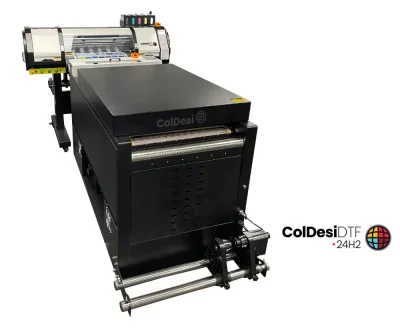
ColDesi DTF 24H2 – A high-performance direct-to-film (DTF) printer with a 24-inch-wide print field and a dual-head system that delivers higher resolution and faster throughput than the compact, entry-level 12H2.
The system is powered by two Epson i3200 printheads, which provide increased speed, improved ink management, and a longer operational lifespan.
In terms of raw production capacity, the 24H2 can print up to 45–55 linear feet per hour, or approximately 100 full-size (8″ × 10″) transfers, placing it in the mid-size production category.
The unit includes an integrated fume extractor, so there’s no need for an external system. Fully assembled, the printer comes in at 562 lbs.
This model is ideal for apparel decorators, custom product businesses, and print shops managing regular multi-shirt orders, offering a strong balance of output, reliability, and footprint.
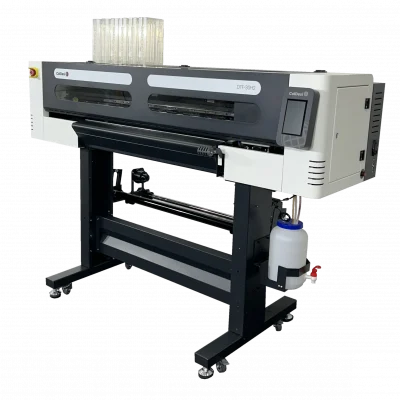
ColDesi DTF 30H2 – The DTF 30H2 expands the print area to 30 inches and maintains a dual-head configuration. It can do up to about 43 linear feet an hour.
That’s roughly 180 full-size 8×10 transfers at an impressive 720 × 1800 DPI.
This makes it ideal for larger production runs or wide-format jobs like jackets, hoodies, banners, and more.
You can print multiple designs at the same time, which really cuts down on setup. Plus, it works on all kinds of materials—cotton, polyester, leather, even wood.
With 1000 ml ink bags, you can print longer without stopping for a refill, a little convenience that makes your day run smoother.
Perfect for commercial high-volume print shops looking to maximize production without compromising detail.
ColDesi DTF 24H5 – A direct-to-film (DTF) printer with a 24-inch-wide print field and a five-head system that delivers maximum throughput and high-resolution output.
Capable of printing up to 158 linear feet per hour, or approximately 400 full-size (8″ × 10″) transfers, it’s ideal for high-volume production and businesses needing fast, large-scale printing.
The 24H5 offers more than standard CMYK output—it features an Expanded Color Gamut option with CMYKOG + White (Cyan, Magenta, Yellow, Black, Orange, Green).
This extended color range produces richer saturation, smoother gradients, and enhanced tonal depth.
It’s ideal for applications demanding high visual fidelity, such as photographic imagery, brand-critical logos, and intricate multi-color artwork.

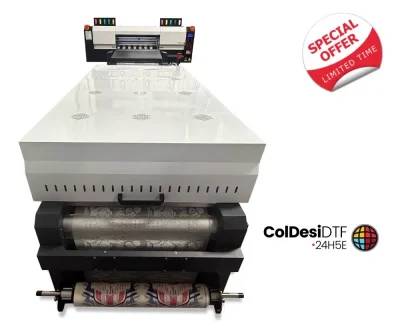
ColDesi DTF 24H5E – A newer, upgraded version of the original 24H5. It keeps everything people already like about the line but adds a few thoughtful upgrades that make day-to-day production a lot smoother.
Namely, this model includes an Extended Dryer System, an Advanced Pre-Heating Chamber, and an automated wet-capping system for enhanced printer reliability and more consistent output.
Featuring a 24-inch print width and five advanced Epson i3200 printheads, the 24H5E delivers outstanding speed, precision, and reliability for high-volume production environments.
In real numbers, it produces 500+ transfers per hour and over 275 linear feet of printed film.
Similarly, the 24H5 offers more than standard CMYK output—it features an Expanded Color Gamut option with CMYKOG + White (Cyan, Magenta, Yellow, Black, Orange, Green).
But that’s not all.
Alongside our flagship models, we also offer two other standout DTF printers worth mentioning in our lineup. First is the ColDesi DTF 12H2, a compact, entry-level system designed for small businesses, startups, and shops with limited space. Second is the ColDesi 24H3R UV/DTF, a hybrid printer that combines UV and DTF printing in one versatile machine.
We simply wanted to make you aware of these additional options because, depending on your goals, one of these may actually be the smartest financial move you can make. Take a few minutes. Compare them. Do your homework.
All models are in stock and available for immediate shipping or local pickup.
And regardless of which model you choose, each one meets or exceeds the promises, features, and performance standards we’ve laid out so far.
Now, if you’re the kind of buyer who likes to see real proof on the page, not just read about it, you’re going to love what’s next.
Up next, we’ll walk through some of the benchmarks, charts, and technical performance metrics so you can see exactly how these systems stack up on paper.
Productivity & Profitability Metrics
Below are comparison charts showing DTF versus the traditional printing methods shops have been using for years, so you can see for yourself how much better DTF really is. We’ll compare how many products each method can produce per hour and the cost per print to show how much more cost-effective DTF really is.
We’ve also included charts comparing our DTF printer lineup by transfer output per hour and maximum print width.

What this chart tells us is simple: wider print capability equals greater flexibility.
The data makes it obvious that stepping up from the DTF 12H2 to the DTF 24H series or the DTF 30H2 doesn’t just give you a few extra inches—it fundamentally helps you lay out more jobs.
With the DTF 30H2 offering a massive 30-inch width, you are not limited to single-file printing.
You can “gang” multiple designs side by side across the film, effectively printing two or three jobs in the time it takes the smaller printers to do one.

What this chart makes clear is simply the sheer scale of difference in output capacity.
While the entry-level DTF 12H2 gets you started with about 50 transfers an hour, the jump to the commercial level printer is massive.
By the time you reach the DTF 24H5E, you aren’t just seeing a slight improvement; you are hitting speeds of nearly 500 transfers per hour.
That is roughly a 10x increase in productivity compared to the base model.
This means a job that would take an entire 10-hour day on a smaller printer gets knocked out in just a single hour on the DTF 24H5E.
When you can turn around bulk orders that fast, you stop worrying about production bottlenecks and start looking for more customers to fill that capacity.

What this tells us is simple: DTF is way cheaper per print.
The chart makes it obvious: DTF comes in well under one dollar, while DTG is roughly twice as high, and screen printing is higher still.
When your cost per print drops this much, you’re not just saving pennies; you’re increasing your margin on every single order.
A dollar saved here and there might look like a small win on paper, but it adds up quickly.
Over the course of a full week of production, it becomes a shockingly large number.

What this chart tells us is pretty straightforward: DTF does not just earn you more per shirt because it costs less to produce. It also lets you produce significantly more shirts in the same amount of time.
DTF averages around 60 shirts per hour, which is roughly double what most DTG setups can manage on a good day.
Screen printing falls even further behind once you factor in all the manual setup, cleanup, and those little stop-and-go moments that slow the process down.
When those slowdowns happen repeatedly throughout the day, they end up eating huge chunks of your schedule.
With DTF, you avoid most of that, which means you stay in a steady, productive rhythm from one job to the next.
DTF Printing Tutorials, Articles & Other Useful Resources

What good is new equipment if you or your team don’t know how to use it? We offer turnkey training and support to make sure you do. Head over to this page to get started.