
Is there a practical reason to add rhinestone and spangle machines to your print shop… or can you do without them?
The answer isn’t as simple as it first appears.
For some shops, these machines open up profitable product lines and entirely new niches—often with margins that make you wonder why you didn’t look into it sooner.
For others, they end up underused and hard to justify, taking up space and capital that could have been used elsewhere. (which is usually the part no one talks about upfront).
So how do you know which camp you’ll fall into?
It really comes down to three things: your customers, the types of jobs you’re already taking on, and how visible your shop is for this type of work.
Let’s start there.
Are you already getting requests for decorated apparel, team uniforms, performance wear, or promo items that rely on sparkle and texture?
Or are most of your jobs straightforward print work?
If those requests are already coming in, the opportunity is basically sitting in front of you.
If they’re not, it doesn’t necessarily mean there’s no demand.
It may just mean those customers aren’t finding you yet (or are going elsewhere… your competitors most likely).
This guide will help you figure out which situation you’re in, and whether these machines actually make sense for your business.
Let’s get into it.
Introduction: The Rise of Bling
We shouldn’t rush this.
Before we talk about machines, techniques, or numbers, we need to start with a simpler question: where is the demand for “bling” apparel actually coming from?
That matters, because once you see where demand comes from, you get a much clearer view of the opportunities around it.
And that’s where it gets interesting. The demand for bling is not driven by a single trend or a clearly defined market segment.
Most of the people buying it wouldn’t even say they’re part of any “bling industry” at all.
Instead, it comes from people, brands, and organizations that need strong visual impact.
They’re typically dance teams, athletes, entertainers, stage performers, and anyone else who depends on visibility—people who need to stand out at a distance, under bright lights, or on camera.
Flat prints don’t do much in those situations. What these buyers are really after is attention and visibility. Something that stands out and reads instantly.
They may not call it “rhinestones” or “spangles,” and they’re not thinking in industry terms like “bling”. They’re just looking for apparel that stands out.
However, the label isn’t important.
What matters is that there is a steady, growing demand for high-visibility, decorated apparel—and it is already showing up in real orders from schools, teams, performers, and performance-based clients.
That’s where the opportunity is, and where you can build profit if you’re positioned for it.
The challenge is that traditional decoration methods aren’t always built for this kind of work. Which is where rhinestone and spangle machines come in.
They give you a way to produce this type of product at scale without relying on a slow, manual process. (You can still do rhinestone work by hand or with basic tools, but that’s a different workflow entirely and sits outside what we’re focusing on here.)
What Is a Rhinestone Machine for Business
Let’s slow this down for a second. We need to clarify what we’re actually talking about here, because if you’re new to this, confusion can set in quickly.
Rhinestones are not the same as spangles.
They’re often mentioned together, but they are completely different materials with different production methods.
Rhinestones, more specifically hot-fix rhinestones, are small faceted stones made from glass, acrylic, or resin. They come with a heat-activated adhesive on the back, which allows them to bond to fabric or other materials when heat is applied using a heat press (or, in simpler setups, a household iron).
Spangles, on the other hand, are small flat discs, usually metallic or holographic, that are punched from a roll of spangle tape.
Instead of the faceted, gemstone-like three-dimensional appearance of rhinestones, spangles are completely flat.
This gives them a different visual effect. They don’t sparkle in the same way, but instead create more of a shimmer or flash when they catch light.
Their production process is also different. In production, spangles are punched from a tape cartridge and arranged onto a transfer sheet to form a design. That design is then heat-pressed onto garments such as t-shirts, costumes, or promotional items.
Because of these differences, each material requires its own specialized equipment.
Rhinestones are applied using an automatic rhinestone-setting machine, while spangles require a dedicated spangle machine.
If you don’t separate these two early on, the rest of the process can get confusing fast.
But we’ve done that now, we’ve clearly separated the two.
So what exactly is a rhinestone machine? And what does it actually do?
At its simplest, a rhinestone machine is a piece of equipment that automatically picks up individual rhinestones and places them onto a transfer sheet to create a design.
What makes it work is that the entire process is controlled by software.
This process is controlled by software.
The machine follows a design file containing precise coordinate data, along with details such as stone size, spacing, and layout.
Using this information, it places each rhinestone accurately onto a transfer sheet.
Importantly, this is NOT the finished product. The machine prepares a transfer, which must then be applied to fabric using heat.
However, if you are selling transfers as a product, that same output can also be considered the finished item in its own right.
This opens up a second business model that can run alongside traditional garment production—where instead of applying the design yourself, you produce and sell ready-made rhinestone transfers to other businesses or customers.
If you want to explore further, it’s worth doing your own research.
With rhinestone machines out of the way, it makes sense to look at the alternative system used in this space—spangle machines.
What Are Spangle Machines and How They Compare
If you’re still here, that says something about you. You’re actually trying to understand this, and that already puts you ahead of most people who skim past the details.
With rhinestones covered, let’s move on to their close relative: spangles.
So what is a spangle machine, and what does it do?
A spangle machine is fundamentally different from a rhinestone system. Instead of handling pre-made stones, it works with spangle tape, a continuous strip of material. The machine punches each spangle from the tape and immediately places it onto an adhesive transfer sheet.
As with rhinestones, the entire process is controlled by software. A digital design file tells the machine exactly where to place each spangle.
While the overall workflow is similar, both systems produce transfers that are later applied with heat. The choice between them comes down to the visual effect you want and the type of product you’re creating.
Rhinestones are typically used when a more traditional “sparkle” finish is desired, while spangles offer a flatter, more reflective look that behaves differently under light.
In practice, some businesses focus on one or the other, while others use both depending on the application.
So now you’ve seen what each machine is and how it all works. Next, let’s talk about what businesses actually get out of it.
Benefits for Existing Businesses
By now, you’ve got a solid grasp of the basics.
You’ve seen where the demand for bling apparel comes from, learned the differences between spangles and rhinestones, and understand how the machines work.
That’s all really good information to have. But what’s in it for you (and your business)?
At a practical level, bling machines can be a pretty valuable addition to what you already do, both in terms of revenue potential and expanding your product offering.
These benefits include:
Custom Apparel & Fashion Pieces
This is usually the first and most obvious way people start making money with a bling machine. You’re basically taking plain garments (hoodies, tees, caps, jackets, and so on) and turning them into personalized, higher-margin products.
These items tend to carry a much higher perceived value. Customers are often willing to pay significantly more for something customized—whether it’s their name, a logo, or a design made with rhinestones or spangles—because it feels personal, unique, and not mass-produced.
But it’s not just individual buyers. Custom bling apparel also works extremely well for sports teams, athletes, dancers, musicians, and stage performers.
For these groups, appearance is part of performance. Sparkle and shine help create identity, visibility, and stage presence.
That’s where the real value gets added! Not just in the materials, but in the perceived branding and presentation.
In many cases, businesses find that these custom pieces can be sold at a much higher margin than standard decorated apparel, while also opening the door to repeat group orders and seasonal demand (competitions, tours, events, and so on).
Promotional Products and Branded Merchandise
Beyond fashion and performance wear, bling machines also fit neatly into the promotional products space.
Businesses, schools, nonprofits, and event organizers are constantly looking for ways to make their branding stand out, and rhinestone or embellished items offer a more premium, eye-catching alternative to standard printed merchandise.
Instead of a basic logo printed on a tote bag or T-shirt, the same item can be upgraded into something that feels more exclusive and attention-grabbing.
This added “sparkle factor” significantly increases perceived value, making it easier to command higher prices per unit compared to traditional promotional products. (which, at this point, is kind of the whole point).
Upselling and Product Line Expansion
If you already sell apparel or custom merch, a bling machine gives you an easy upsell opportunity.
Instead of only offering printed designs, you can add a premium bling option using rhinestones or spangles. Same product, just a higher-end version that looks more eye-catching and feels more valuable.
This can be as simple as offering two versions of the same item, standard and bling, or letting customers upgrade details like names, numbers, or logos.
The key advantage is that you’re not changing your product line, just increasing the value of what you already sell. That usually means higher margins without needing to find a completely new customer base.
Personalized Gifts and One-Off Orders
Bling machines also work well for small, personalized orders, especially gifts.
People regularly look for something more personal than what they can find in a regular store. Names, initials, dates, or short messages made with rhinestones or spangles fit that need well.
These are usually one-off or small-batch orders, which makes them easy to produce and price at a premium. They also tend to be emotionally driven purchases such as birthdays, holidays, graduations, weddings, and similar occasions, so customers care more about the uniqueness of the item than the cost.
From a business perspective, this helps fill the gaps between larger production runs. You are not relying only on bulk orders or seasonal spikes. You also get steady smaller jobs that keep the machine active and generating revenue.
Seasonal and Event-Based Demand
Custom bling apparel sells especially well during holidays and events.
Certain times of the year naturally drive higher demand for custom bling apparel. Holidays, school events, sports seasons, dance competitions, concerts, and festivals all create opportunities for themed designs and group orders.
Christmas and New Year are especially strong periods. People look for personalized gifts, matching family outfits, party wear, and event merchandise. Sparkly designs fit these occasions particularly well, which makes rhinestone and spangle products an easy sell during this time of year.
All of this just goes to show the different ways rhinestone and spangle machines can generate revenue across multiple markets.
The next step is turning that potential into a real, working production setup.
And that’s exactly what we’ll look at next.
Choosing the Right Equipment
You can probably already see where this is heading, can’t you?
We’ve talked about rhinestones and spangles at length now.
So the question now is: what do you actually need to get started?
To make things easier, we’ve gone ahead and lined up a few different machine options you can look at.
Each model falls into a different tier in terms of price, specs, and performance.
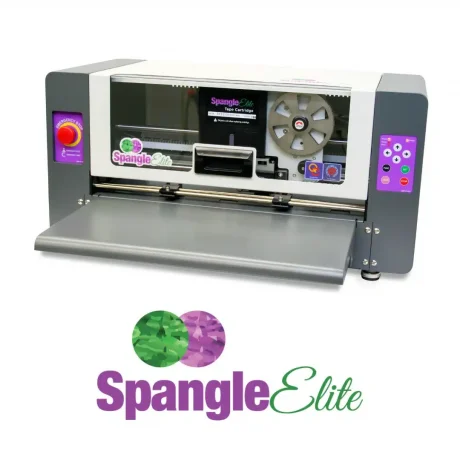
SpangleElite – The SpangleElite is a desktop machine that creates custom “bling” designs for apparel and accessories.
It automatically punches and applies small, holographic discs called spangles onto transfer tape, which you can then press onto garments.
This device can produce up to 900 spangles per minute and create designs up to 13″ x 10.25″ (or 13″ x 20.5″ when combining two sheets).
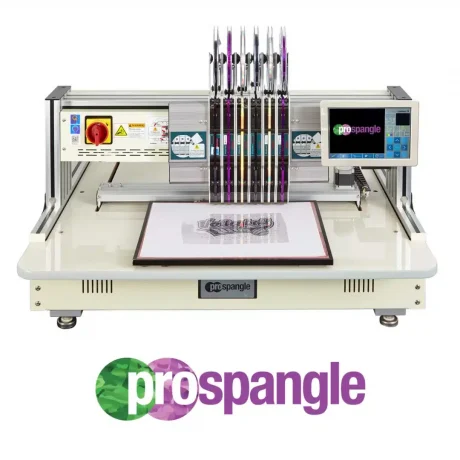
ProSpangle – ProSpangle is the most advanced system of its kind on the market today.
It expands the working area to 13.5″ x 17.5″ for larger, more detailed designs and increases output to 1,000 spangles per minute, surpassing the SpangleElite’s already impressive performance.
With six independent color wheels, it lets you combine multiple colors and sizes in a single run without stopping to reload.
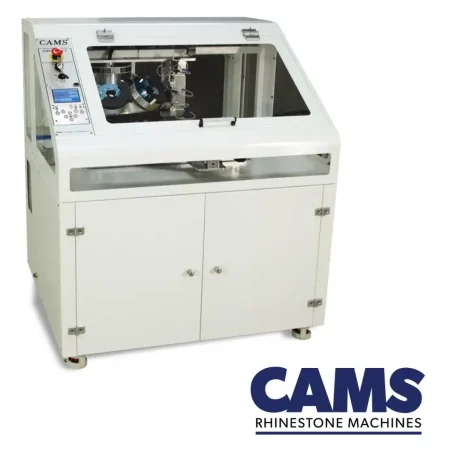
CAMS 1V-6P – The CAMS 1V-6P is a professional-grade automatic rhinestone setting machine designed for high-volume, multicolor rhinestone transfers.
Equipped with six hoppers, it can automatically switch between different sizes or colors of rhinestones, rhinestuds, or nailheads within a single design.
It offers a 15.75″ × 15.75″ working area and places up to 170 stones per minute with precise accuracy.
Compatible with stones from 2mm to 5mm, the system is ideal for dancewear, team uniforms, fashion, and promotional apparel.
So those are your best options, those are your choices. Simple as that.
Each machine sits in a different tier depending on price, capability, and output.
The right one for you depends on how you plan to use it and the scale you are working at.
So there isn’t a single right answer here.
If you are just starting out, you may want to keep things simple and start small and upgrade later. That’s often the easiest way in.
Either way, you now have a clear overview to work from.

Why ColDesi Is the Customization Equipment Supplier Serious Decorators Rely On
Why do decorators stick with us for years? It isn’t just about the equipment. Get the full story on why we are the go-to supplier for beginners and pros alike. Read the article.
Integration Into Existing Workflow
When something new comes along, it’s natural to assume it will disrupt everything you already do.
Most people immediately think: “This is going to be complicated… how am I even supposed to fit this into what I already do? I don’t have time to learn a whole new system.”
In reality, it’s much simpler than that.
Spangle and rhinestone machines practically plug into your existing workflow. In most cases, your current process remains largely unchanged.
You’re not replacing it, you’re just adding to it.
Whether you are using embroidery machines, UV, or DTF printers, this technology works alongside what you already have as a natural extension of your setup.
There’s no need to rework your entire workflow.
Instead, think of it as an additional process that complements what you already do rather than something that requires a completely new way of working.
Because of that, most decorators find the transition surprisingly smooth.
If you already work with printing or similar equipment, you’ll usually get the hang of it in no time since much of the workflow will feel familiar.
Hopefully that gives a clearer idea of how it fits into your current setup.
That said, you may need some additional space for the equipment, and there will be a short setup phase.
But it’s nothing unusual. If anything, that’s to be expected with any new system.