

Dual-Station Automatic Heat Press: Increase DTF Production Without Adding Labor
If your DTF printer can produce transfers faster than your team can apply them, your heat press becomes a production bottleneck. Time spent loading shirts, positioning transfers, and manually operating the press limits how many finished garments your shop can produce each day.
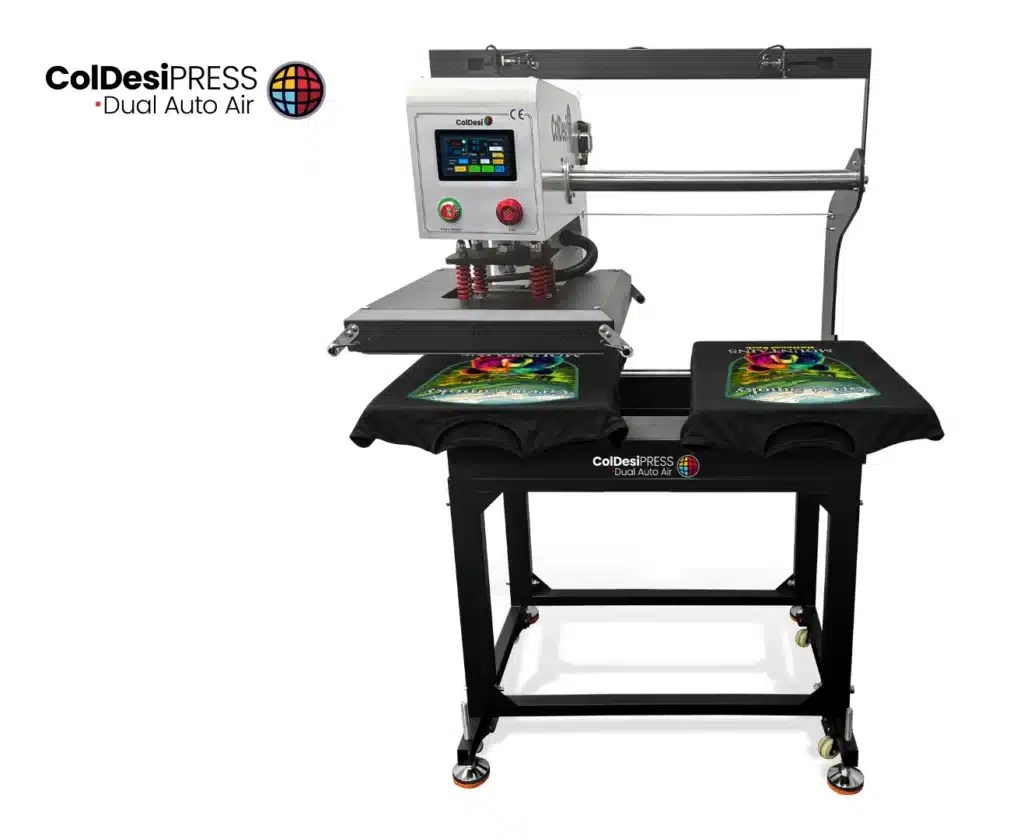
The ColDesi Dual-Station Automatic Heat Press is designed to help businesses increase production capacity, reduce manual labor, and improve turnaround times. With two 16″ × 20″ pressing stations and an automated sliding heat platen, operators can prepare the next garment while another is being pressed. Automatic pneumatic operation, digital controls, and adjustable laser alignment help maintain consistent results across production runs.
The goal is simple: produce more finished garments in less time without adding unnecessary labor. By reducing downtime between pressing cycles and making better use of existing staff, the ColDesi Dual–Station Automatic Heat Press helps businesses take on larger orders, maintain consistent quality, and scale production more efficiently.
What Is a Dual-Station Automatic Heat Press?
A dual-station automatic heat press is a commercial heat press machine designed with two separate garment-loading stations and an automated pressing system.
Unlike a traditional single-station manual heat press, where an operator must complete one pressing cycle before preparing the next garment, a dual-station system allows production tasks to overlap.
While one shirt is being pressed, the operator can position the next garment and transfer on the second station. The upper heating platen automatically moves between stations, allowing production to continue with less downtime.
This creates several advantages for businesses handling repetitive apparel orders:
- Less Waiting Between Transfers: Prepare the next garment while the current transfer is being applied.
- More Efficient Workflow: Keep garments moving through production with fewer interruptions.
- Reduced Manual Operation: Automatic pneumatic pressing eliminates the need to manually operate the heat platen during every cycle.
- Better Use of Operator Time: Employees can focus on garment positioning, transfer preparation, and quality control.
For shops looking to increase DTF production, the biggest advantage is not simply automation. It is the ability to keep the entire heat application process moving.
Watch the ColDesi Dual-Station Automatic Heat Press in Action
Seeing an automatic DTF heat press operate provides a better understanding of how it can improve daily production.
In this equipment demonstration, Marc from ColDesi walks through the machine’s operation, including its digital controls, automatic pressing system, and dual-station workflow.
Watch how the machine applies DTF transfers to garments and how operators can prepare one shirt while another is being pressed.
Key Features of the ColDesi Dual-Station Automatic Heat Press
The ColDesi Dual-Station Automatic Heat Press is designed for the demands of commercial apparel production. Its features focus on improving garment handling, maintaining consistent pressing conditions, and reducing repetitive manual tasks.
Automatic and Semi-Automatic Pneumatic Operation
The machine uses pneumatic pressure and an automated sliding heat platen to complete pressing cycles without requiring operators to manually lower and raise the platen.
The upper heating platen automatically moves between the two stations, helping maintain a continuous production workflow.
Operators can also switch to manual station movement when needed, providing flexibility for different production requirements.
Dual 16″ × 20″ Threadable Platens
Two 16″ × 20″ pressing stations provide ample space for many common apparel decoration applications, including full-front graphics, back designs, and standard DTF transfers.
The threadable lower platens allow garments to be positioned over the platen rather than simply laid flat across it.
This helps operators isolate the area being decorated and manage seams, collars, and other garment features that could interfere with transfer placement.
For businesses producing shirts, sweatshirts, uniforms, and promotional apparel, proper garment positioning contributes to more consistent results.
Digital Temperature and Time Controls
The ColDesi Dual-Station Automatic Heat Press features a digital control panel that provides centralized access to temperature, time, and operating settings.
Operators can adjust temperatures up to 550°F, with a temperature readout accuracy of ±2°F and Fahrenheit/Celsius display options.
The machine also includes an automatic digital timer and dual pre-press timers.
These controls help businesses establish repeatable pressing conditions for different transfer applications and garment types.
Adjustable Crosshair Laser Alignment
Accurate transfer placement is important when producing multiple garments for the same customer.
The adjustable crosshair laser positioning system provides a visual reference to help operators align transfers consistently.
This is particularly useful for businesses producing uniforms, branded apparel, and repeat customer orders where transfer placement needs to remain consistent from one garment to the next.
Consistent Pneumatic Pressure
The machine uses adjustable pneumatic pressure and a pressure-balancing system to help maintain even contact across the pressing surface.
Consistent pressure is essential for successful DTF transfer application, especially when producing multiple garments using the same design.
Unlike manual presses that may depend on operator-applied force, pneumatic presses help maintain repeatable pressing conditions while reducing physical effort.
Commercial-Grade Heating and Construction
The ColDesi Dual-Station Automatic Heat Press features a thick, Teflon-coated cast aluminum heating platen designed to distribute heat evenly across the pressing surface.
Its heavy-duty welded steel framework is built for daily commercial production.
The machine also accommodates materials up to 2.5″ thick, making it suitable for a range of compatible apparel and flat-substrate applications.
An integrated production cycle counter helps operators track completed pressing cycles throughout the workday.
How Many DTF Transfers Can a Dual-Station Heat Press Apply?
One of the most important considerations when upgrading heat press equipment is production capacity.
The ColDesi Dual-Station Automatic Heat Press is designed to improve production efficiency by reducing downtime between pressing cycles.
Unlike a traditional single-station heat press, the dual-station design allows operators to prepare one garment while another is being pressed. The automated sliding heat platen moves between stations, creating a more continuous workflow.
Actual daily production capacity depends on several factors.
Transfer Size and Placement: Larger transfers, multiple decoration locations, and more complex garment designs may require additional positioning time.
Pressing Time: Different transfers and materials require specific temperature, pressure, and dwell-time settings. These requirements affect how quickly garments can move through production.
Garment Handling: Organized garment staging, transfer preparation, and finished-product handling can make a significant difference in overall productivity.
Operator Experience: Experienced operators who understand garment positioning and machine operation can maintain a more consistent production rhythm.
Production Workflow: A heat press performs best when transfers and garments are ready before each pressing cycle. Delays elsewhere in the production process can limit the benefits of automatic pressing.
For businesses handling larger DTF orders, the advantage of dual-station operation is the ability to keep garments moving with fewer interruptions and less repetitive manual operation.
Rather than focusing on a specific number of shirts per hour, businesses should evaluate how the machine can improve their existing heat application workflow.
Manual vs. Dual-Station Automatic Heat Press
Not every apparel business needs an automatic heat press. The right equipment depends on production volume, available labor, and the types of orders being processed.
Feature | Manual Heat Press | Dual-Station Automatic Heat Press |
Operation | Manual pressing | Automatic and semi-automatic pneumatic |
Pressing stations | Typically one | Two |
Operator involvement | More hands-on | Less repetitive pressing |
Loading workflow | Between pressing cycles | Load while the other station presses |
Pressure application | Operator-dependent on many models | Adjustable pneumatic pressure |
Production suitability | Lower-volume or varied work | Repetitive, higher-volume work |
Manual heat presses remain useful for smaller customization businesses, occasional production, and specialized applications.
However, as order volume increases, the time spent manually operating a single-station press can become a limiting factor.
A dual-station heat press allows operators to maintain a more continuous workflow without manually moving the heating platen between stations.
For businesses already investing in higher-capacity DTF printing equipment, improving the heat application process can help prevent printed transfers from piling up while garments wait to be decorated.
Equipment Requirements and Specifications
Before purchasing commercial heat press equipment, businesses should evaluate available production space, electrical service, and compressed-air capacity.
The ColDesi Dual-Station Automatic Heat Press includes the following features and specifications:
Specification | ColDesi Dual-Station Automatic Heat Press |
Platen size | Dual 16″ × 20″ |
Pressing operation | Automatic and semi-automatic pneumatic |
Station movement | Automatic with manual movement option |
Controls | Digital control panel |
Maximum temperature setting | 550°F |
Temperature readout accuracy | ±2°F |
Temperature display | Fahrenheit/Celsius |
Pressing pressure | Adjustable pneumatic |
Air compressor | External compressor required |
Recommended compressor | Minimum 8-gallon tank, 4 CFM |
Alignment | Adjustable crosshair laser |
Timer | Automatic digital timer with dual pre-press timers |
Heating platen | Teflon-coated cast aluminum |
Maximum material thickness | 2.5″ |
Production counter | Included |
Construction | Heavy-duty welded steel framework |
Certification | CE-certified |
Installation Note: The ColDesi Dual-Station Automatic Heat Press requires an external air compressor, which is not included with the equipment. ColDesi recommends a minimum 8-gallon tank and 4 CFM air delivery. Buyers should verify electrical requirements, compressed-air capacity, and available operating space before installation.
Who Should Consider a Dual-Station Automatic Heat Press?
Growing DTF Print Shops
Businesses producing increasing numbers of DTF transfers may discover that heat application becomes the slowest part of their production process.
An automatic DTF heat press can help shops better match their garment decoration capacity to the output of their printing equipment.
For businesses expanding production, a dual-station system offers a way to improve workflow efficiency without immediately adding another pressing operator.

Screen Printing Businesses
Screen printers are using DTF to handle short runs, full-color graphics, personalization, and orders that may not justify traditional screen setup.
However, adding DTF printing also introduces the need for an efficient transfer application process.
An automatic heat press for t-shirts can help screen printing businesses manage DTF orders alongside their existing production. It can be particularly useful when processing repeat designs, employee uniforms, and other jobs requiring consistent transfer placement.

Custom Apparel Businesses
Companies producing corporate apparel, promotional merchandise, team uniforms, and branded clothing often manage orders involving dozens or hundreds of garments.
A dual-station heat press supports repeatable production while reducing the amount of manual pressing required.
For a growing customization business, upgrading equipment should be based on actual order demand and production bottlenecks rather than simply purchasing the fastest machine available.
Is It Time to Upgrade Your Heat Press?
A heat press upgrade becomes worth considering when the equipment begins limiting the number of orders a business can complete efficiently.
Common signs include:
- Your heat press is becoming a bottleneck. Printed transfers are ready, but garments are waiting to be pressed.
- Pressing requires too much operator time. Employees spend a significant portion of their day manually operating the press.
- Daily shirt production is increasing. Larger orders and tighter turnaround times are putting pressure on existing equipment.
- Consistency is becoming more important. Repeat orders require dependable placement, temperature, pressure, and pressing times.
- You want to increase capacity without immediately adding staff. Improving the production process may allow existing employees to handle more work.
For businesses experiencing these challenges, the ColDesi Dual-Station Automatic Heat Press offers an opportunity to improve the heat application stage of production.
The combination of automatic pneumatic pressing, dual loading stations, digital controls, and adjustable laser alignment supports a more organized and repeatable workflow.
More importantly, it allows businesses to focus on increasing finished apparel output rather than simply increasing the number of transfers they can print.
Find the Right Heat Press for Your Production Needs
ColDesi offers a range of commercial heat press equipment and DTF printing solutions for businesses at different stages of growth.
From shops adding DTF printing to established apparel decorators looking to increase daily production, choosing the right equipment starts with understanding your workflow and production requirements.
Businesses looking to automate production further can also explore the ColDesi AP360 6-Station Automatic DTF Heat Press for higher-volume apparel production.
Ready to improve your heat press workflow?
See how the ColDesi Dual-Station Automatic Heat Press can fit into your production process.
Explore ColDesi’s commercial heat press equipment and speak with a ColDesi equipment specialist about your production goals. Fill out the form below to get started.