
How many times have you heard, “You should really sell these!” after showing someone your latest embroidery project?
It starts with family and friends. Then co-workers and acquaintances are saying it too.
At first, you take it as a compliment.
Then come the custom requests. People start asking what you charge. Someone asks if you’ll make one for a friend.
Eventually, someone says, “You should start a business.”
And this time, it hits you like a ton of bricks… because that thought has already crossed your mind more than once.
It’s just that the… excitement… is quickly followed by doubt.
- What if this is just a phase?
- What if it doesn’t work out?
- What if I can’t find enough customers?
- What if I’m not even ready?
- What if everyone believes in me more than I believe in myself?
Those thoughts are completely normal. In fact, nearly every successful embroidery business owner has had them.
The difference is they didn’t let those thoughts make the decision for them.
Instead, they prepared themselves for success by investing in the right tools.
And for most embroidery businesses, that journey begins with upgrading from a hobby machine to a commercial embroidery machine.
Ironically, once you decide you’re ready to upgrade, now you have to figure out which one to buy. And just as importantly, who you should buy it from.
Fortunately, that’s exactly what this buyer’s guide is here for.
It will walk you through everything you need to know, from choosing the right machine to finding a dealer you can rely on and everything in between.
So, if that sounds like the one for you, keep reading.
Because by the end of this guide, you’ll have the confidence to make a decision you’ll be happy with for years to come.
Now, let’s get down to the details.
You've Mastered the Hobby. Is It Time to Start a Business?
So… is it time to start an embroidery business?
If everything we just talked about sounded familiar, then you already know the answer to that.
Otherwise, you probably wouldn’t be here, reading a buyer’s guide for commercial embroidery machines.
But even then, there may still be a small voice in the back of your head softly whispering, “Play it safe.”
And if that’s the case, we need to take a step back and take a bit more of a holistic view.
And a good place to start is by looking at how far you’ve already come.
Think back to where this all started.
Like most people, you didn’t buy your first embroidery machine because you wanted to start a business.
You bought it because embroidery looked like a fun hobby. Maybe you wanted a creative outlet after work, a way to personalize your own clothes, or an excuse to make thoughtful gifts for family and friends.
That’s all it was. A hobby.
You weren’t thinking about profit margins, customer orders, or growing a business. You were simply enjoying the process and learning a new skill.
But that was then.
Now, let’s look at where you are today.
You’ve spent countless hours learning from your mistakes, testing different materials, figuring out what works (and what definitely doesn’t), and yes, probably watching more embroidery tutorials on YouTube than you’d ever admit, too.
These days, you catch yourself estimating how long a project will take. Then you start wondering what someone would actually be willing to pay for it. Embroidered hats, polos, and jackets catch your eye everywhere you go, and your first thought is, “I could make that.”
That’s no longer how hobbyists think.
That’s how someone who’s mastered the craft begins to see opportunities. Whether you’ve admitted it to yourself or not, you’ve already started thinking like a business owner.
And once you see yourself that way, the answer to “Is it time to start a business?” becomes a lot clearer.
Okay, great! Now that we’ve got you thinking like a business owner, then it’s time to start asking business-owner questions.
And the first business-owner question is a simple one: Can this actually make money?
Let’s start there.
Can You Really Make Money With Embroidery?
The answer is yes. But to understand how, we first need to look at how businesses actually make money.
So… where does the money actually come from?
Well, it comes from customers. Every dollar a business earns comes from people who are willing to pay for something they value.
In other words, you get paid by solving a problem or by giving people something they want, need, or desire.
Now ask yourself: Can you create something with embroidery that people would value enough to pay for?
You don’t have to have the answer right here, right now.
Finding a great product idea takes time, thought, and experimentation.
Although, there are embroidery products that have been selling like cupcakes for decades.
They’re proven, in demand, and make a great place to start.
So let’s look at a few examples real quick:
- Hats
- Corporate polos
- Team uniforms
- School apparel
- Baby gifts
- Boutique clothing
- Personalized towels
- Small business branding
You may have already made some of these.
You just didn’t think of them as products people are willing to pay for.
Now, this is just a small sample to get you thinking. There are countless other products you can create with embroidery.
The key is not to invent something completely new. It’s to find products people are already buying and look for ways to make them better, different, or more personal.
So take a look around, see what’s already selling, and put your own spin on it.
Now, before you get too excited, there’s something important you need to understand.
You’ll need the right equipment to produce those products efficiently and consistently.
Many people start with a hobby embroidery machine, and that’s perfectly fine. In fact, it’s how a lot of successful embroidery businesses begin.
But sooner or later, you’ll start to notice its limitations.
Let’s take a look at why hobby machines eventually hold you back and what that means for growing an embroidery business.
Why Hobby Machines Eventually Hold You Back
You probably know this better than anyone, so we don’t need to tell you anything you haven’t already experienced.
But for the sake of argument, let’s walk through it anyway.
So what is it about hobby-level embroidery machines that eventually holds you back?
Well, it’s not one thing you can point to and say, “That’s the problem.”
Instead, it’s a series of small compromises that, over time, start working against you.
On their own, they may not seem like a big deal. Together, they can slow your business down in ways you don’t always notice until they start affecting your bottom line.
Let’s take a look at what those compromises are. Our guess is, you’ve run into at least a few of them yourself.
Constant Thread Changes
Every time your design calls for a different thread color, you have to stop the machine, swap the thread, rethread the needle, and get everything ready to go again. If you’re only making one shirt for a friend, that’s no big deal. But when you’re producing dozens of hats or shirts, those interruptions add up quickly.
To be fair, every thread change may only take a couple of minutes. But multiply that across every order, every color change, and every week, and you’re looking at hours of lost production time.
Slower Production
Hobby embroidery machines simply aren’t built for high-volume production. They’re designed for occasional use, not running hour after hour, day after day.
Even if your machine stitches beautifully, slower stitching speeds mean every order takes longer to complete.
That means you can produce fewer items in the same amount of time.
And if you’re producing fewer items, you’re limiting how much revenue your business can generate.
On top of that, slower production doesn’t just mean completing fewer items each day. It also means having less flexibility to take on larger orders, meet tighter deadlines, or pursue new business opportunities.
Missed deadlines
The longer each order takes to complete, the longer your customers have to wait.
Most customers don’t expect overnight service, but they do expect you to deliver when you say you will.
As production slows, the harder it becomes to keep those promises, especially during busy seasons.
Sometimes, all it takes is one unusually busy week to put you behind schedule.
Limited profitability
You can stay busy all week, have orders lined up, and still wonder why your business isn’t making the money you thought it would.
The reason is simple.
When every order takes longer to produce, every order costs you more time.
And time is usually the one thing you can’t make more of.
Once your schedule is full, there’s only one way to increase your income: work longer hours.
The harder you work, the more obvious it becomes that your earning potential is tied to how much your machine can produce.
More operator time
Hobby machines also demand more of your attention.
Between changing thread colors, restarting designs, and keeping an eye on the machine, you’re constantly stepping in to keep production moving.
Again, those small tasks may only take a minute or two at a time, but over the course of a day, they add up.
That’s time you could be spending talking to customers, marketing your business, or working on the next order instead.
Eventually, something has to give (and it’s usually your time ).
You either end up working longer hours yourself or hiring someone to help keep production on track.
And while there’s nothing wrong with growing your team, doing it sooner than necessary because your machine can’t keep up isn’t a position most business owners want to be in.
At some point, it’s no longer your skills, your work ethic, or your ability to find customers that’s limiting your growth.
It’s your equipment.
No matter how hard you work, there’s only so much your machine can do. It eventually becomes a bottleneck that’s difficult (if impossible) to outwork.
None of this means hobby machines are bad. They do exactly what they’re designed to do.
But if your business has outgrown those limitations, it may be time to start looking at commercial embroidery machines, and more importantly, understanding what separates a good one from the rest.
What Makes the Best Commercial Embroidery Machine for Beginners?
Still with us? Good.
Up until now, we’ve spent a lot of time talking about the problems hobby machines create… and whether or not starting an embroidery business is a viable idea for you.
So where do we go from here?
Let’s focus on the solution!
More specifically, let’s talk about what separates a commercial embroidery machine from a hobby machine—and what features are actually worth paying attention to when you’re buying your first one.
Easy to learn
The easier your machine is to learn, the faster you can get comfortable using it and start producing work you can confidently sell.
A beginner-friendly commercial machine should have intuitive controls, a clear interface, and a setup process that doesn’t leave you reaching for the manual every five minutes.
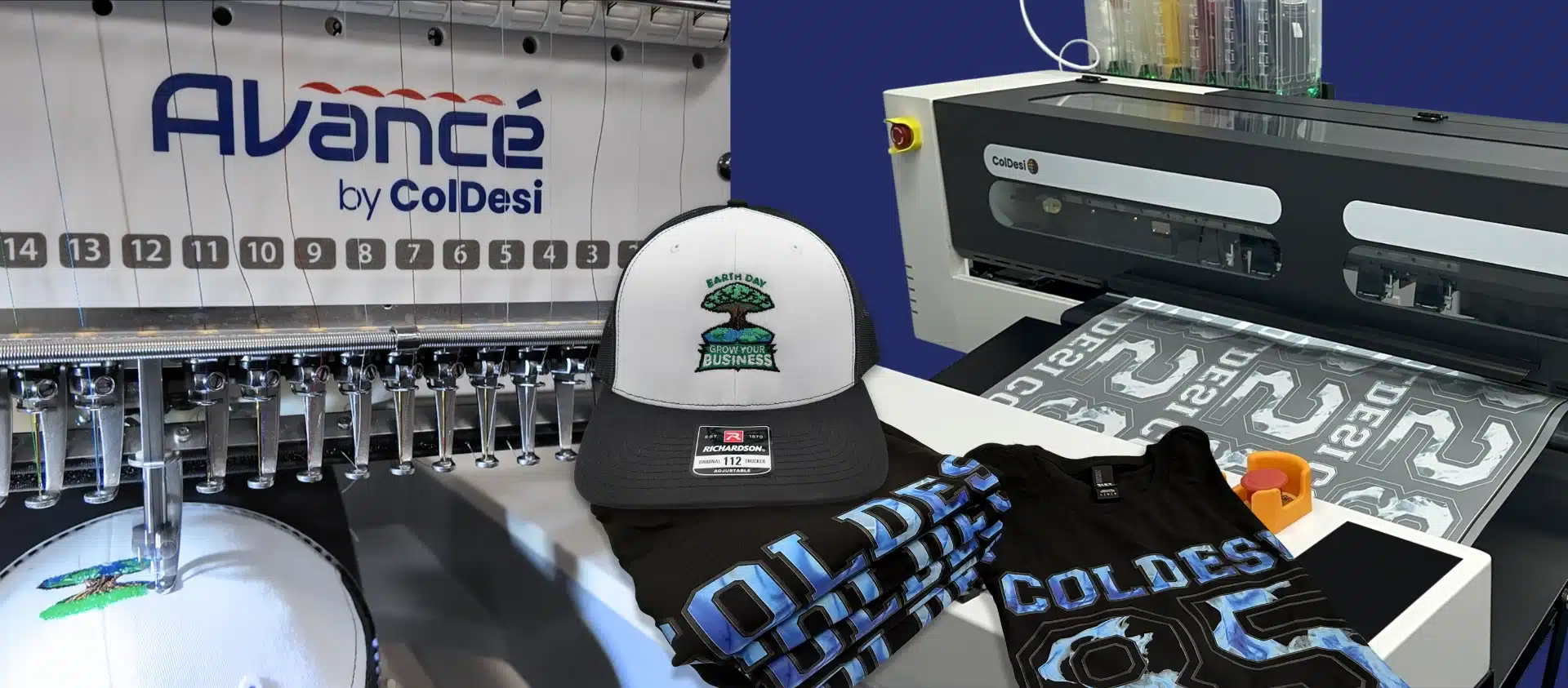
That’s one of the reasons the Avancé line of commercial embroidery machines has become a popular choice for decorators making the jump from a hobby machine to commercial equipment.
Commercial reliability
When you’re embroidering for paying customers, reliability isn’t optional, it’s essential.
The last thing you want is a machine that constantly needs your attention, struggles with longer production runs, or leaves you troubleshooting instead of fulfilling orders.
A hobby machine missing a stitch on a gift for your niece is frustrating. A commercial machine going down when you have 36 polos due tomorrow? That’s not just frustrating, it’s lost time, missed deadlines, and potentially disappointed customers.
That’s why commercial embroidery machines are built for consistent, day-in and day-out production. They can handle longer runs, maintain consistent stitch quality, and give you the confidence to take on bigger orders as your business grows.
Room to grow
Your first commercial embroidery machine should be able to grow with your business. Otherwise, what’s the point of upgrading at all?
Maybe today you’re personalizing gifts for friends and family. A few months from now, you might be embroidering uniforms for a local landscaping company, polos for a church fundraiser, or hats for an entire youth baseball league.
The right machine should have the capacity to handle those larger orders without becoming a bottleneck. After all, the goal isn’t to buy another machine a year from now because you’ve already outgrown the first one.
Professional stitch quality
Customers may not know what machine you use but they’ll absolutely notice the finished product. Similarly, you can have the best design in the world, but if the finished embroidery looks sloppy, that’s what people are going to remember.
They are going to notice if their logo looks clean, the lettering is crisp, and every shirt, hat, or jacket in their order looks like the last one.
Professional stitch quality is what gives your embroidery that clean, polished look people expect when they’re paying for it. Crisp lettering, smooth fills, and consistent stitching all help create a finished product you’re proud to hand over.
A commercial embroidery machine is designed to produce clean, consistent results from the first item to the last. And when your embroidery looks professional every time, customers notice. They come back. They tell other people. And that’s exactly how you build an embroidery business.
Excellent training and support
A commercial embroidery machine is a big investment. It’s also a big step up from what you’re used to.
Even the easiest machine to learn is going to come with a learning curve. That’s completely normal.
The difference is having someone you can call when you have a question, run into a problem, or just aren’t sure what to do next.
That’s why good training and responsive support are so important. Especially if this is your first commercial embroidery machine. The right support can save you hours of frustration and help you become a confident machine operator much faster.
Why the Avancé 1201C Is the Perfect First Commercial Embroidery Machine
Let’s press forward with looking at some of the best commercial embroidery machines, so you know what to purchase if you ever need one.
For this section, we’re bringing the spotlight on two of our most popular embroidery machines, namely, the Avancé 1201C, and its bigger sibling, the Avancé 1501C.
If you’re new to either model, not to worry, we’ll walk you through their features, capabilities, and key differences so you can decide which one best fits your business and your workflow.
Let’s start with the Avancé 1201C.
So, what makes the 1201C model unique and what do you actually get with the 1201C?

The Avancé 1201C is a 12-needle commercial embroidery machine designed for small businesses, startups, and home-based studios that want commercial-level results without investing in a larger (and more expensive) industrial machine. Compact, fast, and surprisingly capable, this model proves that big capabilities can come in smaller packages.
The 1201C can sew up to 1,000 stitches per minute, which is impressive for a machine its size. Measuring 23 x 23 x 63 inches and weighing about 176 pounds, it is actually the smallest and lightest model in the Avancé lineup, but don’t let that fool you. It’s built to keep up with demand.
That lightweight design also makes it one of the easiest commercial machines to transport, making it a great choice for trade shows, pop-up shops, and other live events where portability matters.
Despite its compact footprint, the 1201C is packed with features that make embroidery easier and more enjoyable.
Up front, there’s a 10.1-inch full-color LCD touchscreen control panel that makes managing designs and settings simple. You’ll find 28 built-in fonts and a library of up to 4,000 designs, so you can start creating on day one!
An extended LED lighting system keeps your work area well lit, thread break detection helps prevent mistakes and wasted production time, and its exceptionally quiet operation makes it a comfortable fit for home studios and retail environments.
To make getting started as easy as possible, the Avancé 1201C comes with everything you need right out of the box. You’ll receive five hoops, one cap frame, essential accessories, a one-year warranty that’s upgradeable to five years, and access to some of the best embroidery training in the industry, so you’re supported long after your machine arrives.
Considering everything that’s included, the 1201C offers outstanding value and comes in at a more accessible price point than its larger sibling, the Avancé 1501C, which we’ll look at next.
For complete specifications and technical details, check out the full product page.
When the Avancé 1501C Makes More Sense
The Avancé 1201C packs an impressive amount of capability into a compact machine.
But if you’ve looked through everything it offers and found yourself thinking, “I just wish it had a little more…”—whether that’s more needles, a larger embroidery area, faster production, or greater capacity, then the Avancé 1501C might be exactly what you’re looking for.
It takes everything people love about the 1201C and adds many of the upgrades power users have been asking for—more needles, a larger embroidery area, faster production speeds, greater capacity, and added versatility.
So what exactly does the Avancé 1501C add to the menu?

For starters, the Avancé 1501C shares many of the same features as the 1201C. You’ll get the same intuitive control panel and user interface, the same onboard memory, and the same built-in library of fonts and embroidery designs.
It also comes with the same training and support, along with the same starter package of embroidery essentials, including thread cones, backing, bobbins, needles, oil, tweezers, scissors, and other accessories.
In other words, everything you need to get up and running is included.
So what’s different?
Simply put, it’s bigger. In every way that matters.
The physical size of the machine measures in at 33 x 30 x 63 inches. Yes, it takes up a little more space than the 1201C, but that larger footprint serves a purpose.
It makes room for a generous 22″ × 14″ embroidery area and supports larger hoops, giving you the flexibility to embroider larger designs and handle bigger projects with ease.
The 1501C is also built for higher-volume production. It can sew at speeds of up to 1,200 stitches per minute and features 15 needles, allowing you to keep more thread colors loaded and spend less time stopping for thread changes. The result is faster production, greater efficiency, and less downtime between jobs.
At 197 lbs. (excluding the stand), it’s every bit the commercial-grade machine it looks and feels like.
Another advantage is that the 1501C can grow with your business. You can start with a single machine today, then add additional units as your production needs increase.
By networking multiple machines together, you can build a modular embroidery setup with two, three, six, or even more machines.
If you’d like to learn more about how a modular embroidery setup works and when it makes sense, be sure to check out our in-depth guide.
For complete specifications and technical details, view the full product page for the Avancé 1501C.